
-

-


Follow Us
-

 On Facebook
 On Flipboard
 On Twitter
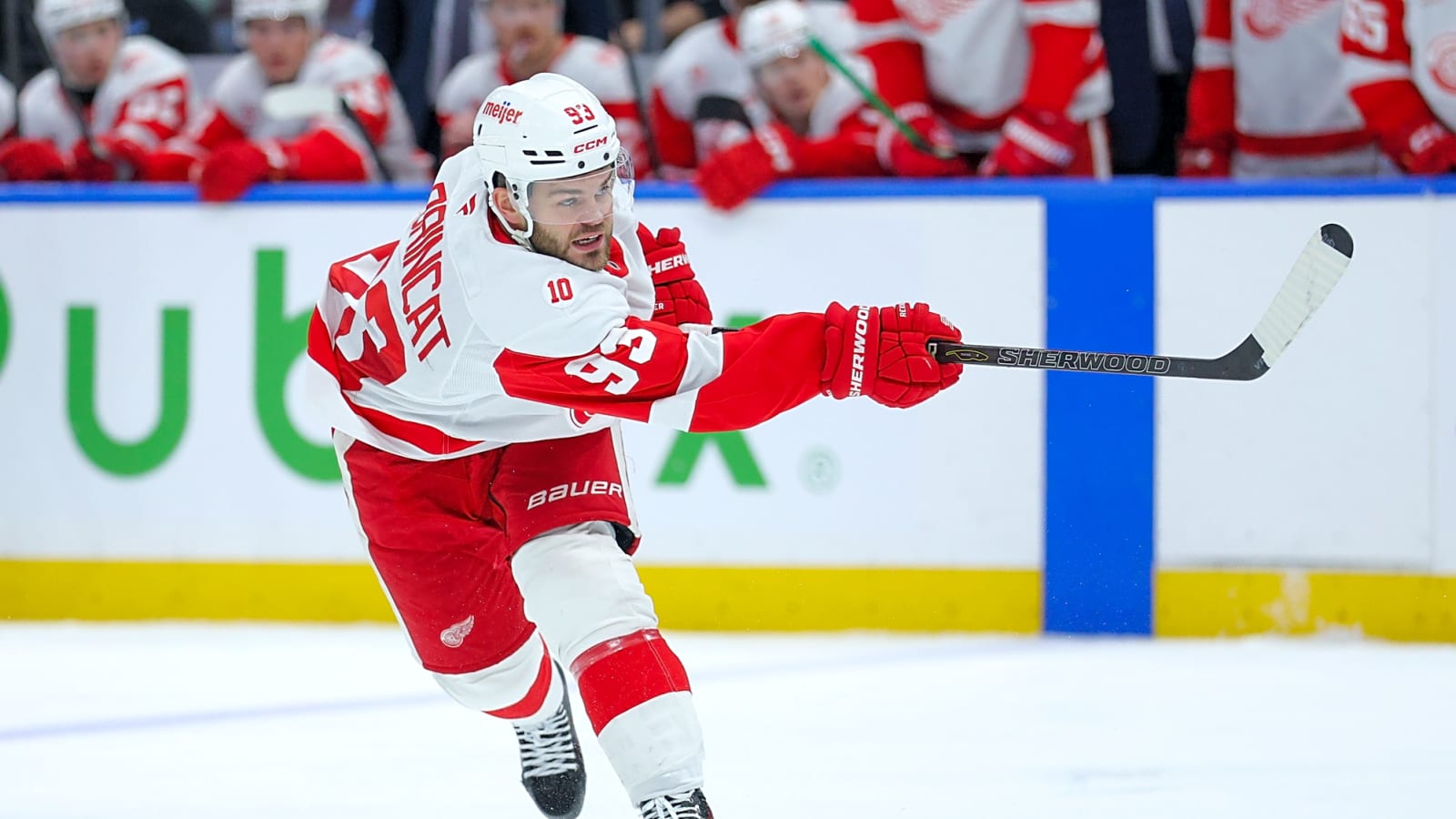
There’s no sugarcoating it. If Alex DeBrincat hadn’t forced his way to Detroit, the Red Wings would likely be the most hopeless team in the NHL. Still probably in the mushy middle with Larkin, Seider, and Raymond, but without the added punch to contend for anything. His production has been among the team’s best since day one, finishing in the top three in points every season he’s been a Red Wing. He was also the piece that lured Patrick Kane to Detroit. Without DeBrincat, the franchise wouldn’t just be missing two top-six forwards; they’d be missing their most talented goal scorer in a decade.
With the season winding down and the playoffs looking unlikely once again, DeBrincat is set to be eligible for a contract extension. Despite the smile that lights up his face every time he scores, it’s hard to imagine he isn’t at least a little frustrated with Detroit. If he isn’t, he probably should be.
Lack of Improvement
DeBrincat has played three strong seasons in Detroit, with this one arguably being the best of his career. And yet, the Red Wings haven’t improved with him on the roster. If anything, they’ve looked worse at times.
When he arrived, Detroit was entering its first real season with genuine playoff ambitions. There were obvious holes in the roster, but that felt reasonable, if not expected. This was still a rebuild, and the assumption was that those gaps would be addressed over time. The forward group, while lacking a quality center and reliable bottom-six depth, was still above average. Their offensive talent alone was enough to fuel dramatic comebacks on a regular basis.
The most noticeable gap would be a second line center though. Having Patrick Kane’s chemistry with DeBrincat make up for his lack of ability at this age, the line clearly needed a running man who could help them really dominate as a solid second line. After three seasons, the options that have circulated have largely been the same. It’s been Andrew Copp, J.T. Compher, and briefly Marco Kasper. None of whom are the top six players on any serious team. Yzerman notably nixed a trade that would’ve sent Marco Kasper for Dylan Cozens in 2024-25.
The team around DeBrincat was a similar story. Defensively, the team was finding its footing. Jake Walman and Jeff Petry were brought in for some stability, which was a solid effort from management, even if it fell flat. Shane Ghostisbehere and Olli Maatta formed a solid third pair at least. The goaltending from Alex Lyon and James Reimer was streaky, but largely a positive relative to their talent, all things considered.
Fast forward to today, and it’s difficult to argue that things have gotten better. The forward group has noticeably regressed to one of the most lacklustre groups in the NHL. The depth is functionally useless, and DeBrincat is still being surrounded by players who are below NHL standard for their roles. Andrew Copp and Patrick Kane are simply not second-line players at this stage of their careers.
The defence has improved this season, though Detroit has fallen to 21st in blue-line production, a category that went a long way towards a good 2023-24 campaign. The goaltending looks better on the whole, but it’s still streaky. As hot as John Gibson ran at times, his first two months were rough, and in five of his last seven starts, he’s posted a save percentage below .900, with only one of those games leading to a positive GSAx.
Most importantly, the team still hasn’t made the playoffs. Detroit is on pace for one of its better seasons in recent memory, and they’re still likely to miss. That says less about the Red Wings improving and more about the rest of the league improving faster, a problem nonetheless.
Hindering His Potential
This is a pick-your-poison situation. Either DeBrincat is being under-utilized by the coaching staff, leaving massive offensive totals on the table, or he’s being depended on so heavily to carry his own line that it limits what he can actually do for the team and himself. Either way, something is holding him back.
Start with the under-utilization. DeBrincat doesn’t get the same opportunities that other stars around the league receive. Take Cole Caufield as a comparison, a player of a similar profile who has spent over 70% of his even-strength ice time alongside first-line center Nick Suzuki. DeBrincat, by contrast, has spent just 9.1% of his even-strength time with Dylan Larkin, Detroit’s top line center, and 11.3% with Lucas Raymond, with 7.4% of that time overlapping. In total, DeBrincat has spent less than 12% of his ice time this season playing alongside a linemate of genuine first-line quality.
That wouldn’t be a problem if his other linemates were at least serviceable top-six forwards. Look at William Nylander in Toronto, another Atlantic Division star who doesn’t play the majority with his team’s number one center. The difference is that Nylander has spent over 50% of the season alongside John Tavares, who is already past 60 points. And when Tavares isn’t there, Nylander has spent over 24% of his remaining time with Auston Matthews anyway.
DeBrincat, meanwhile, has spent nearly his entire season alongside Patrick Kane (42 points) and whichever of Andrew Copp (39 points) or J.T. Compher (24 points) happens to be in the lineup. The disparity in supporting talent is completely unfair to Cat who has put up great totals regardless.
But here’s where it gets complicated. The reason DeBrincat may not be playing with Larkin or Raymond more often is that Detroit’s coaching staff is so desperate to get offense out of more than one line that they’re using him as a jolt for whoever needs it. Copp struggling out of the gate? Stick him with DeBrincat. John Leonard gets called up? Put him across from Cat, and suddenly he looks like a real NHL player. Compher needs to find his game. You know the answer. Even the brief stretches where DeBrincat has played alongside Larkin or Raymond haven’t been about maximizing his output; they’ve been about getting two slumping stars going.
He’s been the team’s jumper cable all season. And that reliance, on a roster this thin, is what’s keeping his point totals from reaching the numbers he’s capable of. As much as players won’t tell you they care about individual stats, I’m sure Cat does care. He’s been left off Team USA twice after being keen about wanting to go. An extra 5-15 points each season probably gets him there, and he gets to have hoisted the gold medal in Milan.
But…
DeBrincat has every reason to want out of Detroit so his prime isn’t wasted on a team that likely won’t contend for a cup. But all that being said, he still loves Detroit more than I think he’d love playing on any other team.
DeBrincat will drop the gloves when the game needs it, he’ll score the big goals with a huge smile on his face, and DeBrincat will drag anyone into the fight any night, every night.
You just gotta hope that love for Detroit doesn’t go out; if it does, the rebuild might as well start over.
More to Read
More must-reads:
- Bull vs. bear: The case for, against NHL's playoff locks, hopefuls
- 'Not enjoying the sport': Max Verstappen admits he could make stunning career choice
- The 'Most Elite Eight appearances' quiz
Breaking News
Trending News








Customize Your Newsletter
 +
+




Get the latest news and rumors, customized to your favorite sports and teams. Emailed daily. Always free!
PRIVACY POLICY COOKIE POLICY CONTACT US
ABOUT YARDBARKER TERMS OF SERVICE


By using this site, you agree to our Terms of Service and Privacy Policy.
This site is for entertainment purposes only.
There is no gambling offered on this site.
Gambling Problem? Call 1-800-Gambler.
