
-

-


Follow Us
-

 On Facebook
 On Flipboard


The Pittsburgh Penguins do not need to force Rutger McGroarty onto the NHL roster just because of his prospect status. That would be a mistake, especially for a team that has spent the past few seasons trying to get younger without completely tearing apart the veteran structure around Sidney Crosby. They also cannot let him become an afterthought.
That is where the Penguins’ forward group has become interesting. Pittsburgh has added skill, depth and competition this offseason, but every new forward makes McGroarty’s path a little less obvious. The issue is not whether he still matters. He does. The issue is whether president of hockey operations and general manager Kyle Dubas has created enough room for one of the organization’s most important young forwards to actually push through.
A projected Penguins lineup recently had trouble finding a natural opening for McGroarty, and that feels like the problem in one sentence. He is close enough to the NHL to deserve real consideration, but the roster is crowded enough that he may still have to fight through a long list of older, safer or more established options. That squeeze is becoming hard to ignore.
Penguins Have More Forwards Than Clear Roles
The Penguins’ forward group looks deeper than it did before the offseason started, but deeper does not always mean clearer. Pittsburgh added Andrei Kuzmenko, Nicholas Robertson and Hendrix Lapierre while already having veterans like Crosby, Evgeni Malkin, Bryan Rust, Rickard Rakell, Tommy Novak, Blake Lizotte and Connor Dewar in the mix.
That does not even include Egor Chinakhov, Ville Koivunen, Ben Kindel, Elmer Soderblom, Justin Brazeau, Avery Hayes, Filip Hallander and others who are either NHL options or close enough to make the depth chart crowded. The Penguins’ updated forward picture shows the problem clearly. Pittsburgh has enough players to create competition, but not enough clean spots for everyone who needs one.
That is dangerous for a player like McGroarty. He is not a fourth-line specialist whose value comes only from forechecking and penalty killing. He also is not a pure skill winger who can be sheltered in an offensive role without being asked to handle details. His value comes from being a direct, competitive, top-nine-type forward who can eventually bring some offense, physicality and two-way habits together.
That type of player needs a real role. Sitting around as the 13th forward would not help much. Playing eight minutes a night in a job that does not match his skill set would not be much better. If the Penguins believe McGroarty can become part of their next core, they need to give him a path that actually tests that projection.
McGroarty Still Has a Case
McGroarty’s 2025-26 season was not perfect, but it was not empty either. He had three goals and six points in 24 NHL games, which does not scream guaranteed NHL regular. It does, however, show that he has already taken the first step from prospect to real option.
His American Hockey League (AHL) production is the stronger part of the argument. McGroarty finished with 10 goals, 24 assists and 34 points in 30 regular-season games with Wilkes-Barre/Scranton, which is the kind of production Pittsburgh should not ignore. His AHL numbers matter because they show he has already done more than just survive at the professional level.
The question is whether that can translate consistently in Pittsburgh. A recent review pointed to both sides of his season: limited NHL scoring, strong AHL production and enough underlying signs to keep the long-term conversation open. That is usually where development gets complicated.
McGroarty does not need to be handed anything. If he wants a spot, he has to prove he can play at NHL pace, get to the inside of the ice and impact games even when the puck is not going in. But the Penguins also have to be careful not to judge him only through a roster crunch they created.
There is still a good player here. Pittsburgh just has to avoid burying him.
The Robertson and Koivunen Competition Matters
McGroarty’s biggest issue may not be one player. It is the number of players who now need the same type of opportunity.
Robertson is the most obvious example. He brings a scoring profile, a fresh start and enough NHL experience to justify a real look. If Pittsburgh wants shooting upside in the top nine, Robertson will get every chance to claim that role.
Koivunen is another important part of the squeeze. His uncertain path has already become one of the more interesting roster questions in Pittsburgh, and he is fighting for some of the same oxygen. Koivunen is more of a skill-and-playmaking bet, while McGroarty brings a heavier, more direct profile, but both need NHL minutes to prove what they are.
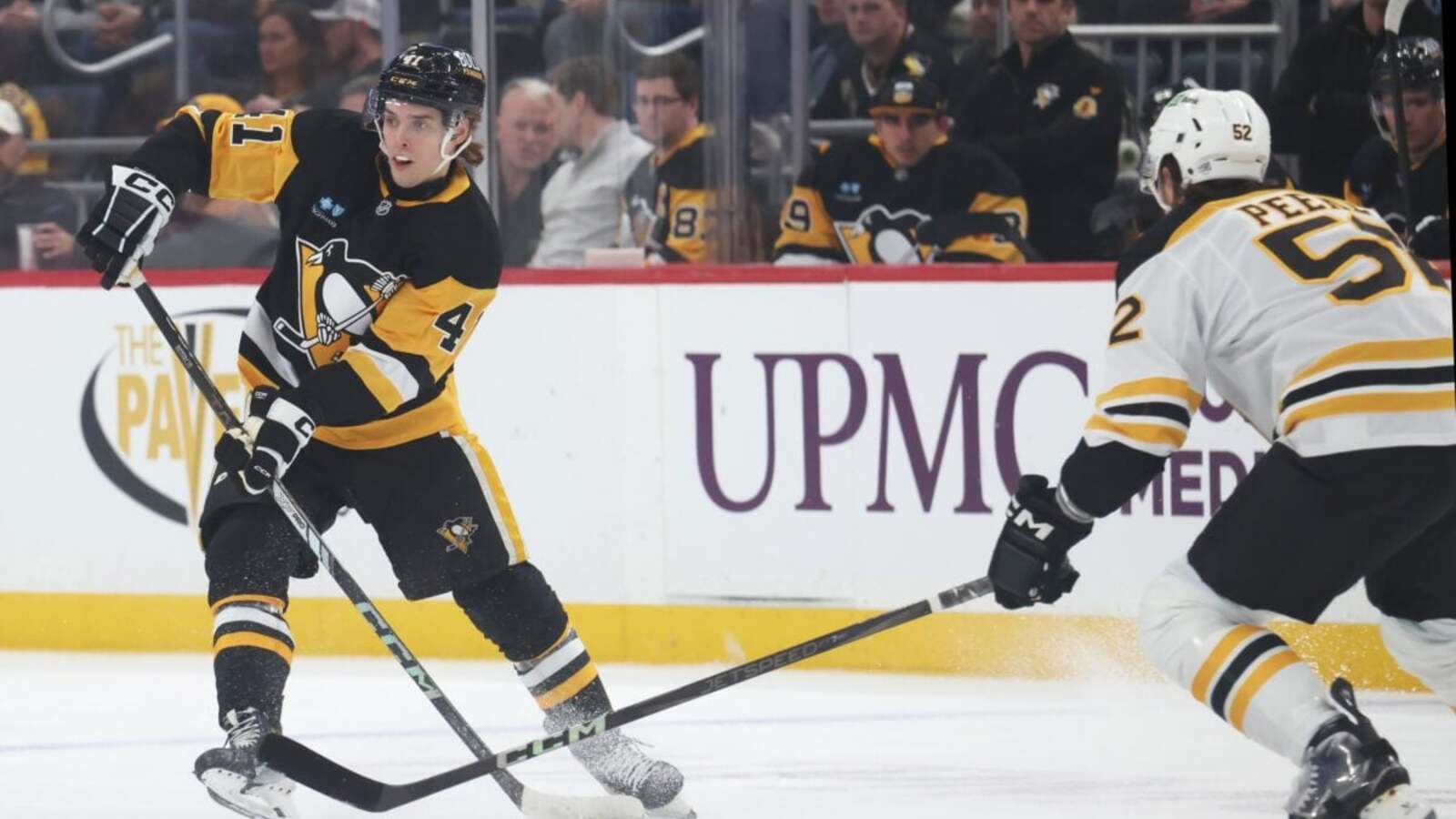
That makes training camp more than a formality. If Robertson, Koivunen and McGroarty are all competing for limited opportunity, the Penguins have to decide what kind of player they want in that spot. Do they need Robertson’s shot, Koivunen’s offensive feel or McGroarty’s two-way edge?
The answer may depend on what happens with the veterans. If Rust or Rakell stays, the room gets tighter. If Pittsburgh makes a trade, the door opens. If Kuzmenko becomes a short-term scoring fixture, another young player may have to wait. That is why McGroarty’s situation is less about one camp battle and more about the larger direction of the roster.
Penguins Cannot Waste a Key Asset
The Penguins acquired McGroarty from the Winnipeg Jets for Brayden Yager, and that context still matters. The McGroarty trade was not a minor prospect swap. It was a one-for-one deal involving two recent first-round picks, and Pittsburgh made the move because it believed McGroarty fit what it wanted to become.
His contract also adds urgency. McGroarty’s entry-level deal runs through 2026-27, and his cap situation keeps him inexpensive enough that Pittsburgh should want him to push for value now. Cheap young players matter even more for teams trying to stay competitive around expensive veterans.
That is why the Penguins have to manage this carefully. Sending McGroarty back to Wilkes-Barre/Scranton is not a disaster if there is a purpose behind it. Letting him dominate the AHL without a clear next step would be a problem. Keeping him in Pittsburgh without a meaningful role would be a different problem.
The plan has to be specific. If he starts in the AHL, he should be working toward a defined NHL job. If he starts in Pittsburgh, he should be put with linemates who allow him to show more than survival minutes. If the Penguins do not see a path for him, then the organization has to be honest about whether its forward group is too crowded.
McGroarty Needs to Force the Issue
The easiest solution is still the one McGroarty controls. He can make the decision difficult.
If he has a strong camp, the Penguins will have to find room. That is how young players break through crowded rosters. They make the safer options feel less safe. They make the veterans look less automatic. They give the coaching staff no choice but to keep them around.
McGroarty has the profile to do that. He is not the same type of player as Robertson or Koivunen, and that can work in his favor. Pittsburgh needs young players who can do more than flash skill. It needs forwards who can win battles, play through contact, protect pucks and still contribute enough offense to matter.
That is the path. McGroarty does not have to become a star this season. He does not even have to become a top-six winger right away. He has to show that he is too useful, too competitive and too NHL-ready to be squeezed out by roster math.
The Penguins have spent the offseason collecting options. McGroarty has to become more than another option. He has to become part of the answer.
Penguins Need a Real Opening
The Penguins’ forward squeeze is not automatically bad. Competition can be useful, especially for a team trying to pull younger players into a veteran lineup. The problem comes when competition turns into congestion, and important prospects lose momentum because there is no defined route upward.
McGroarty is too important for that. He was acquired with a real cost, produced well in the AHL and already has some NHL experience. He is not a finished player, but he is also not a prospect who should be treated like he is years away.
Pittsburgh does not need to hand him a roster spot. It does need to make sure there is a roster spot worth fighting for.
That is the balance. McGroarty has to earn it, but the Penguins have to leave enough room for him to do that. If they do, he could become one of the younger forwards who helps the organization transition into its next phase. If they do not, the squeeze will only get harder to ignore.
More must-reads:
- Panthers stuck in anxious waiting game to learn severity of Aleksander Barkov injury
- Dylan Larkin loudly booed prior to Red Wings' home opener amid brutal situation
- The 'Most HRs by an MLB first baseman' quiz
Breaking News
Trending News


Customize Your Newsletter
 +
+




Get the latest news and rumors, customized to your favorite sports and teams. Emailed daily. Always free!
PRIVACY POLICY COOKIE POLICY CONTACT US
ABOUT YARDBARKER TERMS OF SERVICE


By using this site, you agree to our Terms of Service and Privacy Policy.
This site is for entertainment purposes only.
There is no gambling offered on this site.
Gambling Problem? Call 1-800-Gambler.
