
-

-


Follow Us
-

 On Facebook
 On Flipboard

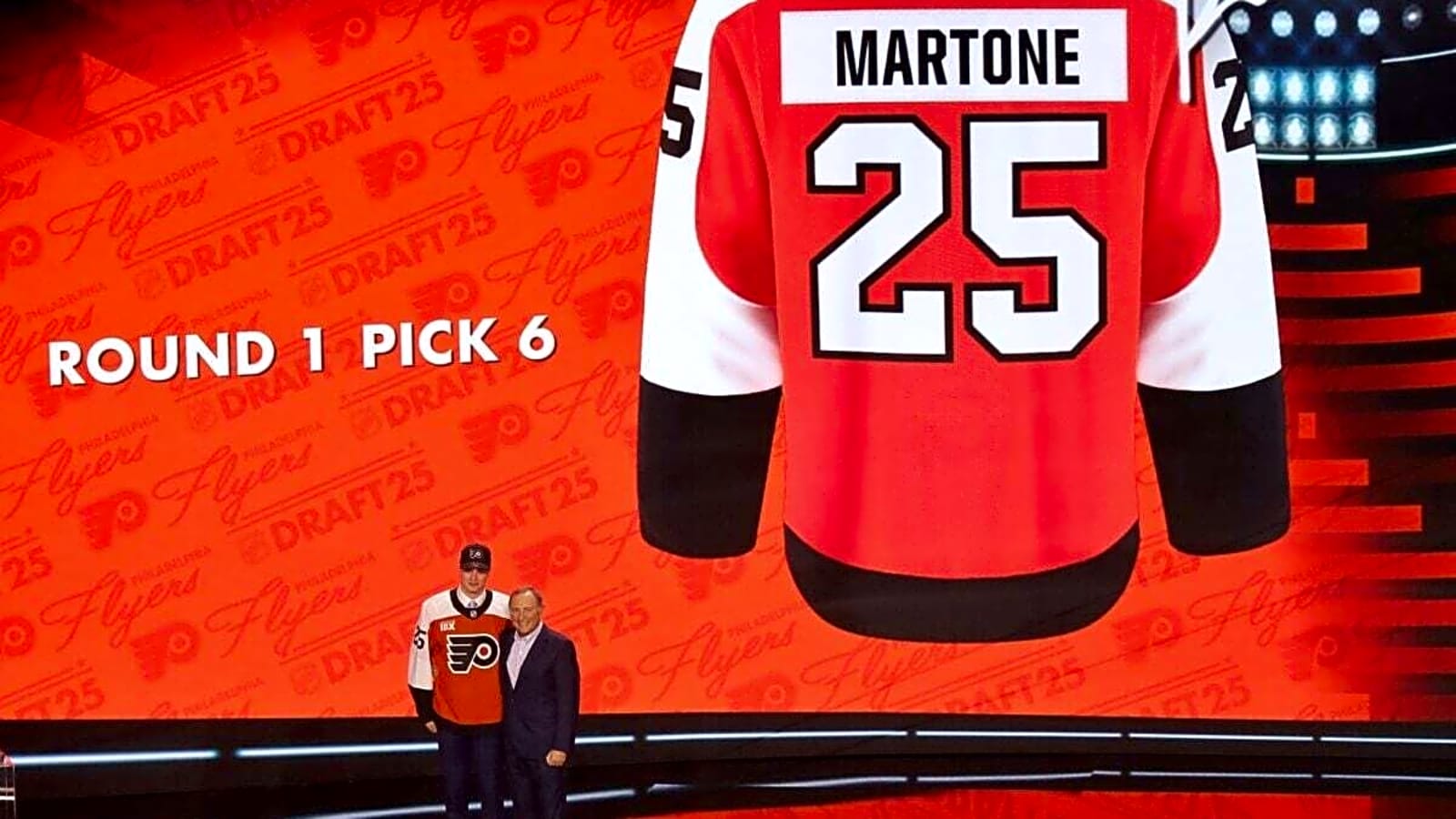
The Philadelphia Flyers have four picks in the 2026 NHL Draft: No. 21, No. 53, No. 181, and No. 213. To set expectations for what those picks can become, let’s look at some historical numbers.
The following data is courtesy of Evolving-Hockey, spanning back to the 2007-08 season. Players drafted before 2007-08 are included. The data consists of all skater seasons with at least 500 minutes of 5-on-5 ice time, of which there are 10,357. All stats are at 5-on-5 and during the regular season only.
Note: Best viewing experience on desktop or horizontally on mobile
Flyers’ First-Round Pick (21st Overall)
The Flyers have the 21st pick in the first round. What does the data look like for forwards and defensemen?
Forwards
Let’s start with forwards and look at games played in each draft pick range for the first round. Aside from the 17-20 to the 21-24 range, we see a minimum of a 14% decrease in total games played from one range to the next.
| Draft Pick Range | 1-4 | 5-8 | 9-12 | 13-16 | 17-20 | 21-24 | 25-28 | 29-32 |
| Games Played | 53,294 | 35,799 | 27,243 | 23,197 | 19,635 | 22,930 | 19,720 | 10,513 |
| Percent Change | N/A | -32.8% | -23.9% | -14.9% | -15.4% | +16.8% | -14.0% | -46.7% |
Let’s shift to forwards who averaged at least 13 minutes in a season (at 5-on-5, to reiterate) but only include each player once. There’s nothing overly scientific about 13 minutes, but that type of usage is typically limited to borderline top-six talents.
| Draft Pick Range | 1-4 | 5-8 | 9-12 | 13-16 | 17-20 | 21-24 | 25-28 | 29-32 |
| 1x Averaged 13:00 | 76 | 50 | 40 | 33 | 25 | 30 | 25 | 11 |
| Percent Change | N/A | -34.2% | -20.0% | -17.5% | -24.2% | +20.0% | -16.7% | -56.0% |
Here, we more or less see the same thing as the last table. Consistent drop-offs, aside from the 21-24 range (a trend that is simply just a coincidence).
To end off the first-round forward section, we’ll shift to those who had three or more seasons with 13:00 of average ice time at 5-on-5.
| Draft Pick Range | 1-4 | 5-8 | 9-12 | 13-16 | 17-20 | 21-24 | 25-28 | 29-32 |
| 3x Averaged 13:00 | 61 | 31 | 31 | 19 | 17 | 19 | 19 | 7 |
| Percent Change | N/A | -49.2% | +0.0% | -38.7% | -10.5% | +11.8% | +0.0% | -63.2% |
This is where we start to see some change. Picks 1-4 are obviously gold, then the 5-12 range is about the same. There’s a notable decline, then picks 13-28 are about the same, before the 29-32 range shows up and drops off severely.
Defensemen
Now, we have defensemen. Here’s the same table format as the forwards, just replaced with defensemen:
| Draft Pick Range | 1-4 | 5-8 | 9-12 | 13-16 | 17-20 | 21-24 | 25-28 | 29-32 |
| Games Played | 18,414 | 15,903 | 14,453 | 14,309 | 13,151 | 7,098 | 6,473 | 3,657 |
| Percent Change | N/A | -13.6% | -9.1% | -1.00% | -8.1% | -46.0% | -8.8% | -43.5% |
Notice that there’s a different trend for defensemen. We see a marginal decline, then the games played get slashed in half from the 17-20 to the 21-24 range. Here’s an ice-time table, but instead of 13 minutes, we have 16:
| Draft Pick Range | 1-4 | 5-8 | 9-12 | 13-16 | 17-20 | 21-24 | 25-28 | 29-32 |
| 1x Averaged 16:00 | 30 | 25 | 21 | 21 | 21 | 10 | 9 | 7 |
| Percent Change | N/A | -16.7% | -16.0% | +0.0% | +0.0% | -52.4% | -10.0% | -22.2% |
As we saw with the forwards, this table is about the same as the games played one. Interestingly, though, the sample size is quite small. Sixteen minutes is far from a lot—four Flyers defenders reached that mark this past season.
Shifting gears, below is a look at defensemen who averaged 16 minutes of 5-on-5 ice time at least three times in their careers:
| Draft Pick Range | 1-4 | 5-8 | 9-12 | 13-16 | 17-20 | 21-24 | 25-28 | 29-32 |
| 3x Averaged 16:00 | 23 | 20 | 15 | 18 | 14 | 5 | 4 | 5 |
| Percent Change | N/A | -13.0% | -25.0% | +20.0% | -22.2% | -64.3% | -20.0% | +25.0% |
An already small sample size is essentially halved in the 21-32 range of the first round. It’s hard to find a defenseman who can log top-four caliber minutes at 5-on-5 after the top 20.
Flyers’ Second-Round Pick (53rd Overall)
As it stands, this is the Flyers’ only other pick in the top 175—in the second round at 53rd overall. Let’s dive into the numbers.
Forwards
For the second-round section, we’ll stick with the same format, but make one change: the ranges are eight picks instead of four (to reduce randomness). Also, the percent change shown under the 33-40 range is being compared to picks 25-32. Here’s a look at the forwards:
| Draft Pick Range | 33-40 | 41-48 | 49-56 | 57-64 |
| Games Played | 18,071 | 15,010 | 17,575 | 18,351 |
| Percent Change | -40.2% | -16.9% | +17.1% | +4.4% |
There’s a drop-off after the late stages of the first round, but every range here is about the same. In fact, the highest games-played total in the second round is between picks 57 and 64.
Now, for forwards averaging 13 minutes of ice time at 5-on-5:
| Draft Pick Range | 33-40 | 41-48 | 49-56 | 57-64 |
| 1x Averaged 13:00 | 20 | 19 | 22 | 22 |
| Percent Change | -44.4% | -5.0% | +15.8% | +0.0% |
This is a pretty small group. At this point in the draft, you should just be happy to get one season of borderline top-six usage. Shifting to three seasons, an 83-player group shrinks to just 43:
| Draft Pick Range | 33-40 | 41-48 | 49-56 | 57-64 |
| 3x Averaged 13:00 | 10 | 10 | 11 | 12 |
| Percent Change | -61.5% | +0.0% | +10.0% | +9.1% |
The same theme as the last table holds here—there’s not much change between picks 33 and 40 versus 57 and 64. To say picks 33 and 64 are the same would be the wrong takeaway, but the gap is probably smaller than we perceive.
Defensemen
Now, a look at the defensemen:
| Draft Pick Range | 33-40 | 41-48 | 49-56 | 57-64 |
| Games Played | 11,545 | 11,568 | 14,080 | 8,156 |
| Percent Change | +14.0% | +0.2% | +21.7% | -42.1% |
Funny enough, there was a percentage increase in games played for defensemen drafted between 25-32 versus 33-40, but the gains were marginal. We see a substantial decrease once the pick range gets closer to the third round. As we’ve seen before, though, the gap is certainly exaggerated. For ice time:
| Draft Pick Range | 33-40 | 41-48 | 49-56 | 57-64 |
| 1x Averaged 16:00 | 17 | 18 | 23 | 12 |
| Percent Change | +6.3% | +5.9% | +27.8% | -47.8% |
There are only 70 defensemen here in total, and yet, the 33-40, 41-48, and 49-56 ranges are all an upgrade on 25-32. But, again, the change is minor.
Finally, we have the defenders who reached the 16-minute average mark thrice:
| Draft Pick Range | 33-40 | 41-48 | 49-56 | 57-64 |
| 3x Averaged 16:00 | 14 | 13 | 16 | 8 |
| Percent Change | +55.6% | -7.1% | +23.1% | -50.0% |
Some solid players are in this range, to be sure—it’s not too difficult to get steals on defense. But in the first round, there were 90 players in the top 20 picks. From 21 to 64, that number is just 65.
Flyers’ Other Picks (181st and 213th Overall)
The Flyers are set to go almost 130 picks without making a draft selection. How do players fare in the sixth and seventh rounds?
Forwards
The data here will be the same (games played, ice time, etc.), but the format will be slightly different. Here’s a look at all the modern-day draft rounds (1-32 is the first, 33-64 is the second, and so on) as well as undrafted prospects.
| Draft Pick Range | 1-32 | 33-64 | 65-96 | 97-128 | 129-160 | 161-192 | 193-224 | Undrafted |
| Games Played | 212,331 | 69,007 | 42,602 | 27,523 | 22,628 | 19,804 | 12,492 | 43,254 |
| Percent Change | N/A | -67.5% | -38.3% | -35.4% | -17.8% | -12.5% | -36.9% | +246.3% |
Since the sample size here is the largest, the returns are pretty consistent. Between rounds four and six, the change becomes somewhat minor, while the seventh round is tricky to find hidden gems in.
What’s especially fascinating here, though, is that the undrafted group is essentially the same as the third round and superior to all the ones after it. Granted, undrafted players can be brought in during their primes—an advantage to picking teenagers—but the point stands.
Let’s shift our focus, now, to the forwards who averaged at least 13 minutes in a season:
| Draft Pick Range | 1-32 | 33-64 | 65-96 | 97-128 | 129-160 | 161-192 | 193-224 | Undrafted |
| 1x Averaged 13:00 | 290 | 83 | 46 | 25 | 25 | 21 | 12 | 44 |
| Percent Change | N/A | -71.4% | -44.6% | -45.7% | +0.0% | -16.0% | -42.9% | +266.7% |
When we look at ice time, things start to get gloomy—especially in the seventh round. The same trend as before holds, but there are very few players who even contribute borderline top-six minutes at 5-on-5 for one season in their careers in the later rounds. Outliers exist, but it’s a tall task to draft in this range.
| Draft Pick Range | 1-32 | 33-64 | 65-96 | 97-128 | 129-160 | 161-192 | 193-224 | Undrafted |
| 3x Averaged 13:00 | 204 | 43 | 26 | 13 | 15 | 8 | 4 | 23 |
| Percent Change | N/A | -78.9% | -39.5% | -50.0% | +15.4% | -46.7% | -50.0% | +475.0% |
Unfortunately for the Flyers, only 12 forwards drafted in the modern-day sixth and seventh rounds have had three seasons averaging 13 or more minutes at 5-on-5. Getting a star player in this range is next to impossible.
Defensemen
Finally, we have defensemen in Rounds 6 and 7. Here’s the games-played data:
| Draft Pick Range | 1-32 | 33-64 | 65-96 | 97-128 | 129-160 | 161-192 | 193-224 | Undrafted |
| Games Played | 93,458 | 45,349 | 21,895 | 17,313 | 16,383 | 10,014 | 8,930 | 28,016 |
| Percent Change | N/A | -51.5% | -51.7% | -20.9% | -5.4% | -38.9% | -10.8% | +213.7% |
Defensemen more or less operate the same as forwards. Round 2 sees a 50% decline from Round 1, Round 3 sees a 50% decline from Round 2, and things slowly mellow out after that. There are more games played by undrafted players than there are in Rounds 6 and 7 combined, and it’s not all that close.
| Draft Pick Range | 1-32 | 33-64 | 65-96 | 97-128 | 129-160 | 161-192 | 193-224 | Undrafted |
| 1x Averaged 16:00 | 144 | 70 | 35 | 32 | 25 | 20 | 15 | 45 |
| Percent Change | N/A | -51.4% | -50.0% | -8.6% | -21.9% | -20.0% | -25.0% | +200.0% |
In trying not to repeat myself, the ice-time data is more or less the same as the games-played data. Only 35 defensemen drafted in the sixth and seventh rounds had a season averaging 16 minutes. On the plus side, that’s the same amount as Round 3.
| Draft Pick Range | 1-32 | 33-64 | 65-96 | 97-128 | 129-160 | 161-192 | 193-224 | Undrafted |
| 3x Averaged 16:00 | 104 | 51 | 20 | 16 | 18 | 10 | 9 | 22 |
| Percent Change | N/A | -51.0% | -60.8% | -20.0% | +12.5% | -44.4% | -10.0% | +144.4% |
To end things off, what do you know: Round 1 has a lot of studs, Round 2 has quite a few, but it sees a percentage decrease of 51%, the middle rounds get murky, and as for the late rounds, good luck. The only active players in this group in the sixth and seventh rounds are Dylan DeMelo, Jacob Middleton, Matt Roy, and MacKenzie Weegar. None of them is below the age of 30.
Takeaways
So, what’s the major takeaway from all of this? Well, for me, after the second round, it’s basically a guessing game. In fact, you could argue the same applies to the later stages of the first round. There are exceptions, like Lane Hutson in the 2022 NHL Draft, who fell to 62nd despite being viewed highly by some public scouts, but the draft is tough.
The Flyers’ second-, sixth-, and seventh-round picks are magic beans. There might be a high-upside player like Xavier Villeneuve who falls to them, but “high upside” usually means nothing that late in the draft. The 21st pick could be something, but even that’s a low-percentage bet. Keep that in mind on June 26 and 27.
More must-reads:
- Connor McDavid sounds incredibly desperate in support of Oilers hiring Mike Babcock
- Chicago Blackhawks acquire Bowen Byram in another blockbuster NHL trade
- The 'Conn Smythe Trophy winners' quiz
Breaking News
Trending News




Customize Your Newsletter
 +
+




Get the latest news and rumors, customized to your favorite sports and teams. Emailed daily. Always free!
PRIVACY POLICY COOKIE POLICY CONTACT US
ABOUT YARDBARKER TERMS OF SERVICE


By using this site, you agree to our Terms of Service and Privacy Policy.
This site is for entertainment purposes only.
There is no gambling offered on this site.
Gambling Problem? Call 1-800-Gambler.
