-

-


Follow Us
-

 On Facebook
 On Flipboard


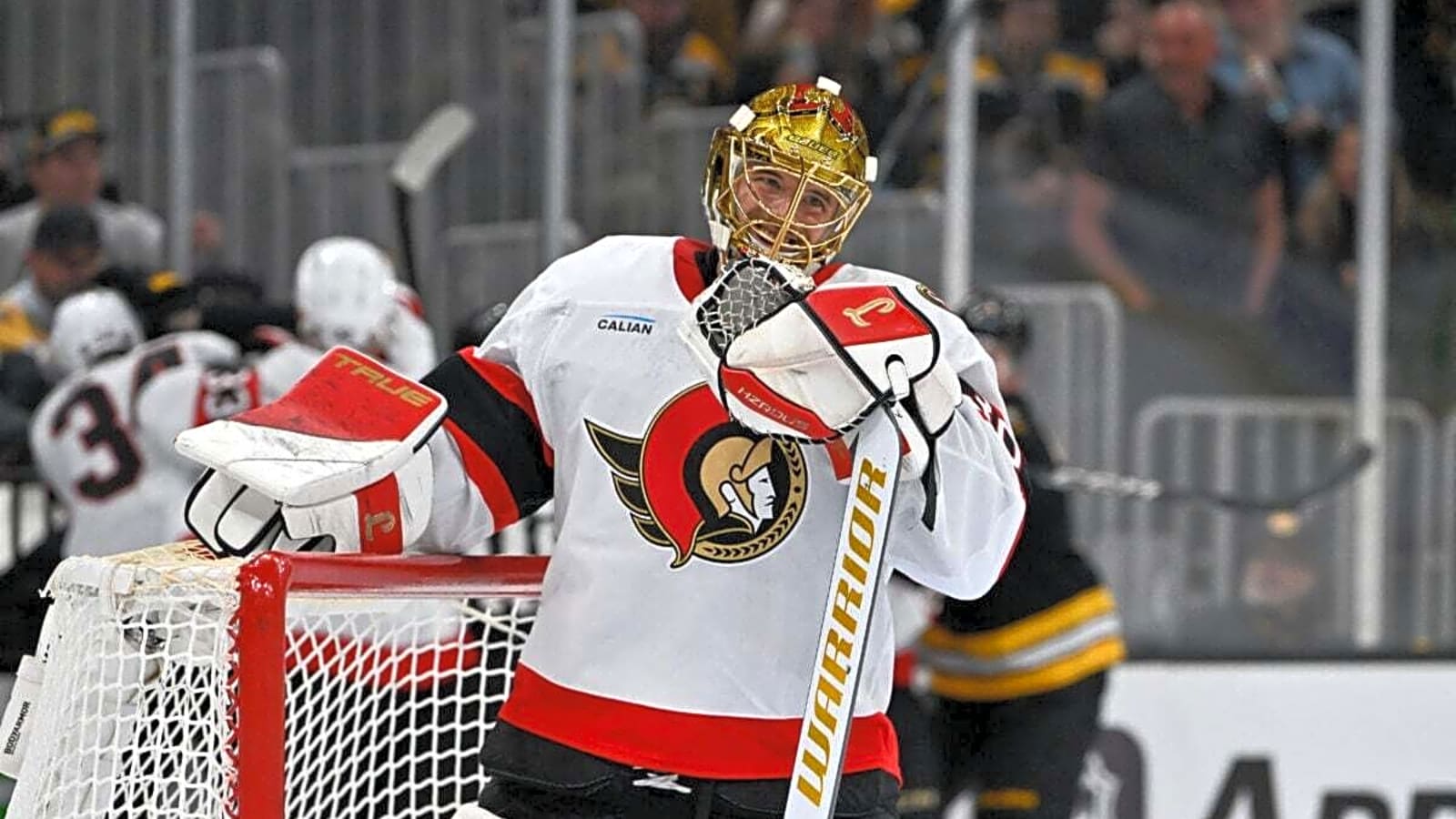
It’s a month into the 2026-27 season, and the Ottawa Senators have been one of the NHL’s best teams so far. Sitting eighth in the league, their offence has been humming with Tim Stutzle, Drake Batherson, and Dylan Cozens at the helm, while Linus Ullmark has the best save percentage (SV%) among goalies with at least four starts, and Jake Sanderson has the third-highest points-per-game average of all defencemen. Injuries have taken their toll, but it seems like nothing can slow them down.
However, that was until Ullmark went down with a lower-body injury late in the game against the Florida Panthers on Oct. 21, forcing the Senators to rely on a tandem of Sam Ersson and Jonas Johansson. Since then, Ottawa’s crease has gone from one of the best to one of the worst, averaging four goals against per game and a combined .863 save percentage (SV%). While the season is still young, the Senators can’t rely on their backups, which puts a lot of stress on the rest of the roster to compensate. It’s a problem that needs to be fixed now before it permanently damages their playoff hopes.
Ersson and Johansson Are Not Reliable
It’s not surprising that the Senators gave Ersson and Johansson a shot this season. Not long ago, both looked like solid young goalies en route to becoming NHL starters.
Ersson’s 2023-24 rookie season had some truly bright moments with the Philadelphia Flyers, which promised big things for the future. But when given the reins in 2024-25, he struggled, leading to a demotion back to backup duties for 2025-26, where he put up the worst average of any goalie with at least 30 starts, finishing with an .870 SV%.
Johansson looked destined for stardom after he was acquired by the Colorado Avalanche in 2020-21. In his first eight appearances, he had a 5-1-1 record, a shutout, and a .913 SV%. His next nine, however, weren’t nearly as strong, leading to multiple stints on the waiver wire before finally signing a two-year deal with the Tampa Bay Lightning. Although he often managed to hold onto the win, he never averaged higher than an .895 SV% or posted a goals-against average (GAA) below 3.00 in his three seasons there.
Unsurprisingly, both goalies have continued to play sub-par with Ottawa. Ersson has been the better of the two, and a 23-save win over the Buffalo Sabres on Wednesday helps, but he still has only an .880 SV% so far this season and has just two wins over eight starts. Johansson, on the other hand, has averaged four goals against per game and has an .848 SV% since his Senators debut on Oct. 24, which is also his only win in four starts.
While both goalies have had some bright moments, they frequently blow leads; Johansson was pulled against the Los Angeles Kings after allowing three goals in less than four minutes before being yanked halfway through the second period. The day before, Ersson allowed three goals in four minutes against the San Jose Sharks en route to a 6-2 loss. Then, against the Anaheim Ducks on Nov. 1, Johansson erased the Senators’ three-goal lead in the second period, leading to a 6-3 loss.
Ullmark Won’t Fix Everything
On the complete opposite side of Ersson and Johansson, Ullmark sits at seven wins, a 1.33 GAA, and a .945 SV% in eight games, making him the best goalie in the NHL this season. Losing him when they did was a tough blow for the Senators, but he’s nearing a return, as he was seen back on the ice earlier this week.
But even if Ullmark continues to put up NHL-leading numbers, it’s not enough to fully counteract the mess waiting behind him. Since 2015-16, the Senators’ starter has never played 50 NHL games in a single season. With his injury history and age, that’s unlikely to change much in 2026-27, which leaves 34 games unaccounted for. So far, Johansson and Ersson have played nine and recorded a 3-5-1 record. Averaged over the rest of the season, that works out to an 11-19-4 record, adding just 26 points to the Senators’ total.
Even if Ullmark returns to his Vezina numbers, which saw him put up 40 wins, a .938 SV%, and a 1.89 GAA over 48 starts, that still only works out to 80 points this season. Last season, it took 98 points to make the playoffs in the Eastern Conference, and at a 106-point best-case scenario, that’s a thin margin of error. Suddenly, there’s a lot more pressure on Ullmark to play more games, putting more strain on his body, and possibly leading to more serious injuries that could tank the Senators’ season.
Having a strong goalie behind you is just as much a motivator as having a weak goalie is a detractor. When Ullmark is in net, the Senators play more confidently because they know their goalie has their back. But when Ersson or Johansson is between the pipes, the Senators have to change their strategy, either playing more conservatively as they did against the Sabres, or focusing completely on offence in order to overcome the goals their goalie will inevitably allow. That’s a lot of stress and uncertainty that isn’t helping anyone.
Staios Created Ottawa’s Goalie Problem
Senators general manager and president of Hockey Operations Steve Staios admitted last season that he failed in his attempt to stabilize the Senators’ crease. “As far as the goaltending, when I talk about making decisions to help this team move forward, the one where I didn’t do a good job was on the backup position,” he said at the Senators’ end-of-season media availability. “I didn’t do a good enough job in supporting Linus in that position and probably didn’t put Leevi (Merilainen) in the best position to have success as well.”
That led to Staios signing Ersson to a two-year, $2.2 million deal to give Ullmark more support, but that led to a logjam ahead of the 2026-27 season. The Senators had to decide between their new 27-year-old Swede and their young up-and-coming netminder, Leevi Merilainen. Unfortunately, Merilainen drew the short straw, which allowed the Vancouver Canucks to claim him off waivers. Suddenly without an AHL starter, the Senators quickly grabbed Johansson for future considerations to fill out their crease.
Despite his honest admissions and good intentions, Staios once again failed to identify goaltending talent, creating his team’s current problems. Now the Senators have two goalies who are no longer NHL-caliber players, and they might be stuck with them for the rest of the season unless they can convince someone to swap one for another struggling youngster. But every game they turn to their backups means the playoffs will get further away, and for a team in the Senators’ situation, that’s inexcusable.
More must-reads:
- Red-hot Cutter Gauthier achieves franchise first with rare feat
- Connor Hellebuyck gives vague explanation for trade request away from Jets
- The 'Most QB wins in a season' quiz
Breaking News
Trending News








Customize Your Newsletter
 +




Get the latest news and rumors, customized to your favorite sports and teams. Emailed daily. Always free!
PRIVACY POLICY COOKIE POLICY CONTACT US
ABOUT YARDBARKER TERMS OF SERVICE


By using this site, you agree to our Terms of Service and Privacy Policy.
This site is for entertainment purposes only.
There is no gambling offered on this site.
Gambling Problem? Call 1-800-Gambler.