
-

-


Follow Us
-

 On Facebook
 On Flipboard

Oilersnation is reviving the Top 100 Edmonton Oilers of All Time list, a project originally created by the late Robin Brownlee in 2015. Bill Ranford comes in at No. 16 on our updated 2025 list. He was ranked No. 11 on Brownlee’s original list.
It’s become the stuff of legend how Bill Ranford started the 1990 playoffs poorly, lambasted in the media and struggling with keeping pucks out of the Edmonton Oilers net, to then turn on a dime and provide perhaps the greatest stretch of Oilers goaltending in franchise history.
Ranford won the Conn Smythe Trophy in 1990 and the Oilers their fifth Stanley Cup in seven years, but it certainly didn’t seem like that was going to be the story after starting their first-round series against the Winnipeg Jets down 2-0 and 3-1. He was not Grant Fuhr — he just needed to be Billy Ranford, as captain Mark Messier allegedly said, as their backs were shoved against the wall.
And he produced, going 15-3 down the stretch, sneaking past the Jets in seven, sweeping Gretzky’s LA Kings (who shockingly upset the defending champion Calgary Flames, and had eliminated the Oilers the year before) and taking down the Norris Division’s Chicago Blackhawks in six games.
Game 1 of the Final wouldn’t end. It went on and on…and on. Ranford would make 50 saves in the triple overtime classic, ended by Petr Klima and his late-night heroics, and the Oilers would make quick work of Boston again, as they had in 1988. Ranford was able to keep the Oilers afloat in those stretches of the game they were hemmed in and leaking chances, providing a flair for the dramatic with his two-pad stacks and kick saves.
He’d likely influence a generation of Edmonton kids playing road hockey or starting in minor hockey with his exciting style and is one of just 14 goaltenders in NHL history to win the Conn Smythe.
“How’d it feel? Light as a feather,” he said, lifting the iconic trophy.
Notable
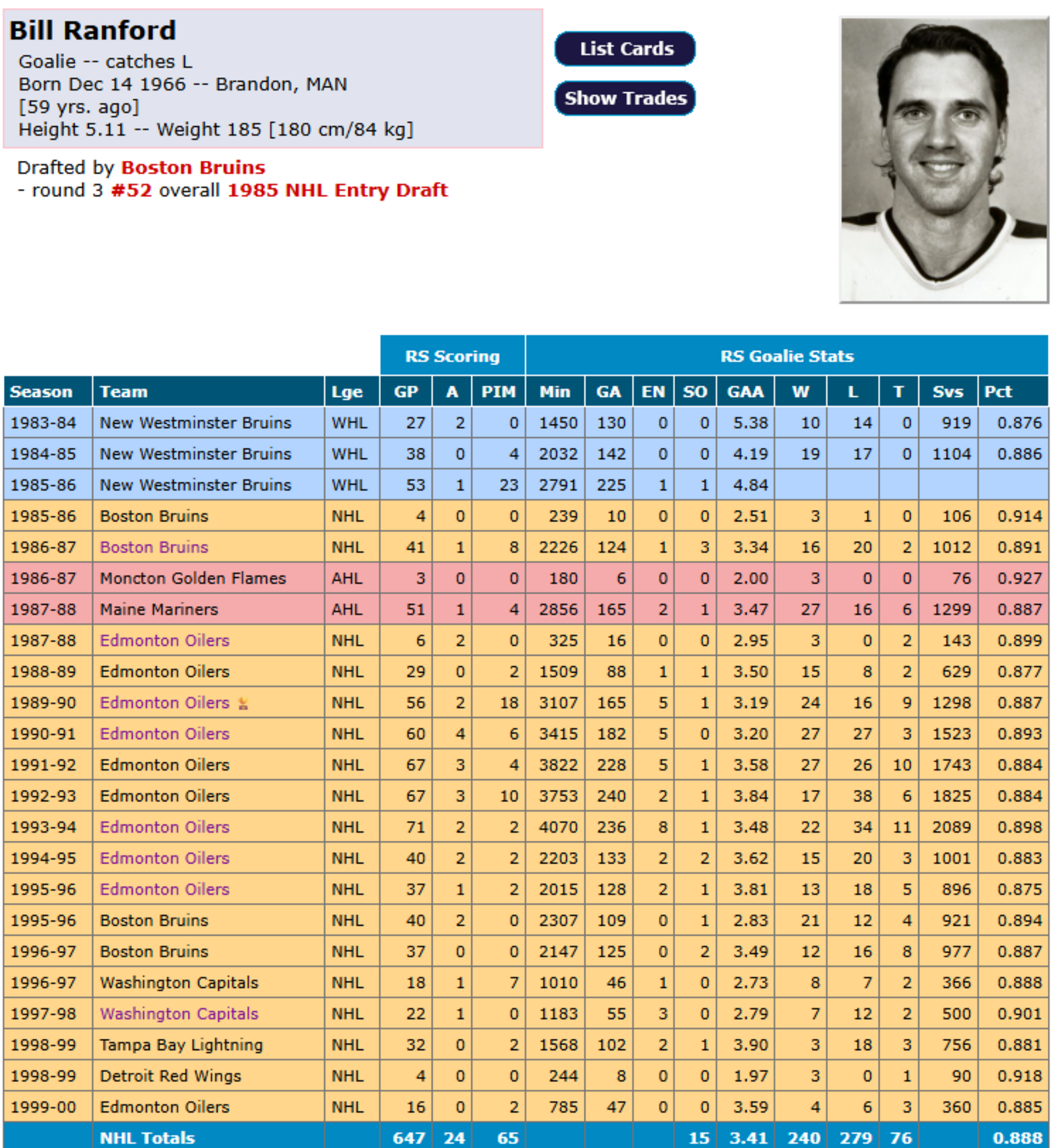
When the Oilers acquired Ranford from the Boston Bruins, the 21-year-old wasn’t happy.
After playing 41 games in 1986-87, the most of any Bruin netminder, Boston didn’t include Ranford in their future plans, revamping their crease with Rejean Lemelin and coach Terry O’Reilly’s preference of Doug Keans.
Used a bait to then trade for Andy Moog, the Oilers’ own disgruntled backup who held out for most of the season, the path for Ranford to play seemed daunting. After all, Glen Sather played Grant Fuhr 75 of 80 games in 1987-88, and Ranford watched from the bench as Edmonton won Stanley No. 4.
Yet, opportunity would knock in 1989-90 as Fuhr suffered appendicitis, then a shoulder injury. It was his chance and he seized it.
The majority of Ranford’s career was in Edmonton, but once the Oilers acquired Curtis Joseph from St. Louis, a decision was on Slats’ hands on who to keep and who to trade. It would be Ranford sent to Boston, the last major contributor from the glory years to be moved.
Ranford didn’t have many big seasons left in the tank, and would shift towards a backup role as he crossed into his 30s. Not long for Boston, he’d backup Olaf Kolzig on a Washington Capitals team in 1998 that made a surprise trip to the Stanley Cup Final. He’d also make stops in Tampa Bay and Detroit before coming back to backup Tommy Salo in 1999-00, officially calling it quits.

The Story
Although hotly debated by our new writer Andrew Cawood recently, who argued Esa Tikkanen should’ve been the playoff MVP, Ranford sure had the backing of his teammates for the honour in that Boston Gardens locker room on a hot May night.
“Billy was such a cool customer, he’s the story of these playoffs,” said Kevin Lowe after Game 5, the championship clinched. “He got better with every game and we couldn’t have won without him. The Conn Smythe? That isn’t enough for him.”
But it wasn’t necessarily smooth sailing afterwards for Ranford. Next season after Fuhr returned drug suspension, he looked like a money goalie again, and coach John Muckler started him over Ranford in the playoffs. It would become Ranford’s crease in 1991-92 and from there, he’d go on to set franchise records that still remain.
No Oilers goalie saw more pucks or stopped more pucks in their time, with 11502 saves, just ahead of Fuhr. He is first in regular season games played with 449, and starts with 428. Ranford’s 167 wins remain second most in an Edmonton sweater.
And although the team around him got worse, and the losing more common, Ranford had the ability to keep the Oilers in games. Perhaps the most forgotten is the 1992 Smythe Division championship, where Ranford helped drag a team running on fumes through two series victories, including a 3-0 shutout win in Game 6 against the Vancouver Canucks.
After the liquidation the Oilers went through (Mark Messier, Glenn Anderson, and Grant Fuhr were all traded that season alone), Sather said it was as rewarding as any Smythe win he could remember.
The organization didn’t induct anyone in 2025-26 into the Oilers Hall of Fame, but frankly, it seems like an easy choice on who should be on the next ballot. Remembered for the highest of highs in 1990, he was a mainstay of the organization in a time of transition, but could dazzle and excite on any given night.

What Brownlee said
As command performances go, you have to look long and hard to find one better than the beauty Bill Ranford turned in over a stretch of seven weeks during the spring of 1990 when he backstopped the Edmonton Oilers to their fifth Stanley Cup and copped the Conn Smythe Trophy as playoff MVP along the way.
And talk about tough acts to follow as an exclamation mark to that post-season performance, well, they don’t get any better. Acquired in a trade with Boston that sent Andy Moog to Beantown a couple seasons earlier, Ranford was forced into the spotlight that spring with Grant Fuhr out with a bum shoulder. His transformation from back-up to backbone was nothing short of stunning, especially if you consider how badly his coming out party started.”
The Last 10
More must-reads:
- Jets' Connor Hellebuyck saga ends with trade to Devils
- Blowout loss to the Maple Leafs highlight Oilers' flaws
- The 'World Series Game 1 starters' quiz
Breaking News
Trending News


Customize Your Newsletter
 +
+




Get the latest news and rumors, customized to your favorite sports and teams. Emailed daily. Always free!
PRIVACY POLICY COOKIE POLICY CONTACT US
ABOUT YARDBARKER TERMS OF SERVICE


By using this site, you agree to our Terms of Service and Privacy Policy.
This site is for entertainment purposes only.
There is no gambling offered on this site.
Gambling Problem? Call 1-800-Gambler.
