
-

-


Follow Us
-

 On Facebook
 On Flipboard
 On Twitter
Something extreme.
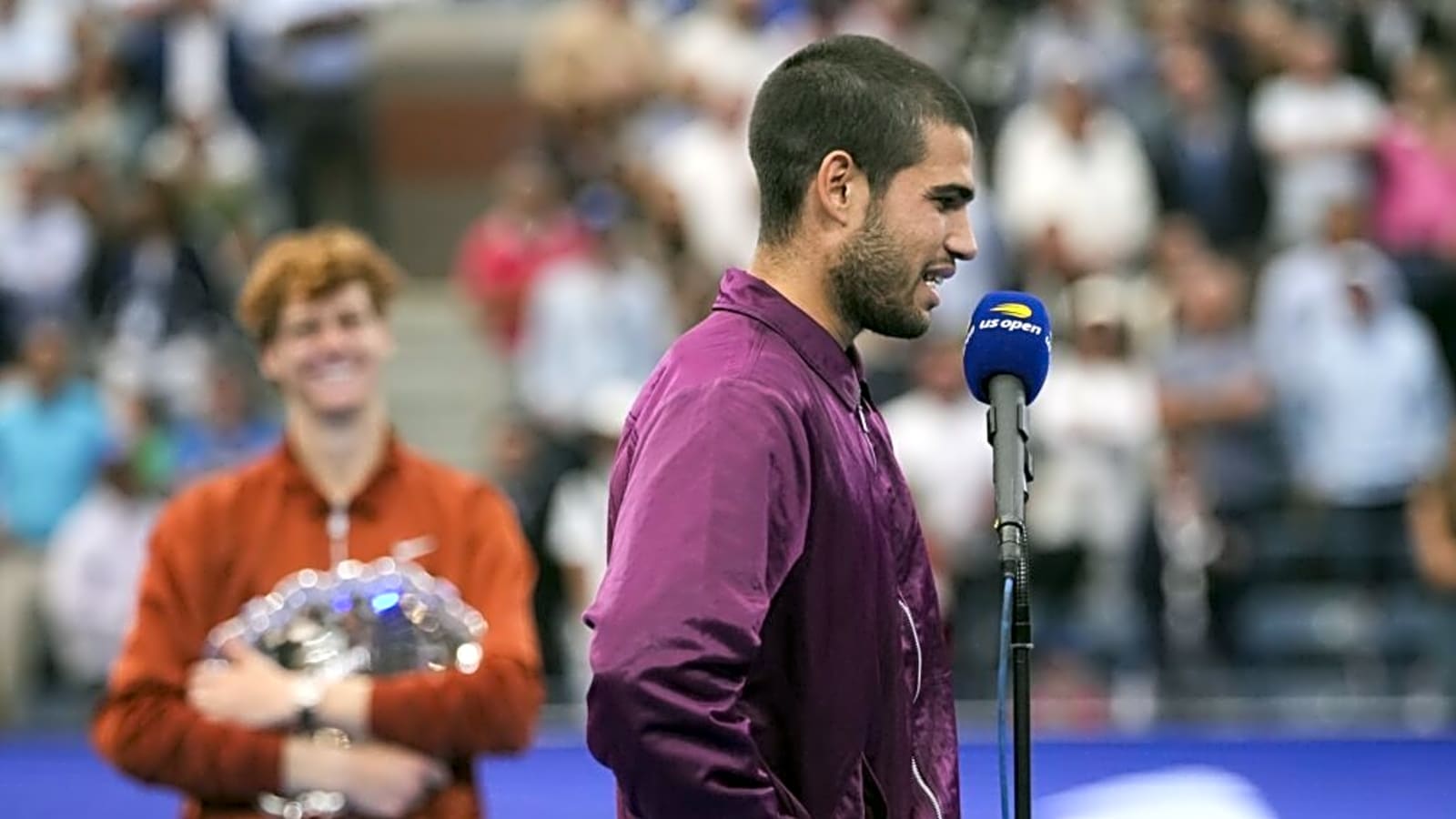
That’s the answer to the question of what would have to happen for one of the newly formed “Big Two” not to win the Australian Open. Carlos Alcaraz and Jannik Sinner are not invincible, of course they aren’t, but something truly extreme would have to happen for either of them not to lift another Grand Slam trophy.
The Law of Extremes in Tennis
Sinner Saved by the Bell
A good illustration came in Sinner’s match against Eliot Spizzirri.
The Italian entered the third-round clash against the relatively unknown 24-year-old as a massive favorite, but then the story was hijacked by brutally hot conditions, the kind in which Sinner has struggled before in his career. One set all, and in the third, the American had a break lead at 3–1, while Sinner was already being hit by cramps, first in his legs, then in his arms, to the point that he could barely stand on court. Defeat looked close. Maybe even a retirement.
Then the so-called heat rule policy kicked in. Conditions had become so extreme that the organizers closed the roof. This wasn’t favoritism toward Sinner; it was weather protocol. During the break, Sinner recovered, and in what were essentially indoor conditions, he managed to turn the match in his favor.
So it nearly happened. Nearly a Grand Slam loss to someone not named Alcaraz. But only because something extreme intervened.
When Extreme Was Named Wawrinka
In that sense, it’s worth remembering the title won in Australia in 2014 by the legendary and irresistible Stan Wawrinka, who will retire at the end of this season.
Back then, too, something extreme had to happen to break the dominance of certain players. Wawrinka actually did something similar again at this year’s Australian Open, especially in the second round, where he defeated nearly half his age Arthur Gea, breaking him after four and a half hours in a fifth-set tiebreak.
The 40-year-old Swiss eventually lost yesterday to ninth seed Taylor Fritz. Symbolically, his final point came via a devastating backhand winner. But the mere fact that he reached the third round at all, and that he was genuinely competitive there, was itself something of an extreme achievement.
Twelve years ago in Australia, there was no fifth-set tiebreak. The old rule applied: a match could, in theory, go on forever. Wawrinka entered that tournament as the world’s eighth-ranked player, clearly a man of enormous talent who had never quite unlocked it fully. He was already 28, a problem in tennis terms. And of course, there was the even bigger problem of playing in the era of the Big Four.
Before that Australian Open, he was 0–12 against Rafael Nadal. Against Novak Djokovic, he had lost their last fourteen meetings. Against Roger Federer, he stood at one win and thirteen losses.
One of those losses to Djokovic came the year before in Melbourne, in the Round of 16. It was one of those matches that felt endless, perfectly captured by its legendary final point. After five hours and two minutes, Wawrinka lost 12–10 in the fifth. Yet it was a match that forged him, showing him he wasn’t as far from those seemingly untouchable players as he’d thought.
In between, he played another brutal five-setter against Djokovic in the 2013 US Open semifinals. By the time they met again in the Australian Open quarterfinal, it was clear that while Novak was still the big favorite, Wawrinka was no longer so distant.
But the point of the story is this: something extreme still had to happen for him to beat him.
That extreme was Wawrinka himself. His tennis.
The Nature of Extreme
The Swiss will go down as a three-time Grand Slam champion, but what’s often forgotten is just how extreme his peak level was. At his best, he could beat almost anyone, almost everyone except Nadal at Roland Garros. Against the relentless baseline consistency of Djokovic and Nadal, he answered with sheer weight of shot.
Of course, he had to defend brilliantly and remain steady himself. But the essence was that extremity. At his peak, he could do both: endure and explode. His one-handed backhand, as much as it troubled him on grass, became a weapon of pure firepower, one that even the greatest defenders the sport has known struggled to contain.
So there he was again at that Australian Open, facing Djokovic. Naturally, it went five sets again. This time, after four hours, Wawrinka finally broke him, 9–7 in the fifth. Heading into the semifinal against Tomas Berdych, the only question was how emotionally drained he was, and whether he still had enough of that extremity left to win the whole thing.
He did, in four hard sets, though the unlucky Czech pushed him. The “small” problem was that the final now awaited: Rafael Nadal.
Had anyone ever beaten both Djokovic and Nadal on the way to a Grand Slam title before? No. Because it was close to impossible.
“He was very good in the big moments” said Magnus Norman famously, the legendary coach who worked with Wawrinka at his peak and is now back with him again. “Grand Slam champions have something others don’t. I played a Slam final and the moment overwhelmed me. He could handle those situations. I think you’re born with that.”
In that final, Wawrinka also faced another extreme circumstance: a physically compromised Nadal. The Spaniard was injured midway through the second set and clearly played far below his usual level afterward. Yet even then, he was extraordinarily hard to beat. And once again, the point remains that something extreme had to happen to shatter the dominance of those giants.
Wawrinka might well have won anyway, because he was extreme himself. But the pieces ultimately fell the way they did.
The New Extreme
Sinner and Alcaraz are extreme in their own way.
Yes, the overall competition today is somewhat weaker. But at the Grand Slams, not much has changed, as there are now two overwhelmingly dominant figures.
Alcaraz and Sinner have won the last eight Grand Slams. Nadal and Djokovic each once had a streak of nine straight. Federer and Nadal share the record with eleven consecutive majors.
The last time Sinner lost a Grand Slam match not to Alcaraz was Wimbledon 2024, against Daniil Medvedev. How? Something extreme happened: Sinner played the match sick.
The last time Alcaraz lost a Slam match not to Sinner was in Australia last year, against Djokovic, again under somewhat extreme circumstances.
Both are now even better, even bigger as players. And it’s frankly tasteless to push the narrative of “weak competition.” It’s not that others are so poor; it’s that these two are extremely good. That’s something to be enjoyed.
Are they unbeatable? Of course not.
As Medvedev, who recently exited in the Round of 16, put it: in ten matches against one of them, you won’t win many, but you can always win one.
So what has to happen to beat them?
Something extreme.
You need an abnormal Wawrinka. Or an injured Nadal. Or a Sinner who can barely stand upright.
The only problem with that theory is this: it has to happen twice in the same Grand Slam.
More must-reads:
- Cowboys have a dangerous plan for George Pickens' contract
- Konnor Griffin megadeal would be franchise-shifting moment for Pirates
- The 'Active 2K-point NBA seasons' quiz
Breaking News
Trending News








Customize Your Newsletter
 +
+




Get the latest news and rumors, customized to your favorite sports and teams. Emailed daily. Always free!
PRIVACY POLICY COOKIE POLICY CONTACT US
ABOUT YARDBARKER TERMS OF SERVICE


By using this site, you agree to our Terms of Service and Privacy Policy.
This site is for entertainment purposes only.
There is no gambling offered on this site.
Gambling Problem? Call 1-800-Gambler.
