
-

-


Follow Us
-

 On Facebook
 On Flipboard
 On Twitter

Even for a team with Red Bull’s history of ruthlessness in driver decisions, the last twelve months have been unusually turbulent at Milton Keynes.
The choice to replace Liam Lawson after just two rounds was a recognition of Red Bull’s mistake in promoting him too soon, as the Austrian team felt the Kiwi was not ready to drive alongside Max Verstappen.
Of course, a lack of pre-season testing put Yuki Tsunoda – Lawson’s replacement – in an almost impossible position. Only a few months later, Christian Horner was fired and replaced by Laurent Mekies.
This volatility has done little to help the increasingly polarising second Red Bull seat.
Despite some impressive signs in his first few rounds in the RB21, Tsunoda struggled for months after his crash in Imola. This is primarily because he never ran with the same updated components as Verstappen.
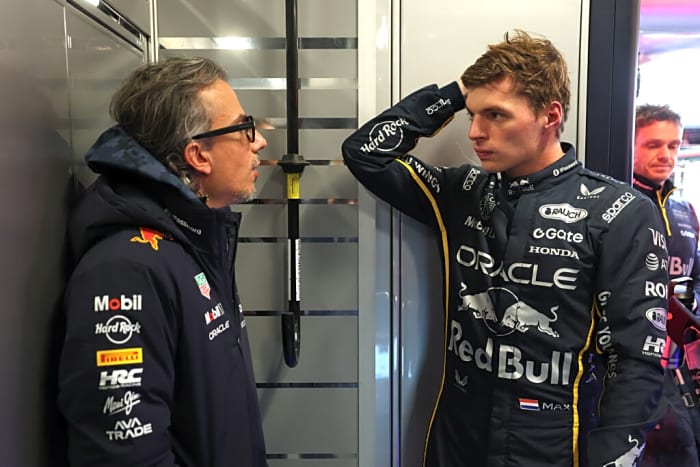
This has made it difficult to assess the 25-year-old, particularly after the team’s recent string of operational errors. Still, Red Bull’s Laurent Mekies has revealed a final judgement is imminent.
Red Bull close to final 2026 decision
There are four drivers competing for three seats (excluding Verstappen’s) at Red Bull and VCARB. The candidates are Yuki Tsunoda, Isack Hadjar, Liam Lawson and Arvid Lindblad.
Hadjar is expected to join Red Bull in 2026, owing to his solid rookie campaign. In many ways, the Frenchman has been the main beneficiary of Red Bull’s early driver swap.
Prior to his move alongside Verstappen, Tsunoda was the faster driver at VCARB. This meant the Japanese driver’s promotion took away a benchmark that – for all intents and purposes – was faster than Hadjar.
Lawson, meanwhile, has seen his market value plummet since being demoted. Like others before him (Albon, Gasly, etc.) the 23-year-old’s chances of returning to the main team are virtually non-existent.
Generally speaking, Lawson has been slightly slower than teammate Hadjar. This deficit, though relatively small, is unlikely to help his chances ahead of 2026.
After all, prior to joining Red Bull, Tsunoda effectively acted as a benchmark at VCARB. He consistently outperformed his teammates (De Vries, Ricciardo, etc.), which helped inform the team’s driver decisions.
In this sense, Lawson’s deficit to Hadjar raises doubts about his ability to act as a reference at the Racing Bulls. This is relevant because, it stands, Tsunoda and Lawson are competing to be Arvid Lindblad’s teammate in 2026.
Currently, Tsunoda is seen as able to more effectively play that role next season. Racing Bulls team principal Alan Permane outlined a few weeks ago that having at least one experienced driver will be important ahead of a regulation change.
What to expect from Red Bull
Ahead of this weekend’s action, Lindblad’s promotion is seen as inevitable. The 18-year-old is expected to make his F1 debut next season. Additionally, the consensus is that Hadjar will partner Verstappen in 2026.
Regarding the second team, Tsunoda is understood to be in a better position to be Arvid Lindblad’s teammate next year.
Laurent Mekies’ affinity for Tsunoda, which does not necessarily exist for Lawson (whose promotion was advocated for by Christian Horner) could also be significant. The Frenchman knows better than most about the #22 car’s struggles this year.
It is rare that Red Bull apologise so consistently for making mistakes with their second driver.
However, Tsunoda’s poor stop in Mexico, Red Bull’s incorrect set-up in Brazil and tyre pressure miscalculation in Vegas have made it clear recent results are not representative of his abilities.
It should be noted that this weekend in Qatar could alter Laurent Mekies and Helmut Marko’s calculations. With that said, the Austrian outfit seem to have made up their minds on Hadjar and Lindblad.
The final piece of the puzzle concerns Tsunoda and Lawson, with this dilemma likely to result in the Japanese driver returning to VCARB in 2026.
More must-reads:
- Blue Jays' Kevin Gausman's historic start continues in loss to Rockies
- New details emerge about Tiger Woods' arrest
- The 'NBA yearly free throw leaders' quiz
Breaking News
Trending News





Customize Your Newsletter
 +
+




Get the latest news and rumors, customized to your favorite sports and teams. Emailed daily. Always free!
PRIVACY POLICY COOKIE POLICY CONTACT US
ABOUT YARDBARKER TERMS OF SERVICE


By using this site, you agree to our Terms of Service and Privacy Policy.
This site is for entertainment purposes only.
There is no gambling offered on this site.
Gambling Problem? Call 1-800-Gambler.
