
-

-


Follow Us
-

 On Facebook
 On Flipboard

One year after being drafted 13th overall in the 2021 MLB Draft, Andrew Painter drew attention from the baseball world as a whole. Painter dominated in his first full professional season, reaching Double-A by year’s end as a 19-year-old. He won the Paul Owens Award, given to the best Phillies’ MiLB hitter and pitcher. His recognition went beyond his organization as well, winning Baseball America’s inaugural MiLB Pitcher of the Year.
With an absurd 1.56 ERA in 22 starts and an overpowering 38.7 K%, the Phillies had a true pitching talent they could bank on. But injuries got in the way of Painter. He was diagnosed with a UCL sprain during Spring Training the next year. Just a few months later, he underwent Tommy John Surgery, not returning until late 2024 in the Arizona Fall League. Finally, Painter debuted in the major leagues in 2026, but struggled badly in his first taste.
Refined Secondary Stuff
Painter’s fastball had been a problem for him during his first stint in the majors. With Fangraphs’ pitch value stat, pitches can be measured as if a hitter got to see them 100 times each. This stat (Pitch type/C) helps balance smaller samples and will be used to evaluate changes in Painter’s arsenal. In his first MLB action, Painter’s fastball suffered with a wFA/C of -3.28 (0 being average). That gave him baseball’s fifth-worst wFA/C in that time (minimum 60 innings pitched).
What really hurt Painter was that his secondary stuff suffered too. Though not to the same extreme as his fastball, Painter had a negative slider (-0.65) and sinker (-0.50). While his curveball (0.11) and splitter (0.12) were both just above average, he lacked a reliable out pitch.
That has not been a problem since being recalled. Painter has swapped out his splitter for a changeup that has been worth 5.49 runs above average. His slider has seen mild improvements (-0.09 wSL/C) as well, giving him two extra pitches to lean on.
The arsenal switch from a splitter to a changeup has benefited Painter most. Painter’s splitter averaged 87.4 MPH, while his changeup has averaged 90.1 MPH. While he found success with his splitter (.195 AVG, 35.7 K%), batters still occasionally barreled it. He allowed three home runs on the pitch, and hitters slugged .415 against it. While the changeup sample is much smaller (55 pitches), he’s yet to allow any hits off it. Opponents are now striking out 46.7% of the time against his new-look offspeed pitch.
Andrew Painter's new changeup is a subtle tweak off his old splitter. Slight rotation of ball, middle finger closer to his index finger.
April: 87.2 mph, 6.5" vert, 11" arm-side
Since Break: 90.1 mph, 4.7" vert, 13" arm-sideHarder with more drop is a nice combo. #Phillies pic.twitter.com/g2mC68zinv
— Lance Brozdowski (@LanceBroz) August 11, 2026
Notable Improvements in Overall Command
Command can be a difficult quality of a pitcher’s to quantify. However, some stats can help indicate the quantity and quality of strikes thrown. One of those quantity stats is Zone%, which is the number of pitches batters see inside the strike zone. Interestingly, Painter had a better Zone% in his initial MLB stint compared to now:
- First 12 MLB starts– 49.4 Zone%
- Since recall– 43.7 Zone%
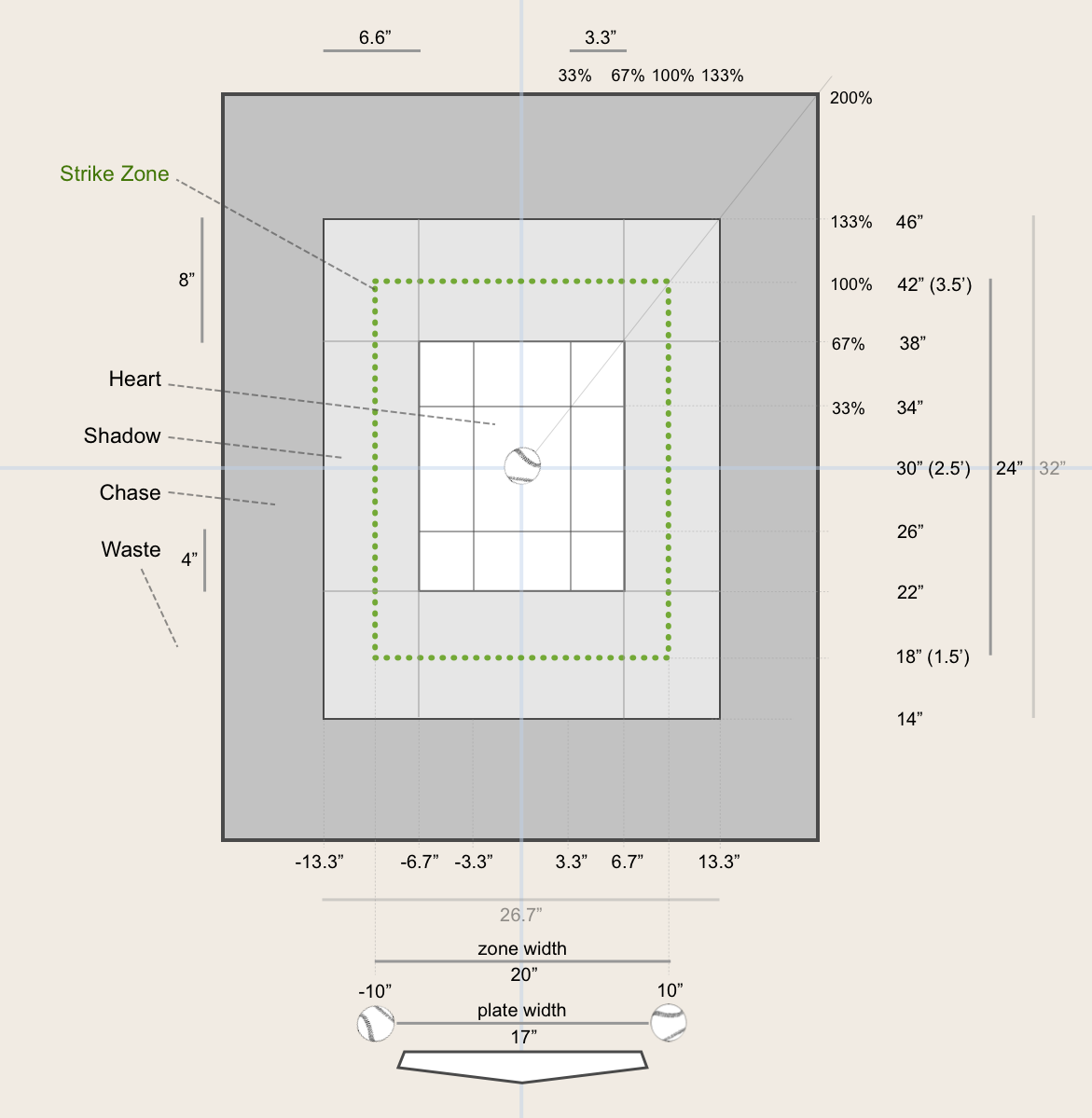
But Zone% is a sweeping metric that covers all areas of the strike zone. Statcast measurements use attack zones, which are broken up into four categories, shown in further detail here. The two that best show a pitcher’s quality of strikes thrown are H-Zone% (Heart Zone%, pitches in the center of the zone) and S-Zone% (Shadow Zone%, pitches along the edges of the zone).
For Painter, this is where the most significant difference in strike quality is shown. Painter is away from the heart of the plate, throwing pitches that are tougher to barrel up.
- First 12 starts– 25.1 H-Zone%, 42.4 S-Zone%
- Since recall– 18.9 H-Zone%, 46.6 S-Zone%
The earlier-mentioned Zone% can still show strike quality. Z-Contact% measures how often batters can make contact on pitches seen in the overall zone. This stat is another that Painter has made big jumps in:
- First 12 starts- 86.9 Z-Contact%
- Since recall- 78.5 Z-Contact%
Painter’s reduction in zone contact helps to illustrate that he isn’t throwing as many easily hittable strikes now.
Andrew Painter’s stats since being recalled from AAA Lehigh Valley:
15.1 IP | 8 H | 5 ER | 7 BB | 16 K
2.93 ERA | 0.98 WHIPpic.twitter.com/zyqIeVjQCG— Phillies Tailgate (@PhilsTailgate) August 11, 2026
Painter Bounces Back Much Better
One area that Painter has struggled significantly this year is starting off the game. Painter has gotten hit hard in the first inning, which has led to him starting games at a disadvantage:
Painter (First inning stats)- 15 innings, 7.80 ERA, .283/.386/.517, four home runs, eight walks
His first-inning struggles kept him from going deeper into games. However, while more subjective, his confidence seems to have increased. As a result, Painter has been able to bounce back from rough first innings and still deliver strong outings. Looking at some of his outings, there are a couple of distinct outings before and after he returned that illustrate his improvements:
June 17– Painter gave up a two-run home run three batters into the game, throwing 23 pitches in the first. He couldn’t regain his confidence and fully spiraled in the second inning. He allowed a leadoff home run to Owen Cassie, then quickly picked up a strikeout. After this, five of the next six batters reached base, giving up three runs on four hits and a walk in that span. Painter would be removed from the game after this inning and was sent to Triple-A after the game ended.
July 31– This was Painter’s first game back in the majors. Painter would allow a double and a home run to the first two batters he faced. However, he dominated the rest of the way, allowing just one hit and no runs over the next five innings. Overall, he went six innings and allowed just two runs in the first, striking out six and earning a quality start.
How about that? Andrew Painter allowed a double and homer to the first two batters. He retired 17 of the next 21. Six strong innings.
— Matt Gelb (@MattGelb) August 1, 2026
More must-reads:
- Return date revealed for Yankees' Carlos Rodon
- Phillies expected to part ways with Don Mattingly at season's end
- The 'Last batting title by MLB team' quiz
Breaking News
Trending News




Customize Your Newsletter
 +
+




Get the latest news and rumors, customized to your favorite sports and teams. Emailed daily. Always free!
PRIVACY POLICY COOKIE POLICY CONTACT US
ABOUT YARDBARKER TERMS OF SERVICE


By using this site, you agree to our Terms of Service and Privacy Policy.
This site is for entertainment purposes only.
There is no gambling offered on this site.
Gambling Problem? Call 1-800-Gambler.
