
-

-


Follow Us
-

 On Facebook
 On Flipboard


At first glance, Cristian Javier’s return to the Houston Astros looks normal. After recovering from a shoulder strain, his four-seam fastball is back to its usual 92.9 mph. But the data reveals a deeper problem: the velocity returned, but the movement that made it effective did not.
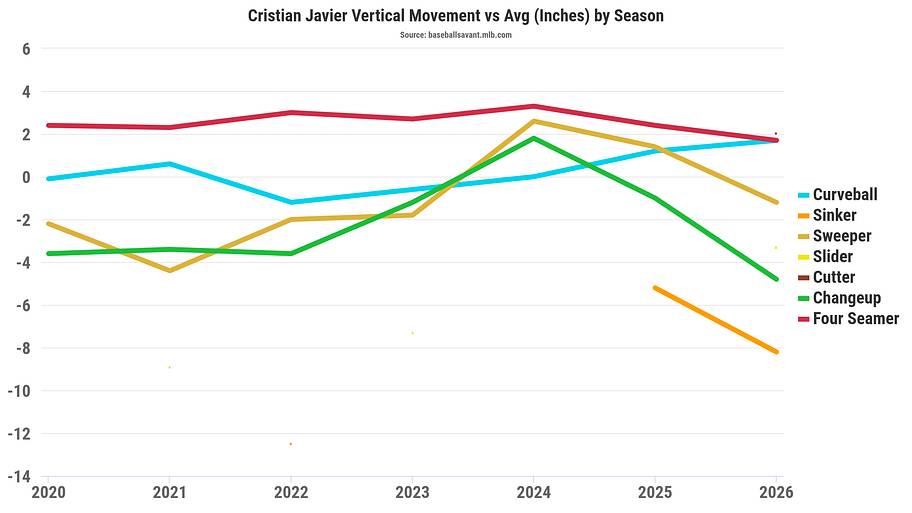
Javier’s historic dominance never depended on overpowering velocity. It depended on deception.
His fastball generated more than 19 inches of induced vertical break, forcing hitters to adjust their swing path upward and swing underneath the ball. In 2026, the pitch is arriving flatter. This is not a problem of leaving the ball over the middle of the plate, but of vertical movement: after losing its ride, the pitch drops directly into the hitter’s natural swing path and carries a .420 xwOBA.
Right-Handed Hitters Have Adjusted to His Arsenal
Hitters have removed the uncertainty from the equation. Instead of chasing pitches outside the zone, they are waiting for the fastball with the confidence that they can square it up. The damage from right-handed hitters captures the problem: Javier is allowing a .305 batting average, a .576 slugging percentage and a .993 OPS this season, along with a 57.6% Hard-Hit rate specifically against his fastball.
That loss of respect has changed how at-bats unfold. Hitters have stopped chasing pitches outside the zone and forced the Dominican right-hander to attack with pitches that are easier to square up. The evidence shows up in his plate-discipline numbers: his walk rate has climbed to 12.0%, his strikeout rate has fallen to 18.4%, and his K-BB% has dropped to 6.4%, a long way from the 24.3% he posted at his 2022 peak, pet Statcast.
Once the fastball loses its effectiveness, the relationship between his pitches begins to break down. His sweeper is producing a .237 xwOBA against it, while his changeup generates a 44.2% Chase rate, two signs that his secondary pitches can still win at-bats.
But they become less effective if hitters no longer feel the need to protect the upper part of the zone. The arsenal still contains quality individual weapons, but the logic connecting them has fallen apart. The pitches are no longer complementing one another.
The Context Behind His Return to Houston
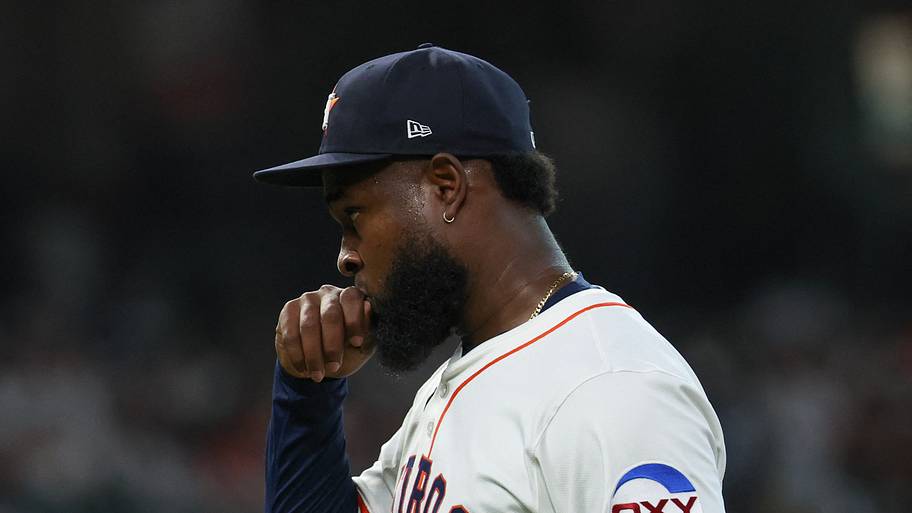
Javier’s return to the Astros’ rotation is a product of Houston’s pitching crisis, not evidence that the right-hander has solved his mechanical issues.
With the rotation carrying a 5.10 ERA and just 2.8 combined WAR in 2026, the Astros needed innings in a hurry, accepting the risk of handing the ball to a pitcher who has posted a 1.68 WHIP through his first nine appearances of the season, five as a starter and four in relief.
Javier got his velocity back after the injury. He still has not regained the characteristic that made that velocity so dangerous.
The radar can keep showing the same 93 mph. The problem is that hitters no longer see the same threat when they swing.
More must-reads:
- Nationals made a painful admission with Luis Garcia Jr. trade
- Blue Jays' Max Scherzer reaches historic MLB milestone vs. Phillies
- The 'Last five-hit game by MLB team' quiz
Breaking News
Trending News


Customize Your Newsletter
 +
+




Get the latest news and rumors, customized to your favorite sports and teams. Emailed daily. Always free!
PRIVACY POLICY COOKIE POLICY CONTACT US
ABOUT YARDBARKER TERMS OF SERVICE


By using this site, you agree to our Terms of Service and Privacy Policy.
This site is for entertainment purposes only.
There is no gambling offered on this site.
Gambling Problem? Call 1-800-Gambler.
