
-

-


Follow Us
-

 On Facebook
 On Flipboard
Now that the ink is dry on the latest surprising late-offseason contract that Arizona Diamondbacks owner Ken Kendrick doled out, this time to former ace Zac Gallen, the D-backs find themselves with a bevy of starting pitchers.
They only need five for the Opening Day roster, but there are seven of them worthy of a spot, plus a flock waiting in the wings in Triple-A, nearly ready to get their own shot at flying.
It wasn’t expected that Arizona, which had publicly said that it was lowering payroll compared to 2025, would be able to re-sign or bring back both Merrill Kelly and Gallen. It was expected that they had a very good shot at getting one of them.
Gallen turned down the qualifying offer in November, which only spurred the belief that Kelly would be the one to come back to the desert. When the D-backs signed Michael Soroka to a one-year deal and announced he would be a starting pitcher on the first day of the Winter Meetings, that only solidified the belief that only one former ace would be back.
Soon, Kelly would sign his two-year deal worth $40 million with a vesting option for a third year. With his signing, Arizona would have one of its two aces back to co-lead the rotation with young, blossoming star Ryne Nelson. It was believed that Gallen would get a large enough contract elsewhere to give Arizona a high compensation pick and that the two would go their separate ways.
This was especially true given how well Gallen pitched down the stretch. He looked like the Gallen of old after a rough first half that made him basically untradeable because no one offered what general manager Mike Hazen believed he was worth.
However, Gallen lingered on the market. Reports soon emerged in late January that perhaps Arizona could find a way to retain the veteran. It would have to be on a creative short-term deal, but over the following few weeks, the momentum only grew, further suggesting that Gallen to the Diamondbacks was a real possibility.
On February 13, it was revealed that Gallen did indeed agree to come back to Arizona on a one-year deal with deferrals and that essentially matched the $22 million qualifying offer he turned down earlier.
With that, Arizona’s rotation depth got a massive boost, but the signing also created some difficult decisions to be made as to who will make the team’s five-man rotation beyond the obvious three. Plus, there’s the looming return of Cy Young winner Corbin Burnes to consider.
The Locks of the Rotation
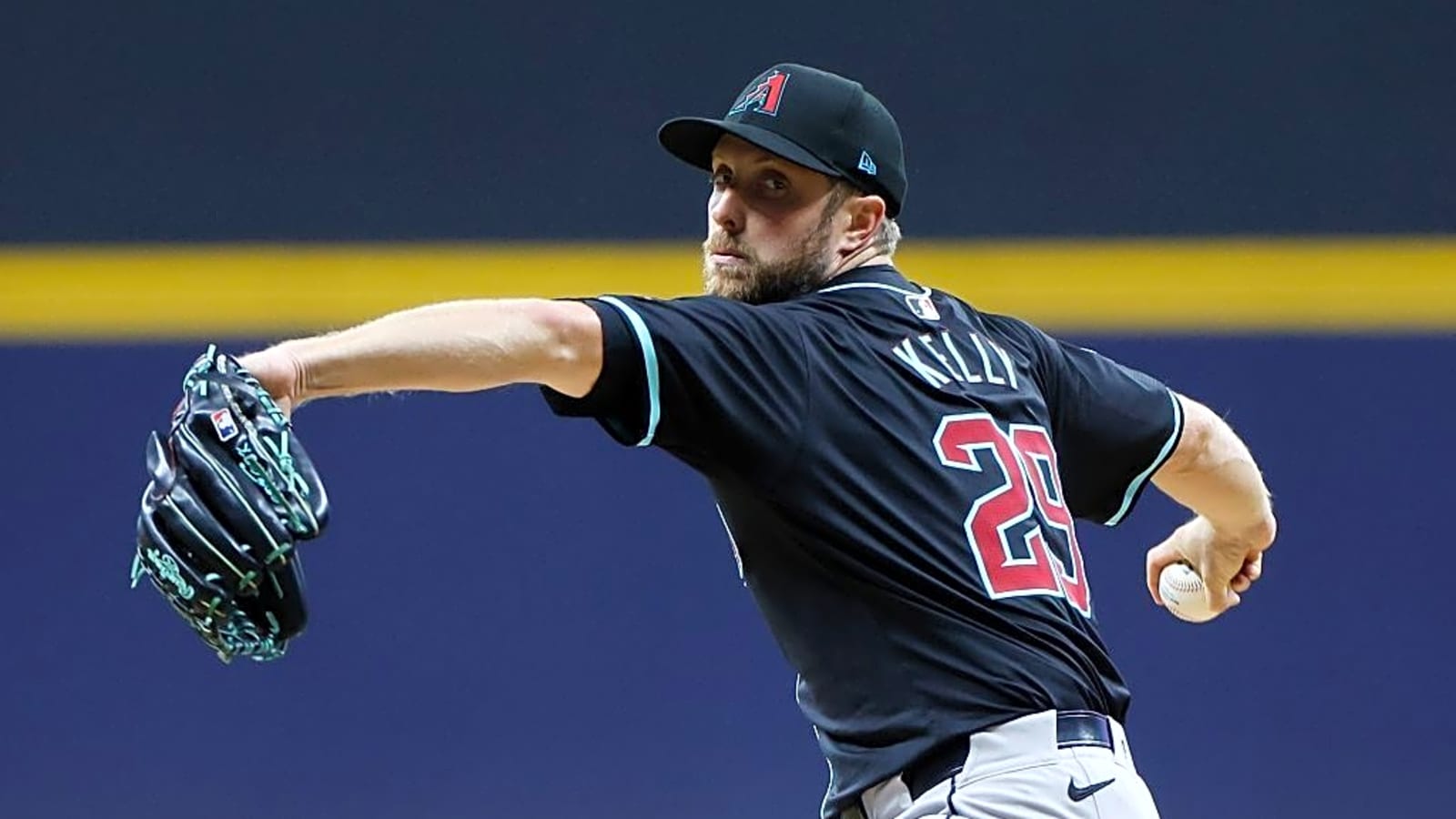
Merrill Kelly, Zac Gallen, Ryne Nelson
With the news that Kelly will start Opening Day, that removes one question regarding these three players. However, these three are the starters Arizona has the fewest questions about. Kelly is coming off another strong season, in which he pitched to a 3.52 ERA over 184 innings. He had a FIP of 3.76, an xFIP of 3.81, and an xERA of 4.15. He had 167 strikeouts compared to only 48 walks.
Kelly is entering his age-37 season but is showing no signs of slowing down. He’s continued to mix his six pitches effectively and knows how to battle hitters. He’s a crafty veteran who refuses to lose and consistently pitches deep into games. He gets plenty of chase, which helps him induce weak contact to go along with a close-to-league-average strikeout rate.
Gallen is projected to be the team’s No. 2, although he might not start game two of the regular season. Gallen saw a second straight season of a downturn in his Stuff+ metrics to go along with worsening end results in his rate metrics. He struggled with the home run ball, was unable to obtain as much chase, and left pitches in bad spots far too much.
However, following the trade deadline, when he knew he was finishing the season in Arizona, he made a few adjustments, and this time, those adjustments seemed to stick and help him. Despite his end-of-season numbers being a career-worst 4.83 ERA and a 4.50 FIP, his second half featured the numbers that fans of Gallen have come to expect.
Over his final 11 starts and 65 innings of the season, he helped pitch Arizona back into the playoff chase, thanks to a 3.32 ERA, 3.95 FIP, 19 walks, 54 strikeouts, and just 51 hits allowed. He gave up only eight home runs. He pitched six or more innings in nine of those starts.
If Arizona can get close to that from him in 2026, with that many innings being eaten up, this contract will be a boon for them. Plus, Gallen will see quite a large number come his way next offseason. Now, he just has to continue that momentum.
As for Nelson, the team will not strike out on its own accord after moving Nelson to the bullpen to begin a season two years in a row before seeing him break out in a starting role following injuries to other starters. The third time is the charm, as after a sensational 2025 season, Nelson is assured a spot in the rotation provided he’s healthy.
Nelson’s fastball proved to be unhittable; opponents hit for just a .207 average with a slugging percentage of only .360 against it. Over his final 127 innings, all but four coming as a starter, Nelson recorded an ERA of 3.03, a FIP of 3.73, 102 hits, 31 walks, and 104 strikeouts. He was Arizona’s most valuable pitcher with 3.5 bWAR, most of which came during this span.
He’s only entering his age-28 season with plenty more potential if he can improve his breaking and off-speed pitches to go along with his dominant fastball. If he can, he could be an All-Star in 2026 and lead Arizona’s staff until Burnes is back.
The Contenders for Arizona’s Final Two Spots
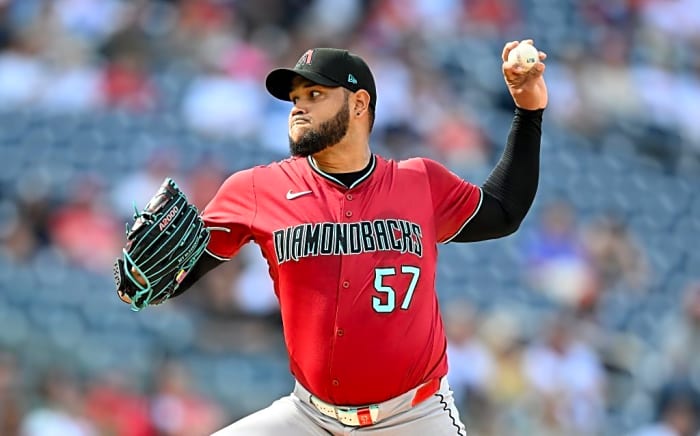
Eduardo Rodriguez, Brandon Pfaadt, Michael Soroka
Rodriguez has yet to live up to the $80 million contract that he signed with Arizona in free agency ahead of the 2024 season. However, he could help the team quite a bit by being a reliable No. 4/5 starting pitcher that keeps them in games until Burnes comes back and unseats one of these last two members of the rotation, provided all five are healthy.
Rodriguez pitched to a 5.02 ERA across 154.1 innings in 2025. He was somewhat unlucky, as his FIP was a much better 4.57, his xFIP 4.44, and his xERA 4.51. If he can get closer to those numbers with his ERA, Arizona will win quite a few more games. He still limits hard contact, but has been giving up far too much contact and walks.
If he can rein in the walks and find a way to induce less contact, or find a way to decrease his sky-high .333 BABIP, then perhaps he can solidify his spot in the rotation. Otherwise, he’ll be pitching for his job and not to go to the bullpen mid-season or in spring training.
Pfaadt is under the same microscope, as he has plenty of talent and the ability to go deep into games every start. However, he’s been unable to put it all together across an entire season. Despite getting a long-term extension, he’s just not realized his potential yet. If he does, he has the chance to be a team’s long-term No. 3 starting pitcher.
Over his 176.2 innings in 2025, Pfaadt gave up 26 homers; the long ball continues to be a glaring issue for him. He doesn’t walk hardly anyone, but he has not developed a key strikeout pitch that he can rely upon. His signature sweeper has been hit harder and harder each year, so that’s one pitch he must improve.
Another 5.25 ERA season wouldn’t be acceptable from Pfaadt, but it appears he had a lot of bad luck last year. His FIP was a far better 4.22, and his xFIP was 4.01. If he can get his ERA closer to those two numbers, it’d go a long way towards getting him that long-term spot in Arizona’s rotation, something the D-backs bet on when they gave him that $45 million extension.
He can do it, as evidenced by a string of 14 starts and 81.1 innings across the middle of the season when he recorded a 4.54 ERA and 3.64 FIP. Now, can he do it across a whole season? He’s the safest bet to do so among these three and the likeliest to hold his rotation spot over spring training.
Soroka, on the other hand, has a lot of factors going against him. Namely, he hasn’t thrown more than 100 innings since 2019 and has dealt with many injuries since then. It’s fair to wonder if having him pitch in the rotation is the right call for him, due to those injuries and the fact he would likely have an innings cap just to protect his arm and body.
Soroka pitched 89.2 innings in 2025, his most since 2019, with two teams. He had a solid 4.52 ERA with a FIP of 4.23, an xERA of 3.53, and an xFIP of 4.21. That was good enough for a 1.1 fWAR in 22 games (17 starts).
He struck out 95 with 29 walks, and he allowed only 72 hits. However, his stats in the rotation were not as good as they were in the bullpen. Over 83.1 innings in the rotation, he had a 4.86 ERA. In an admittedly small sample of 6.1 innings in relief, he didn’t allow a run and looked far sharper with his pitches.
To keep him healthy and see him utilize his unhittable slurve, his best spot might be in the bullpen. He can pitch long relief or develop into a late-inning option for a team with plenty of bullpen questions. His contract contains bonuses for either starting or relieving, and with Arizona’s extra starting depth, he might be the one best suited to head to the ‘pen.
The Rookies and Prospects
Cristian Mena, Dylan Ray, Kohl Drake, Mitch Bratt, Bryce Jarvis
Mena has little left to prove in the minors. He’s ready for the majors but is currently blocked both in long relief and in the rotation. He should be the first call-up if either role needs to be filled.
Ray, Drake, and Bratt all have plenty of upside and are getting more practice in Triple-A. Arizona will need at least one of these three to break out this year and try to force his way to the majors.
Drake and Bratt have the higher upside and potential; look for them to be the ones to make noise. Jarvis isn’t a rookie, but he is a capable arm that can come up and provide solid innings.
The X-Factor
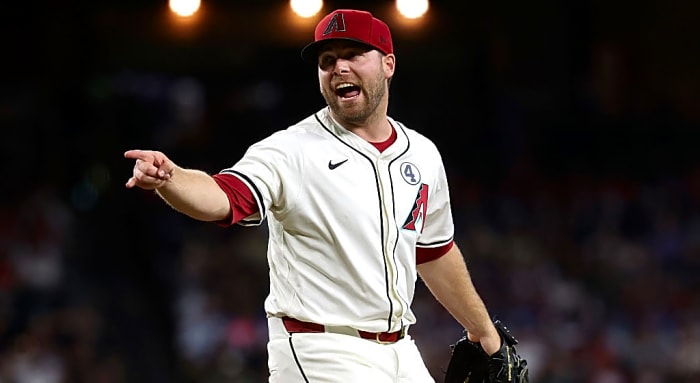
Corbin Burnes
Burnes is expected to return around the All-Star break from the Tommy John surgery he had last June. He is the team’s ace, and he’s the kind of pitcher who can lead a team into the playoffs and pitch Game 1.
However, it is a mystery as to how well he’ll do straight out of rehab. It could take him a few starts to round into form. It might even take him the whole second half. Many pitchers take a couple of months to get back to their previouslevel. Some never do.
Burnes, though, has extra motivation as he has a potential opt-out after this season in his six-year contract.
If he excels, he could get Arizona to add a year to the deal or seek a bigger contract. Plus, he’ll likely want to make up for time lost and help the Diamondbacks get back to the playoffs. He’s an extreme competitor and wants to win. The D-backs will need his help and leadership to do just that.
Come mid-July, provided there are no injuries or setbacks, expect there to be another competition as to who gets moved out of the rotation for Burnes. It’s a great problem for Arizona to have, and getting Burnes back is like getting a Cy Young-caliber pitcher for free at the trade deadline. It could be just what the doctor ordered for this rotation.
If I have to make a prediction for the Opening Day rotation, it’s shaping up to be Kelly, Nelson, Gallen, Rodriguez, and Pfaadt with Soroka in the bullpen. Then, when Burnes comes back, and if everyone is healthy – a big if – one of Rodriguez or Pfaadt will join Soroka in the ‘pen.
More must-reads:
- MLB announces punishment for Framber Valdez
- Details emerge on 'inappropriate' behavior that led to firing of Tigers' Triple-A manager
- The 'NBA scoring champions' quiz
Breaking News
Trending News






Customize Your Newsletter
 +
+




Get the latest news and rumors, customized to your favorite sports and teams. Emailed daily. Always free!
PRIVACY POLICY COOKIE POLICY CONTACT US
ABOUT YARDBARKER TERMS OF SERVICE


By using this site, you agree to our Terms of Service and Privacy Policy.
This site is for entertainment purposes only.
There is no gambling offered on this site.
Gambling Problem? Call 1-800-Gambler.
