
-

-


Follow Us
-

 On Facebook
 On Flipboard


This article was written prior to the news that Cal Raleigh will be going on the injured list with an oblique strain.
After gradually developing and molding himself into one of the best catchers in the game, Cal Raleigh took his game to the next level during the 2025 campaign. His season was nothing shy of historic, as he broke Seattle Mariners franchise records, MLB records, and positional records all in one.
Finishing the season with 60 home runs, Raleigh became one of only seven players to reach this threshold in a single season. Not only this, but he broke the record for most home runs hit by a catcher and a switch-hitter in a single season, won a Home Run Derby, and truly proved that he was a force to be reckoned with offensively.
With this level of production last season, many expected Raleigh to repeat his excellence in 2026. Even though it’s still early, the complete opposite has been the case, though, as Raleigh has been one of the worst hitters in baseball thus far.
Things were so bad, in fact, that Raleigh went through a 0-38 stretch that ended on May 12 against the Houston Astros. He’s also been trying nearly just about anything to get himself back on track, as this hitless streak ended after Raleigh reportedly showered in his full uniform, likely trying to flush out the bad vibes he’s been carrying with him up until this point.
With his season off to this poor a start, buzz has been circling the game about why he’s struggling, and the answer to this question has multiple complicated layers. Rather than it being a singular mechanical inefficiency, unluckiness, or a poor performance against a specific pitch type that’s easy to identify, it’s a combination of much more.
From his mechanics to his underlying data, let’s dive into the bigger picture and try to identify what’s going wrong for one of the game’s most feared power threats.
Stats were taken prior to play on May 13.
Raleigh’s Swing
Two words describe how Cal Raleigh looks from both sides of the plate currently: lost and disconnected.
His recent swings have seemed completely out of sync and as though his upper and lower halves are working independently, a detail that can lead to significant struggles at the plate due to poor mechanics.
Raleigh’s Left-Handed Swing
Beginning with Raleigh’s left-handed swing, the differences are immediately evident from the moment he steps in the box. One of the things Raleigh did that was more unique was that he had a pretty notable amount of rhythm in his swing, swaying back and forth before he began his load and stride.
This season, that has calmed down dramatically, almost completely disappearing altogether. On top of that, Raleigh is now far less stacked on his back half, favoring a wider, more evenly distributed approach than before. In fact, his stance is almost 4.5 inches wider than last year.
On top of that, Raleigh has adjusted his hands pretty noticeably as well. They’re cocked back slightly more than last season, and he’s angled his barrel ever so slightly while doing so. It’s almost as if he’s trying to use his hands to make up for his less-twitchy approach, which hasn’t panned out thus far.
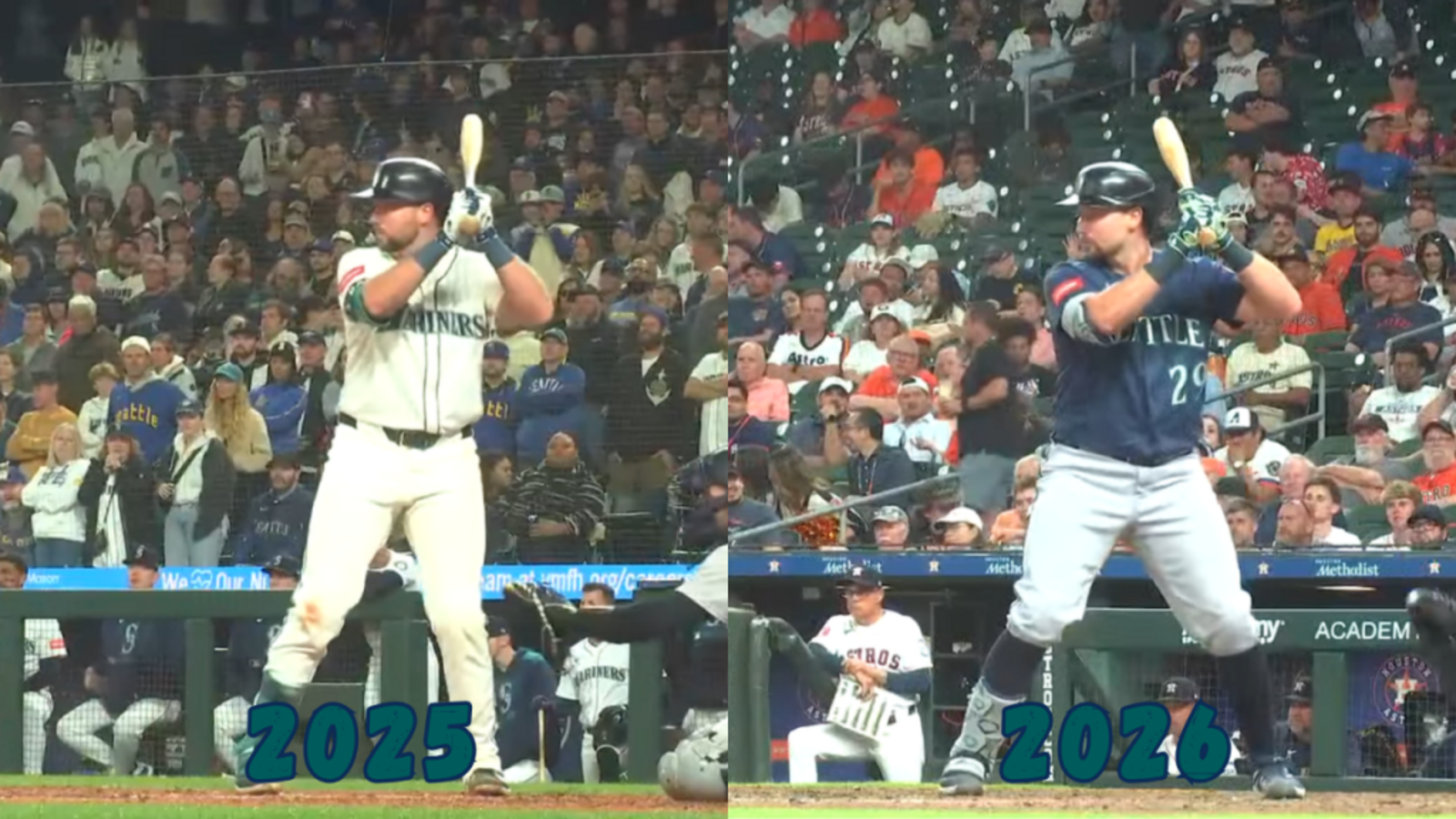
Moving into Raleigh’s load, his stance adjustments shine through once again, alongside some other minor changes. For starters, Raleigh’s stride has changed in a significant manner. He went from having a smaller, but significant leg kick in 2025, to having a smaller, forward and backward stride in 2026.
In all honesty, this isn’t a terrible place for Raleigh to be during his stride. In fact, there’s an argument that he’s in a better position here than last season. The issue is more so that his leg kick is out of sync, and that he’s arguably a little bit too stacked on the back half.
His hands are interesting to observe in this still frame, also, as they begin to really drop during this part of the swing. This is something that begins to become more of an issue once he begins to fire the barrel, as his hands drop even more drastically than before.

Now, once Raleigh begins his move toward the baseball, a few factors jump out.
First off, his front hip is flying open ever so slightly. Although this is a small move, this little mechanical inefficiency drains him of a lot of the potential energy he built up during his load, and hinders him from being able to work behind the baseball.
On top of that, Raleigh is far more “handsy” in his 2026 swing. His hands are dropping dramatically, which is causing him to get under the ball. This is supported by his batted-ball numbers, as Raleigh has seen a 5.3% increase in his fly-ball rate. Without this extra power, Raleigh is hitting the ball in the air and much more weakly while doing so.

All things considered, the four biggest takeaways from his left-handed stroke are his disconnected upper and lower halves, the difference in his load, his hand positioning, and the fact that he’s not properly working behind the baseball currently.
All of these factors have led Raleigh to slash a putrid .179/.270/.375 as a left-hander, in addition to a strikeout rate over 30%.
Raleigh’s Right-Handed Swing
Unlike most hitters around the league, Raleigh’s swing isn’t just suffering from one side of the plate, but rather both. In fact, there’s a legitimate argument that his right-handed swing is currently in a worse position than his left-handed stroke, which is something to monitor moving forward.
Beginning with his setup, Raleigh’s hand positioning has changed on this side of the plate as well. In 2025, he held his bat out in front of him, angled almost completely straight up in the air. In 2026, he’s moved his hands up and back, now letting the bat angle slightly towards the pitcher while above his shoulder.
In addition to this, Raleigh has also widened his stance on this side of the plate. In 2025, his feet sat about 24.8 inches apart, but this number has since expanded to 29.4 inches, following a similar trend to his left-handed swing. He seems to be deeper in his lower half, with his left knee having a slight angle.

Moving into Raleigh’s load, the differences in his swing continue to become more and more noticeable. First off, his bat went from being straight over the edge of his back hip to now being far behind it and slightly angled, which is a byproduct of the change in his setup.
With his barrel now in this position, Raleigh has to work slightly harder to get it through the zone quickly. Rather than it being a quicker move straight to the baseball, he has to drag it behind him slightly, which is something you see later in the swing.
Also, Raleigh’s leg kick has changed ever so slightly. He seems to be bringing his knee up at a slight angle toward his back, while getting to a less stacked position on his back half. This smaller change in weight distribution has deeper implications as he begins his swing, as he’s unable to keep his weight back as well as he could last season.

Once Raleigh’s front foot lands, the issues with his weight distribution become very clear. Raleigh is much less evenly spread during the swing, but rather really has to fight in order to keep himself from lunging forward. As you can see, he’s failing at that, as his body is moving towards the pitcher quite a bit.
With Raleigh less evenly spread, he’s losing nearly all of the energy he built up during his swing, instead favoring a swing where he throws his hands at the baseball as a way to compensate for the lack of power. He also seems to have much less pressure on his back foot, which is even further proof that he’s coming up out of his lower half.
As for Raleigh’s bat positioning, with his hands much higher and behind him, you can begin to see the foundation of the need to drag his barrel through the zone, which I mentioned earlier.

Finally, once Raleigh gets to the point of contact, these differences are finally clearer than ever.
For example, Raleigh’s weight is far more on the front side, and you can see him fighting his body to avoid lunging forward. It’s easier to tell this by looking at his lead leg, which is bent in 2026 because of the extra weight on this side of his body. Last year, it acted more as a stabilizer rather than a support beam.
Even though he’s fighting to keep his weight back, he still catches the baseball far out in front, which is directly because of this move.
Here, you can see Raleigh’s hands are much lower in the swing as a result of the change in hand positioning we talked about earlier. With him having to drag his barrel through the zone, he drops the barrel, which has led to far more weak fly balls.

All things considered, Raleigh’s swing inefficiencies are relatively similar on both the right and left sides of the plate. These mechanical failures have caused Raleigh to make less hard contact and take far fewer “A-swings,” which has zapped a lot of the power he had during the 2025 campaign.
Raleigh’s Poor Data
Now that we’ve taken a deep dive into Raleigh’s mechanical inefficiencies and the impact they’ve had on his game, we can take a closer look at the supporting data and where Raleigh is struggling on that side of things. By doing so, we can connect the dots to complete the bigger picture of why he’s struggling.
If there’s one result of the swing changes we discussed, the biggest takeaway is that Raleigh is losing a lot of the power he had during the 2025 season. This is supported by the data, as Raleigh has seen his power numbers dip all across the board.
For starters, Raleigh’s barrel rate has dipped by exactly seven percent, which is a glaring data point that jumps out. Although the 12.5% barrel rate he’s currently riding isn’t bad by any means, it’s far from the elite number he posted last year. In addition, his hard-hit rate has almost bottomed out, going from 49.6% to 30.8% in just one year.
It goes a step further than that, too. His average exit velocity has fallen below 91 MPH for the first time in two years, currently sitting at a new career-low of 87.4 MPH. In addition, he has yet to hit a ball harder than 110 MPH, something he’s done in each of his seasons.
Building off of this, Raleigh is going through arguably the worst stretch of his career against four-seamers, which could be another byproduct of his less efficient bat path. He’s whiffing more (34.8% whiff rate), striking out more (36.9% strikeout rate), and hitting fastballs hard far less frequently than ever before (28.1% hard-hit rate).
On top of this, Raleigh’s swing-and-miss struggles have remained present. Previously, they weren’t a main sticking point due to how electric his power was. However, when that power slips, these issues become far more concerning.
He’s currently posting a higher strikeout rate than last year (31.1% strikeout rate), a higher chase rate (37.6% chase rate), and a whiff rate that remains over 30%.
With Raleigh’s swing inefficiencies causing a lot of these worsening metrics, he’s in a really bad place currently. He’s no longer impacting the baseball like he previously had, and his plate discipline has worsened. Together, these are far from encouraging signs, especially because Raleigh hasn’t shown signs of improvement as the season has advanced, either.
What Does the Path Forward Look Like?
After seeing the issues with Raleigh’s swing and his metrics that reflect it, this poses one final remaining question: What does the path forward look like for Cal Raleigh?
One of the main things Raleigh needs to prioritize while moving forward is his health. He’s been dealing with oblique soreness since the beginning of May, and it even resulted in him missing three consecutive games at the beginning of the month.
This pain has evidently been bugging Raleigh pretty significantly. When breaking down his swing, the one thing I didn’t mention was that Raleigh has looked like he’s been trying to compensate for this pain by not swinging as hard, as he hasn’t really seemed to get anywhere near his 2026 “A-swing.”
This could explain why Raleigh has been swinging with his hands as opposed to staying with his back half, and working behind the baseball. Those types of swings would be far more strenuous on his oblique.
Once Raleigh’s health is fully intact, the next step is to hammer out the mechanical inefficiencies that have hindered him from truly impacting the baseball as hard as he did last season. Once he gets back closer to his 2025 swing, he’ll be able to consistently barrel the ball yet again, which will help a lot of his power begin to return.
The road forward for Raleigh may be long and hard, but it’s something he can handle as long as he prioritizes his health first and then corrects his mechanics once his body is in a good place. I have confidence that we’ll see a better version of Raleigh at some point this season, but we must remain patient in the meantime.
More must-reads:
- Mariners’ Cal Raleigh heads to the IL for the first time in his career
- 'In a zone': Dodgers' Shohei Ohtani early Cy Young favorite, but his bat lags
- The 'Active 40-HR MLB seasons' quiz
Breaking News
Trending News




Customize Your Newsletter
 +
+




Get the latest news and rumors, customized to your favorite sports and teams. Emailed daily. Always free!
PRIVACY POLICY COOKIE POLICY CONTACT US
ABOUT YARDBARKER TERMS OF SERVICE


By using this site, you agree to our Terms of Service and Privacy Policy.
This site is for entertainment purposes only.
There is no gambling offered on this site.
Gambling Problem? Call 1-800-Gambler.
