
-

-


Follow Us
-

 On Facebook
 On Flipboard
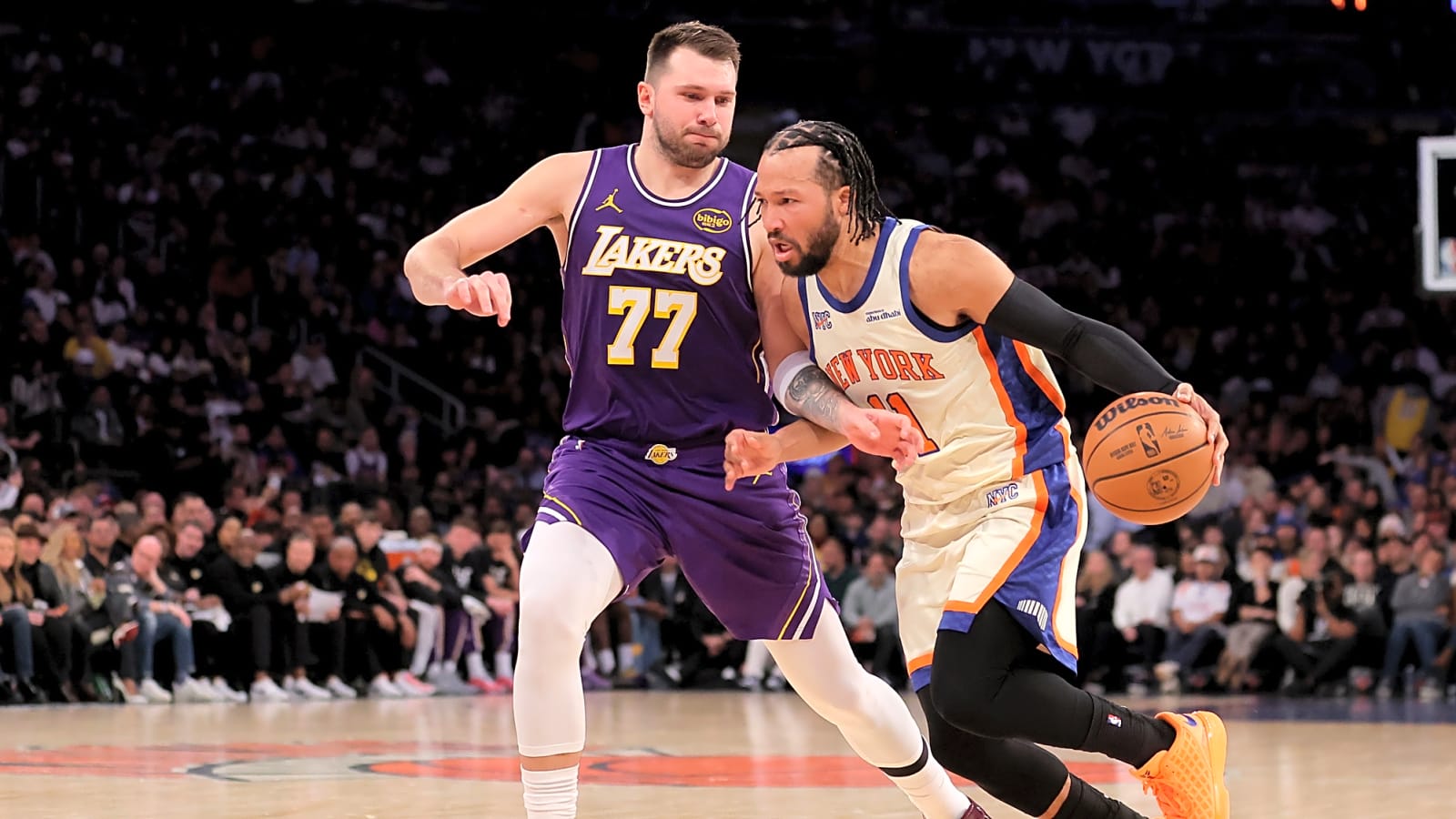
The New York Knicks are back!
Following a stretch so disappointing that it felt as if the team was a loss or two away from someone losing their job, the Knicks have won six straight, with five of those six victories coming by double-digits.
The latest of those was a 112-100 triumph over the Los Angeles Lakers in a nationally televised duel between two of the league’s most popular franchises, marking the first-ever edition of NBC’s “Sunday Night Basketball.” In a spot where Knicks fans had become accustomed to being embarrassed by LeBron James and/or the Lakers, this red-hot New York squad defended homecourt in emphatic fashion.
Like most of their recent victories, the defense took center stage in New York’s win over Los Angeles. The Knicks held the Lakers to just 67 points over the final three quarters as they methodically marched their way out of a six-point deficit at the end of the first quarter.
It’s the fifth time in the last six games that the Knicks held an opponent to 100 points or less, a remarkable achievement in a modern NBA where the league-average team scores 115.6 points per game. Since the start of their winning streak, the Knicks own the league’s best defensive rating (95.2).
While the defensive turnaround is the well-deserved headliner of the Knicks’ surge, it should not distract from the meaningful strides that are taking place on offense.
The Knicks also have the NBA’s second-best offensive rating during their six-game win streak (119.5), trailing the Clippers by a measly 0.1. New York’s offensive efficiency has certainly contributed to the defensive success, as it allows the defense to spend more possessions settled into half-court sets after makes.
It’s not as if the Knicks’ recent offensive production is merely the product of a hot shooting streak, though. Noticeable changes have occurred in their offensive strategy—the type of changes that are certain to make basketball nerds proud.
Mike Brown and the Knicks have cracked the NBA’s math problem.
The Knicks are beating teams to death with a calculator
What are the most efficient shots in basketball?
Here’s your answer, according to NBA.com’s shot-tracking data for the 2025-26 season:
- Restricted area (0.666 FG% = 1.33 points per shot)
- Corner threes (0.384 FG% = 1.15 points per shot)
- Above-the-break threes (0.351 FG% = 1.05 points per shot)
- Paint, non-restricted area (0.445 FG% = 0.89 points per shot)
- Mid-range (0.416 FG% = 0.83 points per shot)
If the goal is to score as many points per possession as possible, every NBA offense should be hunting shots from one of two spots: the restricted area and the corners.
Nobody is doing this better than the Knicks right now.
Since the start of their winning streak, the Knicks rank second in the NBA in corner threes attempted per game (14.2) and fifth in restricted area FGA per game (28.3). Overall, they have attempted 47.6% of their field goals from either the restricted area or the corners, leading the NBA since Jan. 21.
This type of approach gives New York a significant advantage over 48 minutes. Simply put, they are out-“mathing” teams.
Whether they shoot well or not on a given night, the Knicks are taking flat-out better shots than the other team, which means they don’t have to shoot their best to generate more points than the opponent.
The Knicks have shot well recently, but not to a degree that is out of the ordinary. Since the start of their win streak, they rank eighth in three-point percentage on corner threes (44.6%) and ninth in field goal percentage in the restricted area (69.4%). These are excellent numbers, but not what you’d expect from a team that essentially has the No. 1 offense over this span.
Even in other parts of the court, the Knicks have not been unusually scorching over the last six games; they’re last in non-RA paint field goal percentage (29.7%), sixth on mid-range attempts (46.3%), and fifth on above-the-break threes (38.7%).
Despite an average ranking of 12th in field goal percentage across the five zones, the Knicks are scoring the second-most points per possession.
Why? Well, they’re taking great shots. So, their shooting execution is less important.
Taking a lot of great shots typically yields more points in the long run, regardless of whether the team excels at making them relative to league average. Even if the team is not the best at those great shots, an average “great shot” is still far better than an elite “bad shot.” Sometimes, even a bad “great shot” is better than an elite “bad shot.”
For the season, the Lakers are shooting a league-best 50.5% on non-RA paint field goal attempts. Meanwhile, the worst team in the NBA on restricted area field goal attempts, the 76ers, shoots 61.8%.
The more floaters you can turn into layups/dunks, the better.
The same goes for jumpers. Even the best mid-range shooting team this season, the Thunder (47.3%), generates fewer points per shot (0.946) than the 30th-ranked team in above-the-break threes, the Magic, whose 32.1% shooting equates to 0.963 points per shot.
Then, to take it one step further, the Timberwolves are the second-best team at above-the-break threes (37.1%), and yet, they still make those shots less frequently than the 19th-best team at corner threes, the Raptors (37.4%).
The more mid-rangers you convert to threes, the better, especially if you can get those threes out of the corners instead of above the break.
New York is spamming the best possible shots
Over their last six games, the Knicks are loading up on layups/dunks and corner threes, with nearly half of their field goal attempts coming from these spots.
This approach gives them a huge margin for error each night. They could have an average shooting night, but even so, they would still have a good chance of generating more points per shot than an opponent that replaces New York’s layups, dunks, and corner threes with floaters, mid-rangers, and above-the-break threes.
The Knicks were already doing a decent job at this before their winning streak. Through Jan. 20, they ranked 10th in the NBA with 40.7% of their field goal attempts coming from the restricted area or the corners.
However, they clearly had the potential to be much better, given the offensive firepower on the roster. For a team loaded with gifted attackers (Karl-Anthony Towns, Jalen Brunson) and laser-sharp corner shooters (OG Anunoby, Mikal Bridges), 10th was not good enough.
And Brown realized it. Since they hit rock bottom against the Mavericks, the Knicks have made a concerted effort to optimize their shot diet.
The primary difference for New York has been a substantial decrease in inefficient two-point shots. Before the win streak, the Knicks ranked 18th in the league with 26.5 non-restricted-area two-point attempts per game (this includes both paint shots and mid-range shots). During the win streak, they’ve cut that number down to 21.3, placing 28th, a decrease of over five attempts per game. In turn, this has led to an increase from 24.8 restricted area attempts per game (17th) to 28.3 (5th).
In a smaller change, the Knicks are also shifting their three-point barrage even more heavily to the corner. They were already first in the league with 12.3 corner threes per game before the win streak, but that number is up to 13.8 over the last six games. Meanwhile, they’ve cut their ATB three-point attempts down from 27.5 (15th) to 25.0 (would be 23rd for full season).
The Knicks are turning floaters and mid-rangers into layups and dunks, and they’re turning deep threes into short threes. That, my friends, is the bread-and-butter of 2026 NBA basketball.
Pumping up their restricted-area/corner-three FGA rate from 40.7% pre-win-streak to 47.6% over the last six games is no small feat for New York. Considering that the Knicks are averaging 90.7 field goal attempts per game this season, an increase of 6.9% equates to about 6.3 shots per game that the Knicks have converted from floaters/mid-rangers/ATB threes to layups/dunks/corner threes. There are a ton of extra points to be had within those added high-quality shots.
The impact is even greater when comparing the Knicks to their average opponent.
In 2025-26, the league-average team takes just 38.8% of their field goal attempts from the restricted area or the corners. At 47.6% over their winning streak, the Knicks are a whopping 8.8% above the league average. That represents about 7.9 field goal attempts across the league average of 89.3 field goal attempts per game.
Essentially, over their win streak, the Knicks are taking about eight more high-quality field goal attempts per game than the average NBA team. That makes a massive difference on the scoreboard over 48 minutes.
Sustainable progress
The Knicks’ offense has drastically improved in recent games, and the encouraging sign for fans is that the improvement has been achieved in a sustainable fashion.
It’s not as if the Knicks hit 50% of their threes over the last six games. They are shooting pretty well, but not to an unsustainable degree. The primary difference is that they have converted a ton of bad shots into good ones.
If they keep it up, this could be the NBA’s best offense for the remainder of the season. That’s how high the Knicks’ offensive ceiling is when their shot selection is optimal.
This is arguably the main storyline surrounding the Knicks’ winning streak. The defensive turnaround is a wonderful, promising development, but I regret to inform you that it is not sustainable.
The Knicks’ opponents are making 27.1% of their threes over the last six games. This isn’t going to hold up. New York has certainly made promising strides, and it is plausible that they could sustain a much better defense than they had pre-Nets blowout, but they will not consistently be this dominant.
The offense, though, can be precisely as dominant as it has been over this six-game win streak. That’s because the improvement is built entirely around a shift in philosophy, scheme, and tendency, rather than a blip of shooting luck.
The Knicks are playing smarter basketball offensively, and there’s no reason to think that should change anytime soon. After a dismal stretch, they looked within themselves and found the necessary tweaks to concoct a formula that produces maximum efficiency on a nightly basis—and the rest of the NBA should be terrified.
More must-reads:
- Knicks' Josh Hart slams absurd ticket prices ahead of Game 3 of NBA Finals against Spurs
- Celtics, Heat get opposite Giannis Antetokounmpo trade updates
- The 'Last 30-point NBA Finals game' quiz
Breaking News
Trending News




Customize Your Newsletter
 +
+




Get the latest news and rumors, customized to your favorite sports and teams. Emailed daily. Always free!
PRIVACY POLICY COOKIE POLICY CONTACT US
ABOUT YARDBARKER TERMS OF SERVICE


By using this site, you agree to our Terms of Service and Privacy Policy.
This site is for entertainment purposes only.
There is no gambling offered on this site.
Gambling Problem? Call 1-800-Gambler.
