
-

-


Follow Us
-

 On Facebook
 On Flipboard

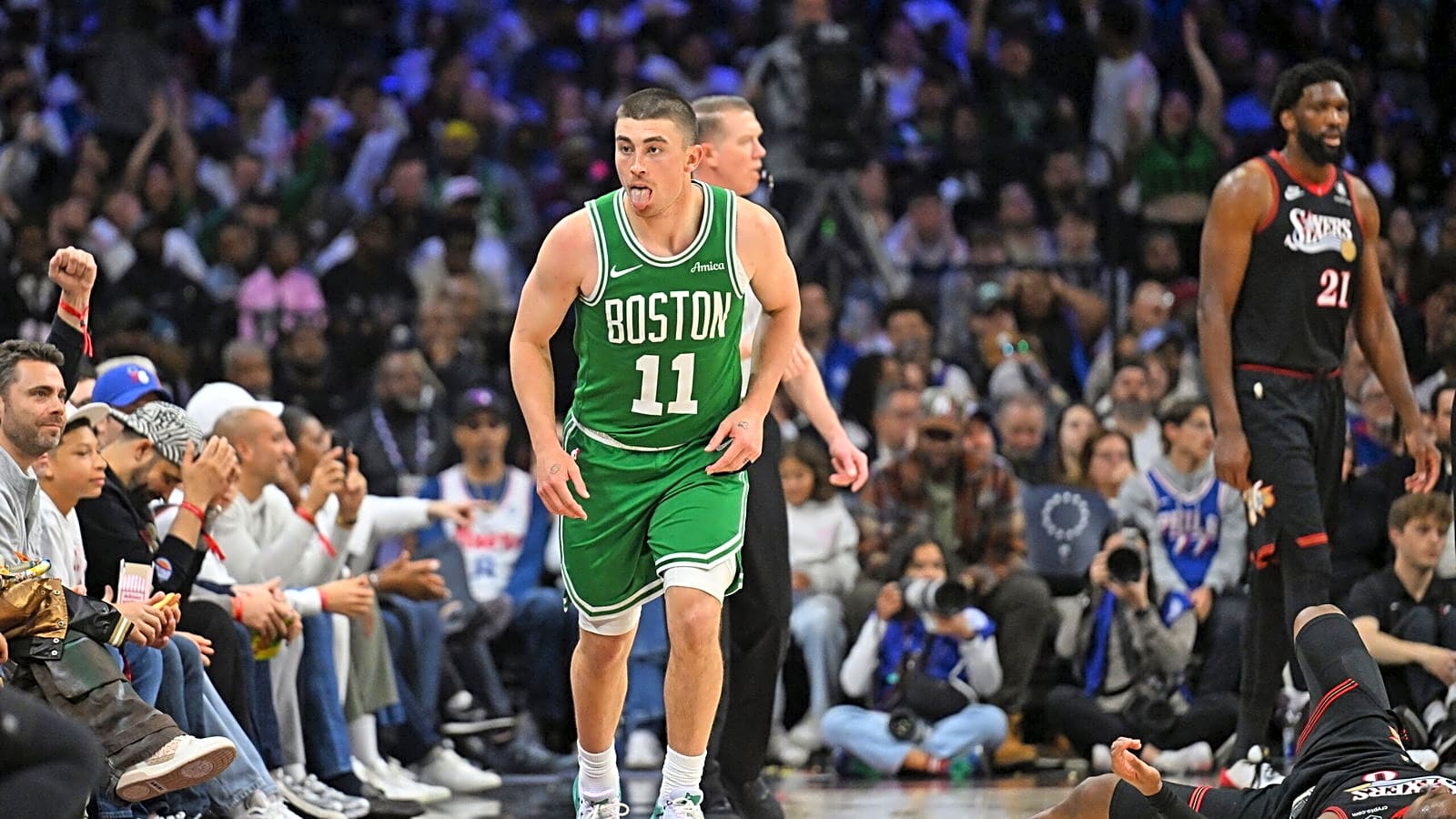
Payton Pritchard etched his name into Boston Celtics lore years ago with his 43-foot buzzer beater in Game 5 of the 2024 NBA Finals. He then became the fourth Celtic to ever win the Most Improved Player Award in 2025.
Celtics fans have watched Pritchard evolve from a bench spark plug into a key contributor over six hard-fought seasons. His shooting and relentless energy embody the playstyle fans have come to call “Mazzulla ball”.
Pritchard’s confidence is infectious. His production — especially as he completes season two of a four-year, $30 million bargain contract — only amplifies his value.
Any diminishing of said value takes a special kind of stubbornness. Still, there are those who question Pritchard’s impact as a reliable weapon come the postseason. But for those detractors, Games 3 and 4 of Boston’s first-round series against the Philadelphia 76ers should put that theory to bed.
Playoff Pritchard Has Arrived
Pritchard has spent much of his NBA career fighting an uphill battle for playoff minutes. Even in the 2024 Finals-clinching Game 5 — when he hit his iconic half-court buzzer beater — he played just 85 seconds. His playing time then fluctuated throughout the 2025 postseason as well.
This playoff run may have much more in store for Pritchard.
Celtics head coach Joe Mazzulla trusted Pritchard to play the entire fourth quarter of a tightly-contested Game 3. Although he didn’t stuff the stat sheet, he delivered when it mattered most. With 1:20 remaining in a two-point game and the shot clock winding down, Pritchard caught the ball with under three seconds to operate. He calmly pump-faked, sidestepped, and buried a three to give Boston a two-possession game. One Jayson Tatum dagger later, and the Celtics reclaimed a series lead.
HUGE SHOT BY PAYTON PRITCHARD
BOSTON UP 5. 1 MINUTE REMAINING IN G3! pic.twitter.com/5AFyaeWT8w
— NBA (@NBA) April 25, 2026

Pritchard carried that momentum into an explosive Game 4. He erupted for 32 points off the bench — the second-most points by a reserve in Celtics playoff history, only trailing Kevin McHale’s 34 in 1991, per NBC’s broadcast.
He made the most of his moment, letting the Philadelphia crowd and Hall of Famer Reggie Miller hear about it.
"That's my guy. We always have a friendly banter."
Payton Pritchard on looking at Reggie Miller after making big shots in tonight's Game 4 win
https://t.co/UPcY8rEvCl pic.twitter.com/e278rGkqpq
— NBA (@NBA) April 27, 2026
How Pritchard Became More Than a Pure Scorer
After five seasons of Pritchard building trust from his coaching staff, the Celtics opened the 2025-26 season with Pritchard as their starting point guard. While Anfernee Simons was a viable alternative, Mazzulla instead chose to expand Pritchard’s responsibilities.
The plan was likely always for him to return to a sixth man role once Jayson Tatum came back. So why make the change at all? Because with a retooled roster lacking continuity, Boston needed as many reliable decision-makers as possible to establish its offensive identity.
Everyone wants to talk about the Celtics’ three-point shooting as their most notable trait, which may be fair. Pritchard certainly contributes to Boston letting it fly, but his key contribution to the Celtics this season was his ability to get to the paint.
Pritchard averaged 11.9 drives per game during the regular season. It was good for more than double his previous career high (5.7 in 2024). He converted an efficient 56.1% of his driving shots, with a specialty in paint jumpers — not a common weapon in the NBA.
His efficiency inside the arc stems from his elite scoring attack in isolation. Among players with at least 100 isolation possessions, Pritchard ranked third in points per possession (1.11) and first in effective field goal percentage (58.6), according to NBA tracking data.
The Celtics, especially without Tatum for much of the season, needed someone other than Jaylen Brown to put pressure on the opponents’ paint. The 6-foot-1 guard may not be the player you’d first suspect to step up in that area, but expectations from others isn’t something Pritchard seems to put much stock into.
Beyond the scoring, his ability to organize the offense for a team that began the season without a traditional point guard was massive. For Mazzulla, who heavily emphasizes the importance of limiting turnovers, Pritchard was the man for the job. Not only did his 8.0 turnover rate rank in the 98th percentile among point guards, per Cleaning the Glass, but his pick-and-roll operation was a great help to centers Neemias Queta and Luka Garza get acclimated to their offensive roles.
Pritchard’s importance to Boston’s regular season success is immeasurable by any one number. For a team that lost its No. 1 offensive engine, its point guard, and several center options, Pritchard stepped up to improve life for himself, and the teammates around him.
The Real Test Begins
Pritchard was never on board with the “Gap Year” narrative. From the start, he made it clear — this team was competing for a championship.
Loved this quote from Payton Pritchard earlier when asked about getting his teammates to buy in:
"They shouldn't be in our locker room if they don't have that mindset. There's only one mindset in the city of Boston: you win championships here." pic.twitter.com/gm8B6QRvhi
— SleeperCeltics (@SleeperCeltics) September 29, 2025
That belief, paired with the composure of a six-year veteran whose confidence never wavered regardless of role, is exactly what this retooled Celtics roster has needed.
But for all the praise earned during the regular season and early rounds of the playoffs, the job is far from finished. The path only gets tougher from here.
Against bigger, more physical opponents, Pritchard’s ability to hold up will ultimately define how viable his size and skill set are in deep postseason runs.
Joe Mazzulla and the Celtics have trusted Pritchard all season. Now they have to lean into it.
More must-reads:
- Warriors finally get good news about LeBron James' free-agency sweepstakes
- Thunder rookie center Aday Mara has brutal Summer League debut
- The 'Most three-pointers by NBA team' quiz
Breaking News
Trending News


Customize Your Newsletter
 +
+




Get the latest news and rumors, customized to your favorite sports and teams. Emailed daily. Always free!
PRIVACY POLICY COOKIE POLICY CONTACT US
ABOUT YARDBARKER TERMS OF SERVICE


By using this site, you agree to our Terms of Service and Privacy Policy.
This site is for entertainment purposes only.
There is no gambling offered on this site.
Gambling Problem? Call 1-800-Gambler.
