
-

-


Follow Us
-

 On Facebook
 On Flipboard

The confetti from Round 1 hadn’t settled in Pittsburgh when Andrew Berry stepped to a microphone and said something that should have sounded reassuring. “He’s our bell cow,” the Browns GM said of Jerry Jeudy, his $52.5 million receiver. The phrase hung in the air like a promise. Except the Browns had just used the 24th pick on a wide receiver from Texas A&M. And they weren’t done shopping. Cleveland had another receiver circled on their board, and the second round was hours away.
The Extension That Started It All
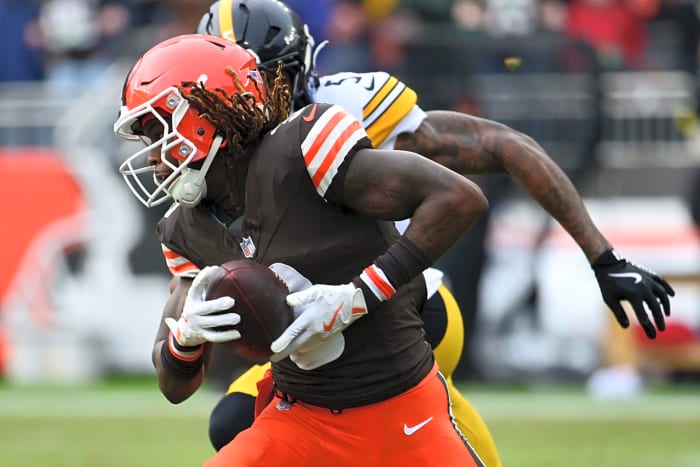
Jeudy earned that contract. In 2024, he posted 90 catches for 1,229 yards, a career high that made Cleveland’s front office feel brilliant. A three year, $52.5 million extension with $28 million in new guarantees followed. The Biletnikoff Award winner had finally arrived. But buried inside that breakout season sat a warning: 13 drops, among the most in the entire NFL. Nobody in the building wanted to talk about the hands. The yardage was too loud. The investment felt too right. That guaranteed money now looks less like conviction and more like a trap door.
The Cap Math Nobody Wants to Print

The extension’s structure matters as much as its headline number. Jeudy’s reported base salaries run $19 million in 2024, $16 million in 2025, roughly $13.49 million in 2026, and $17 million in 2027, with the first two years fully guaranteed at signing and $6 million of 2026 locked in as well. That means Cleveland is already past the point of a clean exit in 2026. A post June 1 trade or release becomes the only realistic escape, and even that leaves dead money on the books into 2027. The “bell cow” framing is not just rhetorical. It is a cap spreadsheet with no easy delete key.
The 2025 Collapse
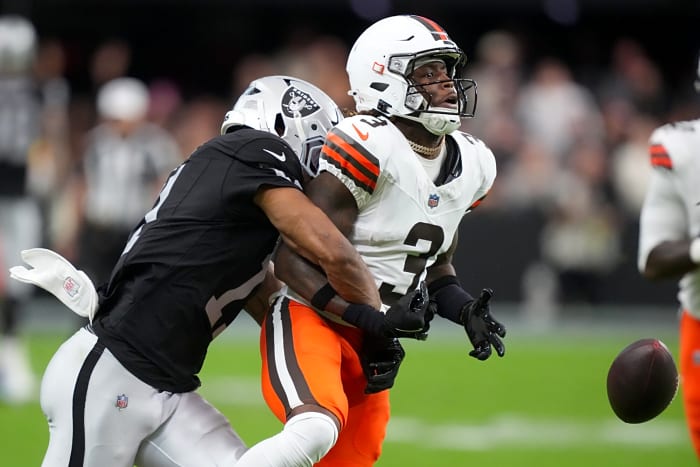
Those drops weren’t a fluke. In 2025, Jeudy caught 50 passes for 602 yards and two touchdowns on 106 targets. His catch rate cratered to roughly 47 percent, a bottom of the league mark among qualified receivers. He added more drops to his ledger, again ranking near the top of the NFL. Yards per target fell from about 8.5 to 5.7. Not a single Browns receiver reached 1,000 yards. The breakout season that justified the extension was starting to look like the outlier, and the regression like the baseline. The gap between the two seasons is stark in plain reading. Receptions fell from 90 to 50. Yards dropped from 1,229 to 602. Catch rate slid from about 62 percent to about 47 percent. Yards per target crashed from 8.5 to 5.7. Every core efficiency marker moved in the wrong direction at once.
Bell Cow, Meet Your Herd

On April 23, Berry selected KC Concepcion at No. 24 overall. The next night, Denzel Boston at No. 39. Two receivers. First 39 picks. For a team whose GM had just called its existing receiver “our bell cow.” Berry’s own explanation killed the metaphor in the same breath, saying, “With receiver rooms, you can have maybe a ball dominant player, or you can essentially build a basketball team with different skill sets. We prefer the second approach.” Bell cows don’t share the pasture. Basketball teams do. Berry said both things into the same microphone, on the same afternoon, and expected nobody to notice the contradiction.
What the Rookies Actually Fix
Concepcion posted 61 catches for 919 yards and 9 touchdowns in his final college season at Texas A&M. That single college year outproduced Jeudy’s entire 2025. Boston led Washington in receiving over his last two seasons and finished 2025 with strong contested catch production. Jeudy drops simple passes at crucial moments. Boston catches contested ones at a high clip. The Browns didn’t draft complementary pieces. They drafted the specific skills their $52.5 million receiver couldn’t provide, which is an organizational correction wearing a “depth” disguise.
The Numbers Behind the Spin

Cleveland allocated the bulk of its 2026 draft capital to offense, including two receivers, multiple offensive linemen, tight ends, and a running back. The class earned high consensus value grades among the NFL’s best. Berry didn’t just add talent around Jeudy. He rebuilt the entire offensive infrastructure. This draft wasn’t about protecting a bell cow. It was about protecting a second year quarterback named Shedeur Sanders, who Berry himself acknowledged remains a work in progress.
Spencer Fano and the Blindside Bet

The single largest capital outlay in this class was not a receiver. It was offensive tackle Spencer Fano, taken at No. 9 overall out of Utah. A top ten pick spent on a blindside protector is the clearest possible statement that the 2026 Browns are a pass offense first project. Fano’s job is to buy Sanders an extra beat. That extra beat is also what determines whether Jeudy sees coverage break down downfield, or whether Concepcion gets clean access on crossers. In a very literal sense, the left tackle pick is an investment in every other offensive pick the Browns made this weekend.
The Ripple Through the Roster

Two early receivers entering the depth chart means Jeudy’s target share drops from 2025 levels, and those levels already produced just 50 catches. If his production falls further, trade speculation will ignite mid season, and the remaining guarantees on his deal create a dead cap hit that makes moving him difficult before 2027. Meanwhile, the draft class leaned heavily toward offense. Berry bet the roster’s ceiling on that side of the ball. If Sanders stalls, every dollar of that offensive investment, Jeudy’s extension included, burns simultaneously.
The Precedent Nobody’s Discussing
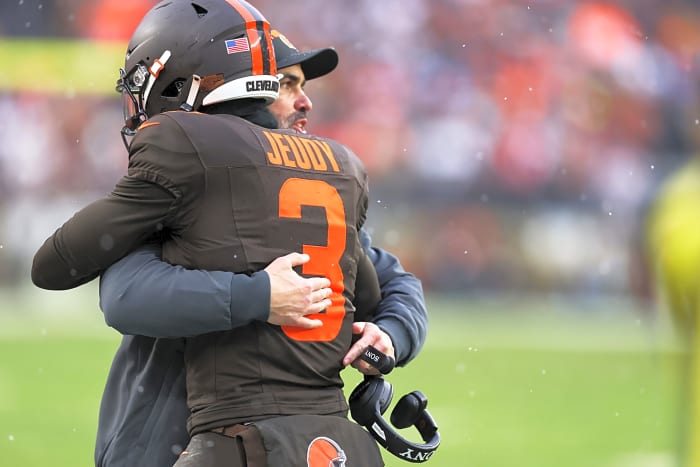
Berry’s willingness to draft around a freshly extended receiver rewrites the rules. Recent investment used to mean organizational commitment. Now it means nothing. Berry insisted the picks had “zero impact” on Jeudy’s status. But two first round grade picks at his position within roughly twelve months of his extension is the impact. Once you see the pattern, every GM reassurance sounds different. The “bell cow” label was never a vote of confidence. It was a retention strategy to prevent a trade request while the front office quietly built its replacement plan in plain sight.
The Quarterback Room Is Not Settled

The tidy narrative says Sanders is the anointed 2026 starter. Berry’s own comments say otherwise. At the league meetings in early April he kept the QB1 job openly competitive and declined to hand the role to any player on the current roster. Back in January he told reporters the incoming head coach would have a direct voice in the 2026 quarterback decision. As recently as this week, Berry reiterated the Browns’ commitment to an open quarterback competition. The receiver room was rebuilt for a quarterback who still has to win his own job. That is a very different bet than the one the “bell cow” quote implies.
The Clock on Jeudy’s Future

If Jeudy regresses again in 2026, the Browns face a brutal choice: absorb the dead cap hit or carry a declining receiver through 2027 on a contract that screams front office miscalculation. Other teams with aging receivers on fresh extensions are watching Cleveland closely. The Jeudy deal is becoming a league wide case study in extension timing. Every GM who signed a receiver off one breakout year just felt a chill. Concepcion and Boston haven’t played a snap yet, and they’ve already reshaped how front offices calculate receiver volatility.
The Trade Market That Could Open

Dead money aside, there is a functional trade window for Jeudy, and it is narrower than fans think. Contending teams lose receivers to injury every August, and a player with a 1,200 yard season on tape in the previous calendar year still carries value at the right price. The Browns’ leverage collapses once the season starts and Jeudy’s 2025 tape is the most recent data point in a buyer’s evaluation. Berry’s cleanest exit is before final cuts, not after Week 6. The “bell cow” language may also be read as a public floor on trade value, keeping outside offers from opening low.
What Beat Writers Are Watching in OTAs

Offseason practice reps are not usually newsworthy. This spring they are. Local beat coverage has flagged Jeudy’s hands work and route tempo as the single biggest on field story of the Browns’ offseason program. Concepcion’s slot versus outside alignment will reveal how Berry intends to stack the room. Boston’s red zone usage will signal whether the Browns see him as a contested catch specialist or a full route tree starter. None of these answers will come in a press conference. They will leak out of practice reports between now and training camp.
The Real Bet Berry Made

The person who determines whether Jeudy’s contract looks brilliant or catastrophic isn’t Jeudy. It’s Shedeur Sanders. The majority of Cleveland’s draft capital went to offense because the entire franchise is now built around whether a second year quarterback can develop. Jeudy’s role depends on Sanders’ accuracy. The rookies’ roles depend on Sanders’ reads. The offensive line investment depends on Sanders’ pocket presence. Berry didn’t draft a receiver room. He drafted a support system for a quarterback who hasn’t proven he deserves one, and Jeudy’s $52.5 million is along for the ride.
So tell us in the comments: is Jeudy still a Brown on opening day, or does Berry’s ‘bell cow’ quote age as the most obvious bluff of the 2026 offseason?
Sources:
Andrew Berry, Cleveland Browns executive vice president of football operations and general manager, press conference, April 25, 2026.
Cleveland Browns official team release, “Browns select WR KC Concepcion with the No. 24 pick in the 2026 NFL Draft,” April 23, 2026.
Over the Cap, Jerry Jeudy contract page, accessed April 2026.
ESPN, Jerry Jeudy 2025 game log and season statistics, Cleveland Browns, retrieved April 2026.
NFL.com, 2026 NFL Draft official results, Rounds 1 through 7, April 23 to 25, 2026.
Andrew Berry, Cleveland Browns pre-draft press conference, April 15, 2026.
More must-reads:
- Patriots QB Drake Maye breaks silence on Mike Vrabel amid Dianna Russini controversy
- How Steelers' Aaron Rodgers reportedly feels about unrestricted free agent tender
- The 'No.2-overall NFL Draft picks' quiz
Breaking News
Trending News




Customize Your Newsletter
 +
+




Get the latest news and rumors, customized to your favorite sports and teams. Emailed daily. Always free!
PRIVACY POLICY COOKIE POLICY CONTACT US
ABOUT YARDBARKER TERMS OF SERVICE


By using this site, you agree to our Terms of Service and Privacy Policy.
This site is for entertainment purposes only.
There is no gambling offered on this site.
Gambling Problem? Call 1-800-Gambler.
