
-

-


Follow Us
-

 On Facebook
 On Flipboard

Three days. That’s how long it took for Martin Emerson Jr. to go from Cleveland cornerback to New Orleans Saint. The 25-year-old, who started 33 games and logged 202 tackles across 50 appearances for the Browns, signed a one-year deal with the Saints on April 28, 2026. GM Andrew Berry closed the door on a reunion without a counteroffer. A third-round pick with four interceptions and 34 pass breakups, gone for nothing. And the secondary depth crisis that created is only the beginning of this story. Would you have matched the Saints’ offer?
The Regression Nobody Could Ignore
The Achilles tear in July 2025 gets the blame, but the collapse started earlier. Emerson’s PFF coverage grade fell from 72.5 as a rookie in 2022 to 47.9 by 2024, ranking him 194th out of 222 cornerbacks. That’s a 171-spot drop in three seasons. He allowed a passer rating of 100.5 when targeted, ranking 49th of 71 qualifying corners. The injury didn’t destroy his market alone. The performance decline had already gutted it. The torn Achilles just made the math official for every front office with a spreadsheet.
What Emerson Actually Looked Like On 2024 Tape
The grades tell one story. The film tells a harsher one. Emerson’s snaps skewed heavily to outside corner, where his lost half-step on comeback and hitch routes was most exposed. Yards-after-catch allowed climbed because his break on the ball arrived a beat late. Missed-tackle rate rose alongside the coverage issues, which is the tell for a corner playing with lower-body compensation before the Achilles actually tore. The 2024 film was already the warning label the 2025 injury simply underlined.
Your Browns Secondary, Stripped Bare

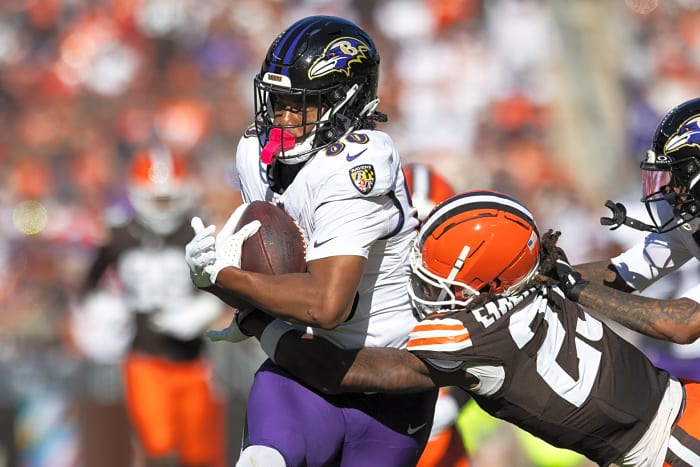
Cleveland now leans on Denzel Ward and Tyson Campbell, acquired from Jacksonville in the October 2025 Greg Newsome II trade, as starters, with second-year corners Myles Harden and Tre Avery filling the gap behind them. The Browns signed Myles Bryant, a 28-year-old undrafted free agent, as depth reinforcement. That’s the replacement for 33 NFL starts: an undrafted journeyman. Roughly 60 to 70 defensive snaps per game now fall to players with a fraction of Emerson’s experience. A defense that set the franchise sack record with 53 in 2025 could watch its pass rush mean nothing if receivers run free underneath.
New Orleans Bought Low on Desperation

The Saints lost Alontae Taylor to a deal reportedly worth nearly $20 million per year. Their replacement cost a fraction of that on a one-year prove-it contract. Mickey Loomis admitted the team hoped to draft a corner early but couldn’t make it work. Emerson visited on a Tuesday and signed the same afternoon. No bidding war. No leverage. The Saints treated this as a scouting experiment, not an investment. All downside risk shifted to the player. That gap between Taylor’s $20 million and Emerson’s minimum tells you everything about how the market values injury uncertainty.
Why The Saints’ Scheme Fits A Recovering Corner

Recovery speed matters less in zone-heavy systems than in press-man alignments, and that is precisely why New Orleans is a soft landing. Cover-3 and quarters looks ask a corner to read the quarterback, sink to a landmark, and break downhill on the ball. Those are reaction skills, not explosion skills. Emerson’s length and anticipation, the traits that produced 34 pass breakups in Cleveland, translate cleanly into that defensive language. A press-man team would have been asking a post-Achilles corner to pass a test his body cannot yet take.
The Newsome Exodus Pattern

Emerson’s departure doesn’t exist in isolation. Greg Newsome II, the Browns’ first-round pick in 2021, was traded to Jacksonville in October 2025 and signed with the New York Giants in March 2026. Two drafted cornerbacks, both gone. The 2023 Browns defense ranked among the NFL’s elite. By 2026, the secondary that supported that dominance has been gutted through trades and free agency departures. Elite defense was a team artifact, not individual mastery. And the Browns are learning that cornerback depth built through mid-round picks doesn’t survive a four-year cycle.
The Achilles Recovery Curve For NFL Corners
History sets the baseline. Corners who tear an Achilles in their twenties typically return at roughly 70 to 80 percent of prior production in year one, with a meaningful rebound in year two if they hold their roster spot. Cam Sutton, Terrance Mitchell, and a handful of others followed that same arc. The pattern explains why the Saints paid for one year and not three. They are buying the year-one discount with an option to walk before the year-two rebound gets expensive. Emerson is the test case for whether that template still holds in a repriced market.
The Contract-Year Trap
Here’s the mechanism connecting every ripple in this story. The NFL’s salary-cap structure creates a brutal timing penalty for young players. Emerson’s four-year rookie deal was worth $5.4 million total. He was heading into a contract year when the Achilles tore in July 2025. A healthy season could have reset his market to an estimated $8 to $12 million annually. Instead, one non-contact injury in July training camp erased potentially 70 to 85 percent of his earning power. Same position. Same league. Same player. The calendar turned, and millions vanished.
Cleveland’s Cap Picture Without Emerson
Walking away from a reunion isn’t a neutral accounting move. The Browns preserve roster flexibility heading into 2026 and carry that room toward a possible trade-deadline corner acquisition if Harden or Avery struggles in early-season coverage. Rollover cap from an unspent Emerson allocation becomes dry powder for a veteran rental. That is the quiet reason Berry did not counter. The money was never earmarked for Emerson. It was earmarked for whoever Cleveland needs in November, which is a different player at a different price.
He Will Bounce Back
Kevin Stefanski said it in July 2025, right after the injury: “He will bounce back. I know what he’s made of, and I know he’s got our support.” Nine months later, Andrew Berry let Emerson walk without a counteroffer. Insider Tony Grossi predicted the Browns would “re-sign him at their price,” calling Emerson’s passion and work ethic undeniable. That prediction died on a Tuesday afternoon in New Orleans. Coaching confidence was theater. The front office’s silence was the real evaluation. Which, honestly, tells you more about how NFL organizations actually work than any press conference ever will.
What The Agent Playbook Looks Like Now

The interesting part of a minimum deal is what gets buried in the incentive sheet. Post-Achilles contracts for starter-caliber corners now routinely include snap-count escalators, interception bonuses, and per-game active roster triggers, because those are the levers that protect the player’s 2027 market without costing the team guaranteed money. Void years at the back end preserve cap flexibility for New Orleans while letting Emerson’s camp argue a higher average annual value in the next negotiation. This contract is the template every injury-recovery corner’s agent will quote for the next two offseasons.
The Prove-It Economy Rewrites the Rules
Emerson’s signing sets a precedent that reaches beyond one player. Third-round cornerbacks entering their fourth year without All-Pro recognition should now expect one-year markets, not multi-year security, when regression and injury intersect. Agents will use this contract as a negative comparable in future negotiations. Teams that passed on corners in the 2026 draft pursued Emerson on minimum terms, confirming the draft class lacked secondary depth. The prove-it deal has become the default offering for injury-recovery talent. The risk transfers entirely to the player. The system rewards patience from teams and punishes bad luck from athletes.
Who Profits, Who Pays

The Saints save potentially $10 million or more compared to a multi-year guaranteed deal. If Emerson performs, they got a starter at clearance pricing. If he busts, they reset with clean cap space in 2027. The Browns freed a roster spot but now face midseason pressure on Berry to trade for veteran corner depth if the secondary struggles early. Emerson carries the heaviest burden: one setback, one bad hamstring, one slow step, and his 2026 market window closes permanently. He’s 25 years old, and his entire career now fits inside a single season.
The Cascade Keeps Breaking

If Emerson thrives in New Orleans with a PFF grade above 65, the Browns face a brutal narrative: they let a recovered starter walk for nothing. If he fails, the Saints draft another corner in 2027, repeating the same cycle of free-agent patching. Other injury-recovery cornerbacks entering 2027 free agency already lost leverage because Emerson’s deal set the floor. Meanwhile, Cleveland could integrate second-round safety Emmanuel McNeil-Warren into coverage schemes to mask the corner gap. One torn Achilles in July 2025. Two franchises restructuring around it. An entire position market repriced. And the ripples aren’t close to finished.
Browns fans, was Berry right to let him walk, or did Cleveland just hand a division rival’s scout team a starter for pennies? Tell us in the comments.
Sources:
New Orleans Saints, “Anfernee Jennings, Martin Emerson Jr. sign with Saints,” April 27, 2026.
Saints Wire (USA Today), “Saints sign former Browns starting corner Martin Emerson after visit,” April 28, 2026.
Over the Cap, “Martin Emerson Contract Details,” accessed April 2026.
The Athletic, “Browns CB Martin Emerson suffers left Achilles injury, will miss 2025 season,” July 29, 2025.
CBS Sports, “Cleveland Browns Transactions 2025-26,” accessed April 2026.
ESPN, “Saints 2026 free agency tracker: Offseason moves, signings,” updated March 10, 2026.
More must-reads:
- Patriots QB Drake Maye breaks silence on Mike Vrabel amid Dianna Russini controversy
- How Steelers' Aaron Rodgers reportedly feels about unrestricted free agent tender
- The 'No.2-overall NFL Draft picks' quiz
Breaking News
Trending News




Customize Your Newsletter
 +
+




Get the latest news and rumors, customized to your favorite sports and teams. Emailed daily. Always free!
PRIVACY POLICY COOKIE POLICY CONTACT US
ABOUT YARDBARKER TERMS OF SERVICE


By using this site, you agree to our Terms of Service and Privacy Policy.
This site is for entertainment purposes only.
There is no gambling offered on this site.
Gambling Problem? Call 1-800-Gambler.
