
-

-


Follow Us
-

 On Facebook
 On Flipboard

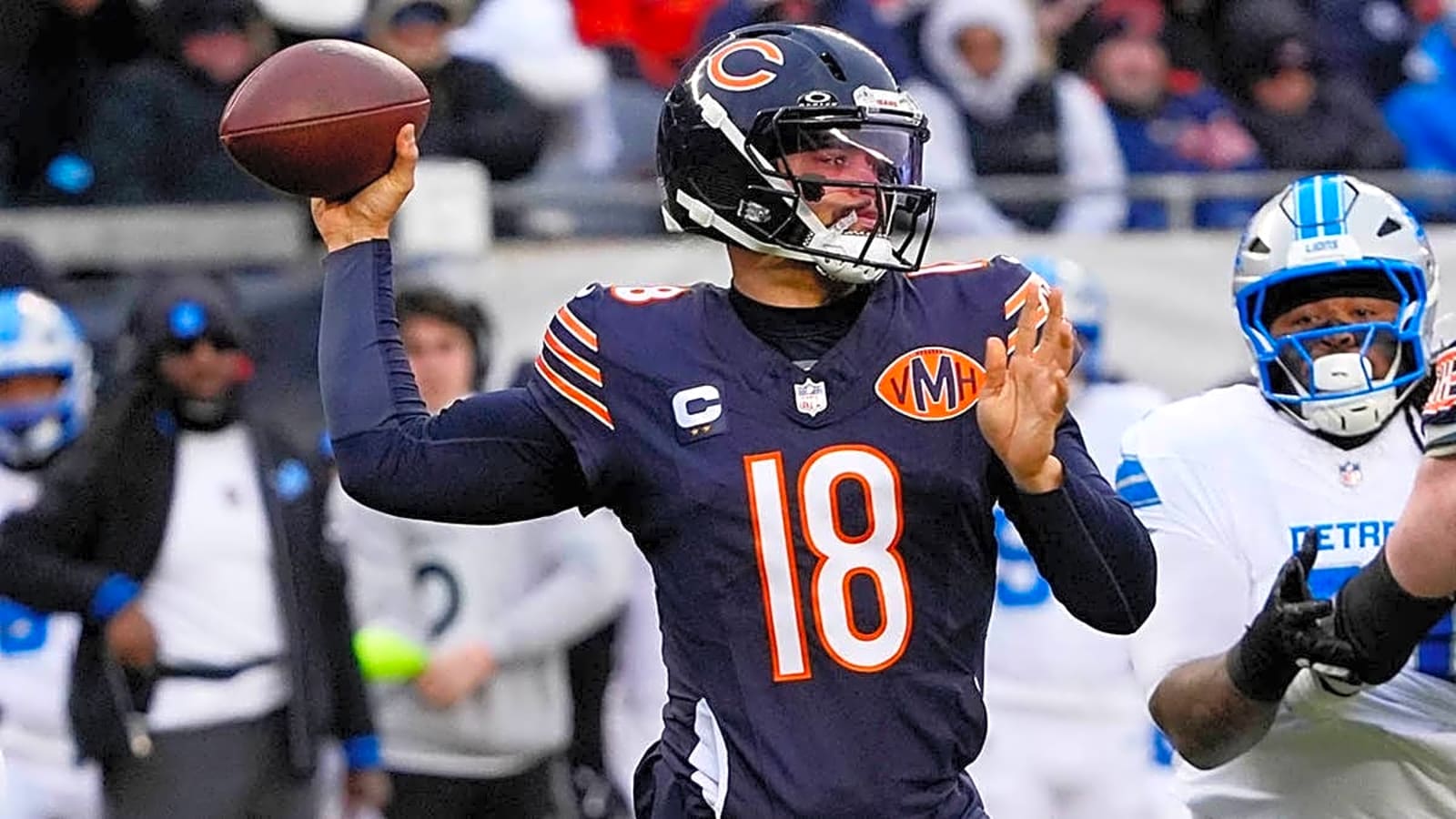
With all 32 NFL teams preparing for OTAs and mandatory minicamps, Athlon Sports is going under the hood to see what key questions remain for each team before training camps open in July. These questions might not get answered at minicamps, but any opportunity for new coaches to get familiar with their roster, rookies to get a feel for life in the NFL and free agents to get comfortable with a new team can be helpful.
The focus today is on the Chicago Bears. Despite uncertainty about the team’s plans for a new stadium, there is no uncertainty about the upward trajectory of the product they’re putting on the field. The Bears went 11-6 in 2025, winning the NFC North for the first time since 2018 and reaching the playioffs for just the fourth time since going to the Super Bowl in 2006. Rookie head coach Ben Johnson did exactly what he was hired to do: rejuvenate the offense and play a major role in the development of second-year quarterback Caleb Williams.
Staying on top in one of the best divisions in football won’t be easy, but the Bears clearly have a foundation on which to build.
3 biggest offseason questions for the Chicago Bears
How much better can Caleb Williams get?
After an inconsistent rookie season, the 2024 No. 1 overall pick showed great improvement under Johnson’s tutelage. In 2025, Williams completed 330 of 568 passes (58.1%) for 3,942 yards and 27 touchdown passes, with seven interceptions and a passer rating of 90.1.
While Williams acknowledges that he’d like to get his completion percentage higher, there’s no denying he made some ridiculous plays last season — like this unbelievable fourth-down TD pass that forced overtime in the divisional playoff loss to the Los Angeles Rams.
Symbolically, there is at least one more step for Williams to become the ultimate Chicago Bears QB. While his yardage total last season set a franchise record, the Bears are still the only team in NFL history that has never had a quarterback reach 4,000 yards or 30 touchdowns in a season. Williams came close last year, and he’s focused on improvement.
“It was good for me to be able to see, to be able to feel, to be able to go out there and win games,” he said. “But that wasn't my goal, that's not my goal. That's not where I want to be. I want to be the best. I want to win. I want to be, as we call it, a world champion, a Super Bowl champion. I want to be the best Bears quarterback, best quarterback. Yes, that was a good steppingstone for me, but that wasn't the last steppingstone. Being able to grow off of last year and be able to progress in ways that I want to. That last year wasn't really anything. It was a good year and we’ve got many more good years coming up.”
Is Chicago the next team to embrace three tight ends?
Rams head coach Sean McVay last season tinkered with an offensive formation featuring three tight ends, and he found it to be an effective scheme. The Bears had success last season with two tight ends, veteran Cole Kmet and first-round draft pick Colston Loveland — and then they drafted another TE, Stanford’s Sam Roush, in the third round this year. So is Johnson the next offensive guru to embrace three tight ends?
Johnson said Roush is a player he feels highly about. “He can contribute to the run game, pass protection, and catching down the field,” Johnson said. “We feel like we got one of the more complete tight ends that this draft had to offer. But in regard to big picture and just where the league is going, obviously teams have had success with the two tight end, three tight end sets. Things kind of always go full circle it seems like, and it wasn't that long ago that three receiver sets were kind of the norm, and now it seems to be transitioning over a little bit more. But I think the more you can look to attack the defense, whether it's you want to give them a base defense or you feel comfortable competing against them when they're in their sub defenses, the flexibility that tight ends give you, it adds a dimension to your offense.”
Fantasy managers won’t love the group effort, but Loveland and Kmet last season combined for 88 catches, 1,060 yards and eight TDs.
“I think it's the same as last year,” said Kmet. “I thought we did a lot of great stuff in 12 personnel (one RB, two TEs) within the run game and in the pass game as well. I thought Colston and I both made plays and obviously Colston really came alive there down the stretch, which is really cool to see as a third-down and red zone threat. He's going to have a chance to do a lot of special things his upcoming year.”
Can the Bears defense replicate the Seahawks’ success?
Chicago allowed 24.4 points per game last year, 23rd in scoring defense, so it’s a stretch to think the Bears can look like the 2025 Seattle Seahawks, whose defense led them to a Super Bowl. But, at least in the secondary, Chicago is following the Seattle model.
While the Bears lost two key defensive backs via free agency — safety Kevin Byard and cornerback Nahshon Wright accounted for 12 of the team’s 23 interceptions in ’25 — they signed Seahawks safety Coby Bryant and used a first-round pick (25th overall) on Oregon safety Dillon Thienaman.
Bryant worked well last season with Seattle rookie safety Nick Emmanwori, and the Bears have high hopes Thienaman can do some of the same things.
“He's very versatile,” Johnson said of Thienaman. “So, he can play down, he can play the post. Oregon played him as more the Tampa middle-read player quite a bit, which showcased his playmaking ability. He has a nose for the football. … I think the thing that you see is when the ball's in the air, he's got fantastic acceleration to get to that catch point. And then when he gets there, he arrives with some violent intentions.”
More must-reads:
- Browns' Myles Garrett linked with two NFC contenders as trade rumors grow louder
- 49ers get more bad news on 'untradable' Brandon Aiyuk
- The 'Men's French Open champions' quiz
Breaking News
Trending News





Customize Your Newsletter
 +
+




Get the latest news and rumors, customized to your favorite sports and teams. Emailed daily. Always free!
PRIVACY POLICY COOKIE POLICY CONTACT US
ABOUT YARDBARKER TERMS OF SERVICE


By using this site, you agree to our Terms of Service and Privacy Policy.
This site is for entertainment purposes only.
There is no gambling offered on this site.
Gambling Problem? Call 1-800-Gambler.
