
-

-


Follow Us
-

 On Facebook
 On Flipboard


The Pittsburgh Steelers have the utmost belief in second-year defensive lineman Derrick Harmon. The team used their 2025 first-round pick on Harmon, and they watched as he impressed as a rookie.
Entering his second season with the Steelers, the franchise expects even more out of Harmon. He figures to be a key part of the defensive line rotation alongside Cam Heyward, Keeanu Benton, Yahya Black and Sebastian Joseph-Day.
The key for Harmon, however, is avoiding the dreaded sophomore slump. To do so is quite simple, however. Harmon is already on the cusp of being an elite pass rush threat from the interior. In order to take the next step and avoid the fallback of year two, he has to become just as dangerous stopping the run.
Where Harmon Must Improve
As a rookie, Harmon proved his NCAA scouting report right. He was a force to block on passing downs, using his size and strength to easily maneuver around a one-on-one situation. He finished 2025 with 27 total tackles, 3.0 sacks and five quarterback hits. Despite missing five games, he displayed a game wrecking ability along the defensive line.
The more pressing issue for Harmon in year two is adjusting his technique in run downs. Contrary to the bully-like ability he has in obvious passing downs, Harmon struggled to excel against the run.
The biggest reason I could identify was pad level. The simple, time-tested piece of football mechanics rang true for Harmon as a rookie. He was often the high man in one-on-one situations, which made him much easier for the offensive line to block and displace. Part of the struggle was him adjusting to the NFL level of competition, while part of it was he defaulted to his pass-rush footwork and mechanics, which led to him being less productive in obvious run situations.
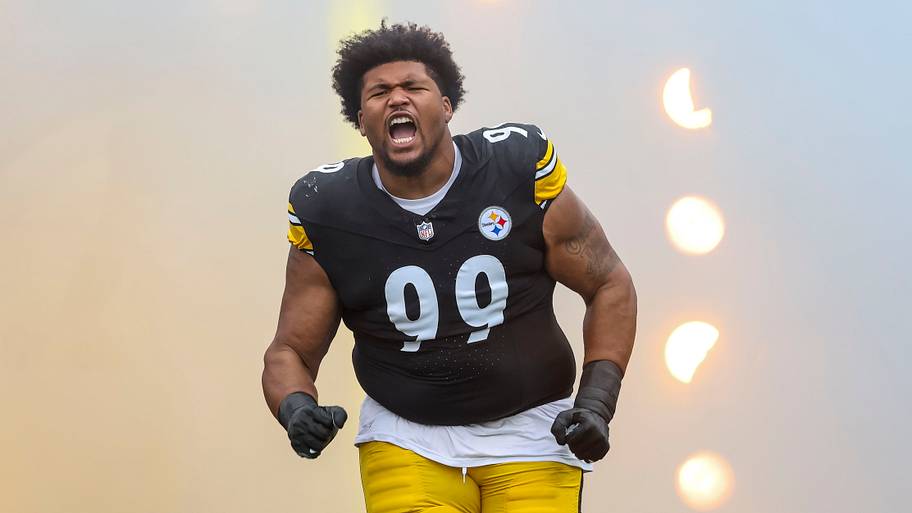
Harmon Ready to Dominate for Steelers in 2026
Like any rookie, Harmon entered the NFL with room to grow. Based off of how he's performed in training camp and in his two preseason apperances, he's clearly addressed his biggest need.
In two preseason contests, Harmon made just three total tackles, with only one comnig individually. But that doesn't paint an accurate picture.
The biggest improvement Harmon flashed against both the Green Bay Packers and New York Jets was flashing some stout run blocking. One specific play against the Jets was maybe the best piece of evidence for this case.
And that play came on the Steelers' first defensive series of that contest. The Jets ran some pre-snap motion before handing the ball off. The Jets' offensive line pulled to the left, the Steelers clogged things up two or three yards after the line of scrimmage, and before the tailback could cut back to the right, Harmon and company swallowed him up.
From start to finish, Harmon showed exactly what the team needed to see. His pad level was low, he shot quick hands, and kept his feet centered under him. He used his strength to keep his gap plugged and not be pushed back too far.
Then, as the play begins to shift back the other way, Harmon's heads up playstyle allows him to quickly react to what the ball-carrier was doing. He rips his right arm in a swim-move away from the pulling guard to free himself up and make the stop.
It was a play that defensive captain Cam Heyward makes time and time again. It's a play that now Harmon is prepared to make regularly.
And that's the key for Harmon. If he can bring that level of run-stuffing, he instantly becomes a well-rounded and complete interior defensive lineman. The Steelers already have plenty of those, and now the next potential All-Pro is ready to avoid the dreaded sophomore slump.
More must-reads:
- NFL teams preach family, then remind players it's a business
- Cowboys, Maxx Crosby connection gains new life
- The 'Most starts by an NFL QB' quiz
Breaking News
Trending News




Customize Your Newsletter
 +
+




Get the latest news and rumors, customized to your favorite sports and teams. Emailed daily. Always free!
PRIVACY POLICY COOKIE POLICY CONTACT US
ABOUT YARDBARKER TERMS OF SERVICE


By using this site, you agree to our Terms of Service and Privacy Policy.
This site is for entertainment purposes only.
There is no gambling offered on this site.
Gambling Problem? Call 1-800-Gambler.
