
-

-


Follow Us
-

 On Facebook
 On Flipboard
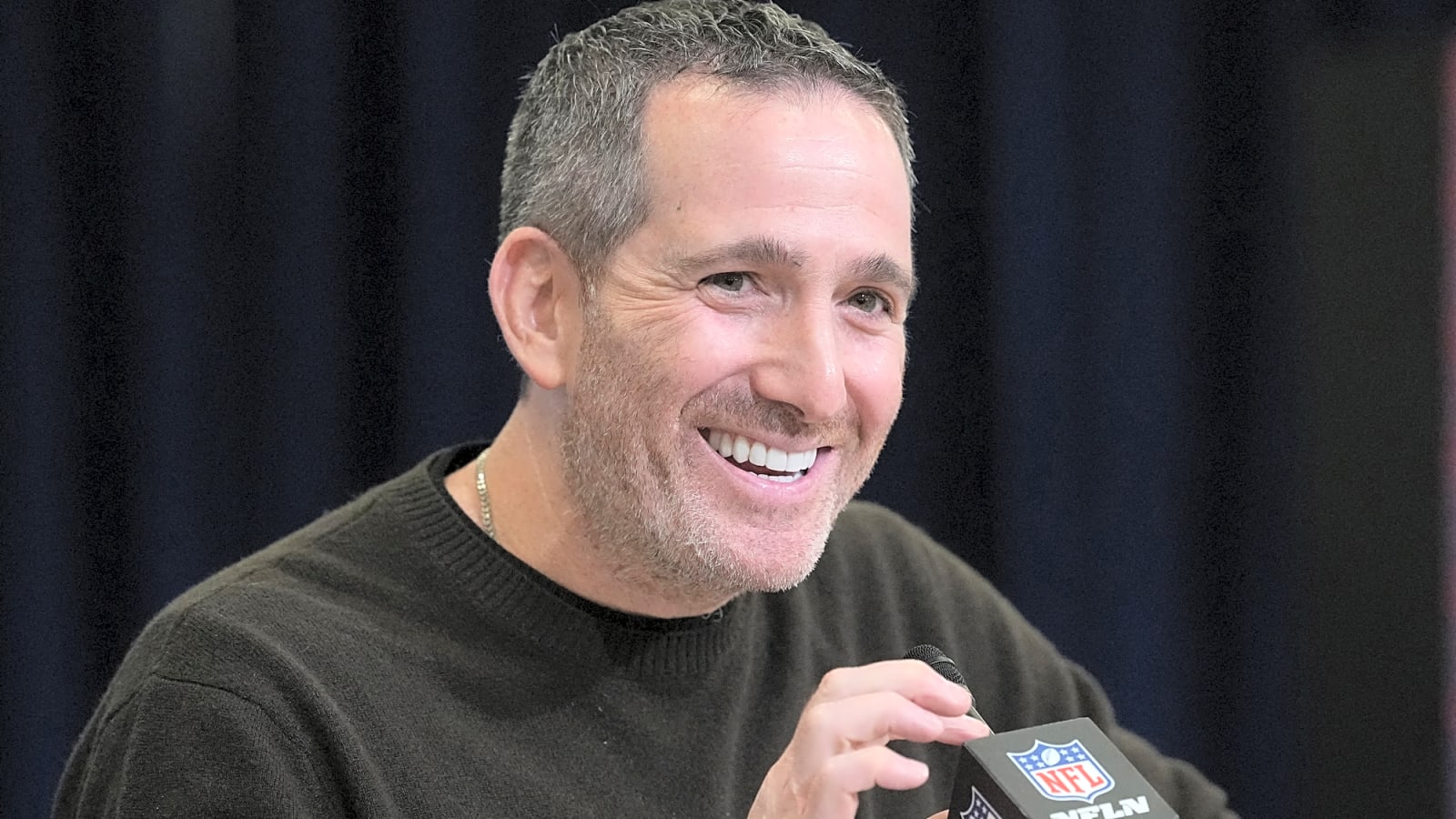
For most NFL teams, going 11-6 and winning a division title would constitute a successful season. Not the 2025 Eagles, who likely entered the year with designs on putting together a dynastic run. The team rolled to 14 regular-season wins in 2024 and then rampaged its way to four straight playoff victories, including blowouts against the Commanders in the NFC title game and the Chiefs in the Super Bowl.
Philadelphia trounced Washington and Kansas City by a combined 50 points, but the club could not maintain that extraordinary level of play last season. The Eagles’ offense was the main culprit. The unit fell off a cliff after losing Super Bowl-winning coordinator Kellen Moore to the Saints’ head coaching job and promoting pass-game coordinator Kevin Patullo as its new OC.
Patullo, close friends with Eagles head coach Nick Sirianni, oversaw a stark drop-off in production. The Eagles slid from second in rushing, seventh in points and eighth in yards to 18th, 19th and 24th in those categories.
Top receiver A.J. Brown wasn’t shy to voice his frustration with Patullo’s lifeless offense throughout the season. By Brown’s own admission, he and quarterback Jalen Hurts grew apart. Meanwhile, a banged-up offensive line was not the juggernaut it was the prior year, which partially explains why running back Saquon Barkley went from transcendent to decent. The 2024 version of Barkley was a 2,005-yard rusher who averaged 5.8 yards per carry and came in third in MVP voting. Last year, Barkley went for 1,140 yards on 4.1 YPC and was irrelevant in the MVP race.
When the playoffs rolled around in January, Philadelphia’s offense was unable to flip a switch and return to the form it showed a year earlier. The team was flat during a 23-19 home loss to the 49ers in the wild-card round. A slew of staff changes ensued, as we covered in depth in our Offseason Outlook in February.
Sirianni did not retain Patullo, whom the Eagles replaced with first-time OC Sean Mannion. A former NFL QB, the 34-year-old Mannion is already Sirianni’s fifth OC since he assumed the reins in 2021. With Mannion on the way in, offensive line coach/run-game coordinator/Eagles institution Jeff Stoutland stepped away after 13 years. Chris Kuper, previously the Vikings’ O-line coach from 2022-25, now has that gig in Philadelphia. Ryan Mahaffey, who followed Mannion from Green Bay, took over Stoutland’s run-game coordinator duties.
While the Eagles’ staff shakeup made waves early in the offseason, it pales in comparison to several headline-grabbing roster decisions general manager Howie Roseman executed over the past several months. Hoping to upgrade a team that fell from Super Bowl champion to one-game playoff participant, Roseman was heavily involved in the trade market. Roseman also made a decision on the mercurial Brown’s future and authorized pricey contract extensions for a few core players.
Trades:
- Dealt WR A.J. Brown to Patriots for 2028 first-round pick and 2027 fifth-rounder
- Acquired OLB Jonathan Greenard, No. 244 from Vikings for No. 98, 2027 third-rounder
- Acquired WR Dontayvion Wicks from Packers for No. 153, 2027 sixth-rounder
- Traded 2027 seventh-rounder to Panthers for QB Andy Dalton
- Sent S Sydney Brown, Nos. 122, 215 to Falcons for Nos. 114, 197
A.J. Brown‘s annoyance with the Eagles’ sluggish offense came to a head during a sideline spat with Sirianni in the wild-card round. That game went down as Brown’s last as an Eagle, ending an otherwise brilliant four-year Philadelphia term in crash-and-burn fashion. Brown, one of the greatest Eagles receivers ever (the greatest, if you ask him), caught just three of seven targets for 25 yards and dropped two passes.
After a year of grousing and passive aggressiveness from Brown, an offseason divorce looked inevitable. It was just a question of whether Roseman would find a trade offer to his liking before the draft. Roseman understandably held out a high asking price for the three-time All-Pro/Pro Bowler, but nobody was willing to meet his demands of a package built around first- and second-rounders.
When the dust settled on the draft in late April, Brown remained an Eagle. At that point, it became clear a trade would have to wait at least several more weeks.
Had Roseman dealt Brown before 4pm ET on June 1, the team would have absorbed $48.59MM in dead money and lost $20.12MM in cap space this season. Sure enough, a little after that deadline passed on the afternoon of June 1, the Brown trade — somehow overshadowed by an even bigger blockbuster (the Browns and Rams’ Myles Garrett swap) — became official. The Eagles still took a major financial hit, but spreading Brown’s dead money over two seasons ($21.8MM this year and $27.1MM in ’27) and freeing up $7MM in 2026 cap room was the more palatable outcome.
Brown reportedly identified the Patriots, Chargers, Bills and Chiefs as his preferred teams during the months-long process. It does not appear the Chargers, Bills or Chiefs aggressively pursued him, but the Rams made an offer that included a 2028 first-rounder. However, combining concerns over Brown’s degenerative knee condition with an inability to make a corresponding trade involving receiver Davante Adams, the Rams backed away.
With the Rams out of the picture, New England — already Brown’s long-anticipated destination — became the lone runner in the marathon. The Patriots had a WR1 vacancy after releasing Stefon Diggs, leaving room for Brown. It didn’t hurt that the 29-year-old Brown is a lifelong Pats fan who has a good rapport with head coach Mike Vrabel. Brown played his first three NFL seasons under Vrabel in Tennessee, where the wideout eclipsed 1,000 yards twice. He went on to reach the mark in all four years in Philadelphia, which sent first- and third-rounders to the Titans for him in 2022.
Roseman was unable to reel in a first-rounder in what is expected to be a loaded 2027 draft class in exchange for Brown. Instead, he agreed to acquire the Patriots’ 2028 first-rounder as the main piece of the return. Roseman declared afterward that “a first-round pick is a first-round pick. Doesn’t matter. Teams are still going to be playing football in 2028.”
DeVonta Smith, previously an elite sidekick, is now the lead dog in a remade Eagles receiving corps that waved goodbye to Brown and Jahan Dotson in the offseason. Although Dotson only caught 18 passes for 262 yards and a TD last season, the Falcons gave him a guaranteed $10MM on a two-year, $15MM pact.
A month after Dotson walked, the Eagles found a potential No. 3 WR replacement (if not a new No. 2) in Wicks. The Eagles didn’t give up an exorbitant amount in draft capital for Wicks, but with only one season of team control left at the time, they immediately handed the former Packer a one-year, $10.5MM extension. In typical Roseman fashion, he baked four void years into the agreement.
As a member of a crowded Packers receiving corps during his first three years in the pros, Wicks made 18 starts in 46 games. The 6-foot-1, 206-pounder notched modest production in Green Bay, where he averaged 40 catches, 491 yards and four TDs per 17 games, but the Eagles see untapped potential.
While it remains to be seen if Wicks will turn into a legitimate starter in a new setting, he has shown well in camp. It helps that he has familiarity with Mannion and Mahaffey, who were on the Packers’ staff from 2024-25. Mahaffey was Wicks’ position coach.
Rewinding to last November, the Eagles shipped a third-rounder to the Dolphins for Jaelan Phillips. The edge rusher fit in nicely during his two months in an Eagles uniform, though they acquired him knowing he could exit in free agency a few months later. The sides made progress toward an agreement on March 8, but when the legal negotiating window opened the next day, the Panthers outbid the Eagles on a four-year, $120MM offer. Out went Phillips, leaving a glaring hole in the Eagles’ pass-rushing contingent. The silver lining is that they are likely to receive a compensatory third-rounder in return next year.
While the Eagles were discussing a deal with Phillips, they had other irons in the fire at the position. Roseman was in talks with Vikings brass over Greenard, who wanted a raise on his $19MM salary. Trade discussions intensified after Phillips signed with the Panthers, as the Eagles and Greenard’s agent were already in extension negotiations by March 11.
It took over a month for a trade to cross the finish line, but the Eagles and Vikings finally settled things on Day 2 of the draft. Although the Vikings wanted a second-rounder for Greenard, they accepted two thirds instead. The Eagles, who beat out at least two teams for Greenard, ponied up on a four-year, $98MM extension and guaranteed him $50MM at the time of acquisition.
Greenard, a 2024 Pro Bowler who divided his first six years between Houston and Minnesota, has been terrific when healthy. He went into last year aiming for a third straight season of 12-plus sacks, but a shoulder injury limited him to a dozen games and required surgery.
Last year’s health problems continued a troubling trend for Greenard, who has only managed one full season (in 2024). The 29-year-old missed between two and nine games in his other five seasons, and he is once again shy of full strength as he begins life as an Eagle.
Greenard injured his pectoral while lifting weighs in July, forcing him to open camp on the active/PUP list. He still hasn’t returned two-plus weeks later. In the event Greenard remains on the shelf when the Eagles finalize their roster on Aug. 30, he will be ineligible for their first four regular-season games. If that happens, the onus will be on third-year edge defender Jalyx Hunt to continue ascending and fourth-year man Nolan Smith to bounce back from an underwhelming 2025.
In far less splashy offseason trades, the Eagles sent a late-rounder to Carolina for Dalton and cut ties with Sydney Brown in a pick swap with the Falcons. The well-traveled Dalton and once-hyped reserve Tanner McKee are competing for the No. 2 job behind Hurts. Neither has pulled away from the other so far. Unless the Eagles keep four passers, one of those two will be gone soon via trade or release. They are not going to cut fifth-rounder/developmental rookie Cole Payton, which could only leave one spot for Dalton or McKee.
Sydney Brown was a third-rounder in 2023, but he never started more than six games in a season with the Eagles. Although Brown worked as a core special-teamer throughout his time Philadelphia, the club decided to go in another direction ahead of the final season of his rookie contract.
Extensions and restructures:
- Reached four-year, $152MM extension ($40.85MM guaranteed) with DT Jalen Carter
- Signed OLB Jonathan Greenard to four-year, $98MM extension ($50MM guaranteed)
- Agreed to three-year, $78MM extension ($38.94MM guaranteed) with DT Jordan Davis
- Inked WR Dontayvion Wicks to one-year, $10.5MM extension ($9MM guaranteed)
- Removed 2028 from Landon Dickerson‘s contract; G owed $36MM through 2027
- K Jake Elliott accepted $1MM pay cut in exchange for $5MM guarantee
- DB Michael Carter II agreed to reduce salary from $10.25MM to $2.77MM ($1.45MM guaranteed)
Five defensive tackles have scored deals worth at least $24MM per year over the past several months. The Eagles doled out two of them, including a record-setting payday for Carter.
The Titans’ Jeffery Simmons took the lead at the position on a three-year, $105.8MM extension in late June. The next day, a report came out indicating the Eagles were hesitant to make a similar commitment to Carter. Whatever reluctance the Eagles may have had quickly dissipated. A little over a month later, they locked in Carter for the foreseeable future.
Now averaging $38MM per annum, Carter is No. 1 among interior D-linemen in that category. He also sits first in guarantees ($106.85MM).
The Eagles have now gone out on a limb twice for Carter, who joined the club as a high-risk, high-reward first-round pick in 2023. Philadelphia chose Carter ninth overall after moving up from No. 10, a pick they acquired in a trade with the Saints a year earlier. Based on talent, Carter was worthy of a top-10 selection. The 6-foot-3, 314-pounder was a force at Georgia, where he was an indispensable member of two straight national title-winning teams, but he came with legitimate character concerns.
On Jan. 15, 2023, three-plus months from the draft, Carter was involved in a fatal street-racing crash that killed former Georgia teammate Devin Willock and recruiting staffer Chandler LeCroy. While Carter avoided jail time or a prison sentence by pleading no contest to misdemeanor charges of reckless driving and racing, multiple teams removed him from their draft boards. The Eagles, known to have an affinity for SEC prospects and Georgia Bulldogs in particular, decided Carter was worth the risk.
Philadelphia’s draft gamble on Carter has obviously panned out. Otherwise, the team wouldn’t have picked up his $27.13MM fifth-year option for 2027 during the spring and followed it with an enormous extension.
At his best, Carter has been a game-wrecking monster. He finished second to the Texans’ Will Anderson Jr. in Defensive Rookie of the Year voting and ranked as Pro Football Focus’ fifth-best interior defender in 2023. Carter only started one game in his first season, but the Eagles elevated him to a full-time spot after Fletcher Cox retired. He responded with a second-team All-Pro regular season. Carter and the Eagles’ spectacular defense continued to shine in a playoff run that culminated in a Super Bowl title.
Like his team as a whole, Carter took steps backward last year. Carter’s season began inauspiciously when he was ejected after the Week 1 kickoff for spitting on Cowboys quarterback Dak Prescott. Beyond that, shoulder problems hampered Carter throughout the year. After missing only two games from 2024-25, he played in a career-low 11 and finished a lackluster 80th among PFF’s 127th qualified interior D-linemen. He checked in well behind his main linemates, Davis (No. 15) and Moro Ojomo (No. 28), in that category. Carter nonetheless earned his second straight original-ballot Pro Bowl nod, upping the value of his fifth-year option.
Pro Bowl honors aside, last season was probably the worst of Carter’s still-young career. Clearly unfazed, the Eagles are banking on a healthy version returning to his top-tier ways this year and over the long haul. After the extension came together, Roseman declared: “We don’t do anything based on retroactive performance; we’re doing things based on future performance.”
It took until the Eagles reported to camp to settle negotiations with Carter, but they concluded their business with Davis before the league year began in March. Davis, a Carter teammate at Georgia, came off the board 13th overall in 2022. The 6-6, 336-pounder made 18 tackles and came off the bench in eight of 13 games as a rookie, but his production and importance to the Eagles’ defense have increased dramatically since then.
A few months after the Eagles’ Super Bowl-winning season, Davis’ second straight 17-start campaign, they exercised his $12.94MM fifth-year option in April 2025. He responded with a third consecutive 17-start year and the best numbers of his career. While finishing sixth in run stop win rate, Davis set across-the-board personal highs in tackles (72, including nine for loss), QB hits (six) and pass deflections (six).
The Eagles saw superb defensive tackle Milton Williams leave in free agency in 2025. In danger of a repeat with Davis next offseason, they made him the highest-paid nose tackle in league history. He and Carter are on track to stay together for at least four more years, but the clock could be ticking on Ojomo. Unless the Eagles give out yet another huge raise along the D-line, Ojomo could cash in with another team in 2027.
On the other side of the line, there was talk of Dickerson retiring over the winter, though he debunked those rumors in early August. Without context, it would have been a shock for a high-caliber, well-compensated player to walk away from the sport at age 27. But injuries have dogged Dickerson dating to his time as a college lineman at Florida State (2016-18) and Alabama (2019-20). He has since undergone at least 13 surgeries, including a meniscus procedure in August 2025.
Dickerson rebounded from his latest surgery to start in all 15 appearances last season, upping the former second-rounder’s career total to 77 in 78 games. Dickerson’s three-year Pro Bowl streak ended, though, and he agreed to a notable contract alteration in March. Along with removing the 2028 season from the four-year, $84MM extension they gave Dickerson in ’24, the Eagles cut his 2026-27 pay from $39MM to $36MM. The team saved approximately $4.3MM in cap space in the transaction, though Dickerson will have a chance to make his lost $3MM back via incentives.
Elliott joined Dickerson and Michael Carter in accepting a more team-friendly arrangement. The amendment came on the heels of a second consecutive disappointing season for Elliott, a nine-year vet and one of the Eagles’ longest-tenured players. Elliott was a second-team All-Pro in 2023, but he has hit just 48 of 63 field goals (76%) since then. He only missed two regular-season extra points out of 90 in that two-year span, though he failed to convert a crucial PAT in the wild-card round. The Eagles do not have any other kickers on their roster, but they may have to scramble for one if Elliott’s 2024-25 struggles drag into game action this year.
Free agency additions:
- Riq Woolen, CB: One year, $12MM (fully guaranteed)
- Marquise Brown, WR: One year, $5MM (fully guaranteed)
- Arnold Ebiketie, OLB: One year, $4.3MM (fully guaranteed)
- Jonathan Jones, CB: One year, $2MM (fully guaranteed)
- Johnny Mundt, TE: One year, $1.5MM ($750K guaranteed)
- A.J. Epenesa, DE: One year, $1.4MM ($688K guaranteed)
- J.T. Gray, S: One year, $1.49MM ($350K guaranteed)
- Dameon Pierce, RB: One year, $1.29MM ($250K guaranteed)
- Chandler Martin, LB: Two years, $2.13MM
- Elijah Moore, WR: One year, $1.32MM
- Michael Jordan, G: One year, $1.22MM
- Erik Ezukanma, WR: One year, $1.15MM
- Samori Toure, WR: One year, $1.08MM
- Brandon Hayes, WR: One year, $885K
- Shaun Wade, CB: One year, $885K
The Eagles pursued former Saints cornerback Alontae Taylor when leaguewide negotiations commenced, but they lost that sweepstakes to the Titans. Tennessee authorized a three-year, $58MM deal with $42MM in guaranteed money for Taylor, leading Philadelphia to pivot to Woolen on a much shorter, far less expensive commitment.
It was an eye-opener that Woolen, PFR’s 14th-ranked free agent (Taylor was 12th), did not secure a multiyear payday. Even defensive coordinator Vic Fangio expressed surprise the Eagles landed Woolen on a one-year pact, but the venerable play caller is “thrilled” to pair him with first-team All-Pro Quinyon Mitchell.
One of the tallest corners in NFL history, the 6-foot-4 Woolen quickly became a fifth-round steal for Seahawks GM John Schneider. During his four years in Seattle, Woolen played in 64 of 68 games (53 starts) and pulled in 12 interceptions, including a league-high six as a rookie. He also deflected 53 passes, ranking in the 93rd percentile in that category (per PFF).
Despite a strong body of work, Woolen took a backseat to ex-Eagle Josh Jobe last year and became a trade candidate before the November deadline (Fangio indicated the Eagles had interest then). Schneider ultimately retained Woolen, who continued as a solid contributor and had a notable role on a Super Bowl-winning defense.
Although he made a career-low seven starts, Woolen registered the fourth-highest snap share among Seahawks defenders (72.82%). He helped cover for shutdown corner Devon Witherspoon, who missed five games with a knee injury. Woolen picked off just one pass, his first time with fewer than two in a season, but broke up a dozen and held opposing QBs to pitiful numbers (54.2 completion percentage, 75.5 passer rating) as the nearest defender on 72 targets. That’s typical for Woolen, who has yet to surrender a completion rate above 57.7% or a passer rating higher than 79.8 in a season.
If the Eagles get the usual version of Woolen, he will provide an easy upgrade over Adoree’ Jackson and Kelee Ringo, who combined for 13 starts in 2025. Nobody has signed the soon-to-be 31-year-old Jackson since he became a free agent in March. Meanwhile, thanks to the additions of Woolen and Jones (a 10-year vet with 78 career starts), Ringo has fallen down the depth chart and could be off the team soon. Mitchell, Woolen and Jones are on track to serve as the Eagles’ top boundary corners, leaving Ringo and fellow 2023 fourth-rounder Jakorian Bennett as trade candidates.
Ebiketie, a Penn State product, returned to Pennsylvania several weeks before the Greenard trade. The former Falcon entered the league as the 38th overall pick in 2022, though he never made more than six starts in a season with the club.
Ebiketie tallied 11 to 12 QB hits in each of his first three seasons, and he totaled six sacks in both 2023 and 2024. However, his playing time dropped in Jeff Ulbrich‘s first year as the Falcons’ D-coordinator in 2025.
After amassing a career-high 543 defensive snaps the previous season, Ebiketie was on the field for just 384 last year. He played his third straight full season but only managed six QB hits and two sacks along the way. While Ebiketie didn’t wow anyone with his counting stats, PFF rated his performance an impressive 27th among 119 qualified edge defenders. The outlet had Epenesa, another Eagles newcomer along the edge, at No. 86.
Like Ebiketie, Epenesa came into the league as a second-rounder (54th overall, 2020) who has mostly worked as a reserve. The ex-Bill has been fairly productive, having averaged 10 QB hits, 4.5 sacks, four PDs and an INT per 17 games, but his health became a question mark in the offseason.
Epenesa missed a grand total of one game in the previous two years, yet a $5MM free agency agreement with the Browns fell through over a failed physical. Two-plus months later, the Eagles picked up the 27-year-old at a bargain rate. If he isn’t contending with some sort of career-altering health issue, Epenesa’s track record suggests he will give the Eagles credible depth.
Of all the free agents the Eagles brought in on offense, Marquise Brown may have the best shot to carve out a significant role. The seven-year veteran was a full-time starter with the Ravens and Cardinals through 2023, but after signing with the Chiefs in 2024, he missed 15 games with a shoulder injury.
Brown returned to play 16 games last year, though he made just six starts and finished third among Chiefs wideouts in offensive snap share (49.5%). To his credit, the 5-9, 180-pounder put up respectable numbers as a complementary wideout in K.C., where he caught 49 passes for 587 and five TDs.
Marquise Brown rolled into town when A.J. Brown was still on the Eagles’ roster. Wedged between the “Hollywood” signing and the trade with New England, the Eagles added to a crowded receiving corps in the first round of the draft (more on that below). But thanks to the late-spring blockbuster with the Patriots, Marquise Brown is arguably the most proven receiver the Eagles have behind Smith. With 371 catches and 33 scores on his resume, the 29-year-old should at least offer capable, reasonably priced insurance.
Re-signings:
- Braden Mann, P: Four years, $14MM ($7MM guaranteed)
- Dallas Goedert, TE: One year, $7MM (fully guaranteed)
- Fred Johnson, T: One year, $2.1MM ($800K guaranteed)
- Grant Calcaterra, TE: One year, $2MM ($700K guaranteed)
- Marcus Epps, S: One year, $1.55MM ($125K guaranteed)
On an offense that fell well short of expectations in 2025, Goedert did his part to keep the unit afloat. In Year 8 of his career, Goedert played just under 75% of offensive snaps and set personal highs in receptions (60) and TDs (11, a franchise record for his position). The career-long Eagle now sits fifth in franchise history in catches (409), tied for ninth in touchdowns (35) and 14th in receiving yards (4,676).
Combining Goedert’s history of quality production with the potential of taking on $20.49MM in dead money if they did not re-sign him, the Eagles prioritized keeping the 31-year-old. In order to avoid losing a key starter and taking on an unwanted cap hit, the Eagles persuaded Goedert to push back the void date on his contract on multiple occasions.
The extra negotiating time enabled the sides to reach an agreement on March 15, four days after free agency officially began. Although the Eagles drafted a potential heir apparent in the second round (more on that later), Goedert will remain their No. 1 TE for at least one more year.
The Jets spent a sixth-rounder on Mann in 2020, but he only made it through three seasons of his four-year rookie contract with them. Gang Green waived Mann in April 2023. The Steelers claimed Mann, though he was unable to make their roster that August. A couple of weeks after the Steelers cut ties, Mann joined the Eagles on a practice squad arrangement. The move paid off for team and player, as Mann quickly overtook Arryn Siposs for the Eagles’ punter job and has not relinquished it since.
Now the all-time franchise leader in yards per punt (49.5), Mann became one of the league’s highest-paid punters when he re-signed in March. The 28-year-old is tied for fourth in guarantees, tied for fifth in total value, and fifth in average annual salary at the position.
The cheapest deal on this list belongs to Epps, but he has a real chance to take over Reed Blankenship‘s vacated safety spot. While the Eagles will use slot maven Cooper DeJean as a safety in their base defense, that may only be around 25% of the time (give or take a couple percentage points). They will need a different defender to step up alongside Andrew Mukuba the rest of the way. That could be Epps, who filled in for an injured Mukuba at times in 2025 and is now competing against Carter for the job.
Epps first played in Philadelphia from 2019-22, where he worked as a full-time starter in the last of those seasons. A few weeks after the Eagles lost Super Bowl LVII to the Chiefs, Epps accepted the Raiders’ two-year, $12MM offer in free agency. While he was again a 17-game starter in the first year of the contract, a September 2024 ACL tear threw Epps’ career off course. He eventually made his way back to Philadelphia last August and wound up making four starts in 12 appearances.
The 30-year-old Epps has not pulled in an INT since 2021 or broken up a pass since 2023, but he carries far more safety experience than Carter. The former Jet, whom the Eagles acquired last October, has primarily functioned as a slot corner. Given DeJean’s presence, Carter looked like a potential cap casualty early in the winter. As mentioned above, though, he took a sizable pay cut in March. The Eagles then largely ignored safety in free agency and during the draft, setting up either Epps or Carter to team with with Mukuba when DeJean is in the slot.
Notable losses:
- Reed Blankenship, S
- Nakobe Dean, LB
- AJ Dillon, RB
- Jahan Dotson, WR
- Brandon Graham, DE (released)
- Kylen Granson, TE
- Sam Howell, QB
- Adoree’ Jackson, CB
- Azeez Ojulari, OLB
- Ogbonnia Okoronkwo, DE
- Jaelan Phillips, OLB
- Matt Pryor, G
- Za’Darius Smith, DE (released)
- Brett Toth, OL
- Joshua Uche, OLB
- Ben VanSumeren, FB
The Eagles made a pair substantial investments at inside linebacker in 2025, first re-upping Zack Baun on a three-year, $51MM pact and then trading up one spot in the draft to grab Jihaad Campbell at No. 31. Considering the valuable resources they poured into the position a year ago, expectations were that Dean would cash in elsewhere in the offseason. Sure enough, during Day 1 of the free agent negotiating period, Dean exited Philadelphia on a three-year, $36MM agreement with the Raiders.
While Dean was effective when healthy during his four-year stint with the Eagles, injuries were problematic from 2023-25. The Eagles, who grew accustomed to not having Dean in that span, are in good position to move on without him. Baun is one of the premier LBs in the game, and the Eagles are high on Campbell after his encouraging rookie performance. They also have nice depth in Jeremiah Trotter Jr., Smael Mondon and Chance Campbell.
The Eagles do not look as well off at safety, where they have bid adieu to a starter in back-to-back offseasons. A year after trading C.J. Gardner-Johnson to Houston in 2025, they lost Blankenship to the Texans in free agency. A 2022 UDFA from Middle Tennessee State, Blankenship improbably became a full-time starter in his second season and held the role for the rest of his time with the Eagles. After intercepting three passes and setting career highs in tackles (113) and PDs (11) in 2023, he hauled in a personal-best four INTs on a championship defense the next year.
Blankenship ranked as one of PFF’s top 30 safeties in each of his first three seasons, but he plummeted to 89th out of 91 qualifiers in a one-INT 2025 campaign. He nonetheless scored a generous raise to join a stacked defense in Houston, which awarded him a three-year, $24.75MM deal.
Graham, an Eagles legend who holds the franchise record for games played (215), rode off into the sunset after they blew out the Chiefs in Super Bowl LIX. It proved to be a short-lived retirement for Graham, who rejoined the Eagles last October.
While Graham only played 113 defensive snaps in nine games, he chipped in three sacks and contributed at both DE and DT. The 38-year-old has gone unsigned since the Eagles released him in a procedural move on June 2, though he has left the door open on playing a 17th season. Graham and the team have stayed in touch, which suggests he could be part of their pass-rushing rotation again this season.
Draft:
- Round 1, No. 20 (from Packers via Cowboys): Makai Lemon (WR, USC) (signed)
- Round 2, No. 54: Eli Stowers (TE, Vanderbilt) (signed)
- Round 3, No. 68 (from Jets): Markel Bell (T, Miami) (signed)
- Round 5, No. 178: Cole Payton (QB, North Dakota State) (signed)
- Round 6, No. 207 (from Texans via Rams, Titans and Eagles): Micah Morris (G, Georgia) (signed)
- Round 7, No. 244 (from Texans via Vikings): Cole Wisniewski (S, Texas Tech) (signed)
- Round 7, No. 251 (from Rams): Uar Bernard (DT, International Player Pathway) (signed)
- Round 7, No. 252 (from Rams): Keyshawn James-Newby (EDGE, New Mexico) (signed)
Despite already having the two Browns, Smith, Wicks, Moore and others in their WR corps, the Eagles traded up three spots (in a deal with the Cowboys, of all teams) and snagged Lemon 20th overall. The move-up blindsided the Steelers, who were on the phone with Lemon and were ready to take him at No. 21, and made it even more obvious A.J. Brown’s time in Philadelphia was running out.
In the 5-11, 192-pound Lemon, the Eagles added a prized prospect who was not supposed to drop into the 20s. Daniel Jeremiah of NFL.com ranked Lemon as the 12th-best player in the class, calling comparisons to Lions superstar Amon-Ra St. Brown “warranted,” while Dane Brugler of The Athletic had Lemon at 13th overall.
It came as a surprise when the Rams passed on Lemon at No. 13, but they were bent on drafting polarizing QB prospect Ty Simpson. With the Buccaneers on the clock at No. 15, the Steelers explored a trade to go up and get Lemon, but the Bucs wouldn’t budge. They stayed put and drafted pass rusher Rueben Bain Jr., whom they coveted, and then the Eagles pounced when Lemon was still there five picks later.
The Eagles may have gotten a steal in Lemon, but hamstring troubles have left the 2025 Biletnikoff Award winner behind schedule at the outset of his career. Lemon was unable to participate in mandatory minicamp in June, and though he recovered in time for training camp, he injured his hamstring again in early August. The USC product has not practiced since, nor did he play in the Eagles’ preseason opener against the Ravens on Saturday.
In the absences of Lemon (and Smith, who has also battled hamstring troubles), the likes of Moore and 2025 UDFA Darius Cooper have stepped up in camp and made legitimate arguments for roster spots. It’s nice to have that type of depth, but as the Eagles attempt to fill Brown’s giant void, it would be ideal to have the mega-talented Lemon healthy and ready to contribute as a rookie.
Not content to stop at Lemon, the Eagles went for another pass catcher in the second round. Best-case scenario: Stowers will follow Brent Celek, Zach Ertz and Goedert as a long-term solution at tight end.
A former backup quarterback at New Mexico State, Stowers transferred to Vanderbilt and transitioned to tight end. The 6-3, 239-pounder quickly took to his new position and continued to rise after transferring to Vanderbilt in 2024. Over two seasons and 25 games with the Commodores, Stowers caught 111 passes for for 1,407 yards and 11 scores. He was a two-time All-SEC performer, a unanimous All-American and a John Mackey Award winner during that stretch.
Following up his prolific Vanderbilt tenure, Stowers put on a show at the Combine in February. The 23-year-old set a tight end record with a 45.5-inch vertical jump, led this year’s class of TEs in the broad jump, and finished second to Kenyon Sadiq in the 40-yard dash (4.51) and 10-yard split. A couple months later, Stowers followed Sadiq (No. 16, Jets) as the second tight end off the board.
While the Eagles invested a premium pick in Stowers, they did so realizing his blocking is a question mark. Considering they also have Goedert, Mundt, Calcaterra and Cameron Latu in the mix, they can afford to break Stowers in slowly if they want.
Similarly, Philadelphia does not need to rush the mammoth Bell into action. The 6-9, 346-pounder was a two-year left tackle starter at Miami, but there is no hope of taking Jordan Mailata‘s job any time soon. Bell is also isn’t going to usurp right tackle from Eagles icon Lane Johnson this year, but they may have a vacancy there next season. Johnson said this month that this season — his 14th in the league — will “probably” be his last. While following Johnson’s Hall of Fame-caliber act will be an unenviable task, it could be Bell’s responsibility if he develops to the Eagles’ liking as a first-year swing tackle.
Other:
- Picked up OLB Nolan Smith‘s $13.75MM fifth-year option
- Promoted Parks Frazier from pass-game coordinator to QBs coach
- Assistant GM Alec Halaby stepped down
- Extended assistant GM Jon Ferrari and promoted VP of football ops and strategy Adam Berry to AGM
- Added former Jets GM Mike Maccagnan as personnel executive
- Lost senior VP/tertiary football executive Bryce Johnston to Falcons
- Hired Jerrod Johnson as senior offensive assistant/special projects for the head coach
- Signed eight UDFAs
Smith, another ex-Georgia Bulldog, followed Carter to Philadelphia in the same draft class. As the 30th overall pick, and as someone with no original-ballot Pro Bowl selections on his resume, Smith’s option for 2027 checks in on tier four of the four-level option hierarchy. If he stays healthy and comes anywhere near his potential, that will be a bargain for the Eagles. Whether Smith will actually do it is another matter, as he has gone through an up-and-down career thus far.
Smith played a limited defensive role as a rookie and missed five games with a torn triceps in 2025. The 25-year-old only mustered three sacks and one TFL, which let down a team that needed pass rushers to step up after Josh Sweat signed with Arizona.
Replacing Sweat would have been easier had the 2024 version of Smith shown up. That player recorded 6.5 sacks in 16 games and 10 starts during the regular season. He added another four sacks in the playoffs before succumbing to the triceps injury in the Super Bowl. It would be nice for the Eagles if the Smith from two years ago (or an even better model) shows up in 2026, especially with Greenard iffy for the start of the season. It would also help Smith, who could be in line for an extension if the light bulb goes back on this year.
As for the Eagles’ staff, despite hiring an outside OC, they opted for continuity with the promotion of Frazier to QBs coach. Mannion did not retain Scot Loeffler, who only lasted a year with the Eagles. Frazier and Sirianni have been together in multiple stops. When Sirianni was the Colts’ OC from 2018-20, Frazier was on their staff in various roles. They reunited in Philadelphia last year.
Top 10 cap charges for 2026:
- Jalen Hurts, QB: $31.97MM
- Lane Johnson, RT: $20.3MM
- Jordan Mailata, LT: $15.86MM
- DeVonta Smith, WR: $10.73MM
- Landon Dickerson, LG: $10.28MM
- Dallas Goedert, TE: $10.23MM
- Saquon Barkley, RB: $9.88MM
- Jalen Carter, DT: $9.21MM
- Zack Baun, LB: $7.64MM
- Jonathan Greenard, OLB: $6.28MM
The Eagles’ largest cap hit belongs to Hurts, whose Super Bowl LIX MVP honeymoon was fleeting. Along with earning a place in Brown’s doghouse last year, Hurts drew criticism from anonymous team sources for his gun-shy play. No longer having to walk on eggshells around Brown, Hurts could make a case for a raise if he meshes well with Mannion and a reworked receiving corps in 2026. The three-time Pro Bowler is still under contract through 2028, but he has no guaranteed money left after this year.
As part of a division whose second-place finisher stumbled to a 7-9-1 record, the Hurts-led Eagles coasted to an NFC East title last season. They are the favorites to take the crown for the third year in a row, but the rival Cowboys, Giants and Commanders each improved on paper over the past several months. As we saw last year, though, just winning the division isn’t enough for the Eagles. Even with Brown gone, they should have enough blue-chip talent to challenge NFC heavy hitters like the Rams, Seahawks and 49ers for the conference and return to Super Bowl contention.
More must-reads:
- Vikings lose Jamal Adams for season, putting his career in doubt
- Giants' John Harbaugh offers Odell Beckham Jr. update after preseason debut
- The '2008 Week 1 starting QBs' quiz
Breaking News
Trending News




Customize Your Newsletter
 +
+




Get the latest news and rumors, customized to your favorite sports and teams. Emailed daily. Always free!
PRIVACY POLICY COOKIE POLICY CONTACT US
ABOUT YARDBARKER TERMS OF SERVICE


By using this site, you agree to our Terms of Service and Privacy Policy.
This site is for entertainment purposes only.
There is no gambling offered on this site.
Gambling Problem? Call 1-800-Gambler.
