Yardbarker's best-of NFL positional series continues with linebackers. This does not cover pure pass-rushing threats -- we will get to them -- but rather true off-ball defenders who thrived as traditional inside and outside 'backers.
Scott W. Grau/Icon Sportswire
This is not a position where the 100-plus-year-old franchise has produced a host of dynamic options, but Dansby excelled as a playmaker during his three stints with the Cardinals. A 2004 second-round pick, Dansby played six seasons with the Cardinals before joining the Dolphins in free agency. He later returned in 2013, earning second-team All-Pro acclaim, and closed his career in the desert in 2017. The off-ball 'backer paired 15 interceptions with 33 sacks as a Cardinal, starting for the franchise's only Super Bowl team. Dansby snared a game-deciding Aaron Rodgers fumble in a wild-card shootout and scored five defensive TDs as a Cardinal.
Bob Verlin/Getty Images
The first draft choice in Falcons history, Nobis stormed to Defensive Rookie of the Year acclaim to start one of the best careers that has not brought Hall of Fame entry. Nobis earned a first-team All-Pro nod in 1967, a rather impressive feat considering it came during Dick Butkus' pre-injury heyday. Nobis finished his 11-year Falcons career with five Pro Bowl honors and two All-Pro distinctions -- the second a second-team accolade in 1968 -- but no playoff games. Nobis played during an era with Butkus, Ray Nitschke, and, after the 1970 merger, Willie Lanier roamed at middle linebacker. That made All-Pros tough to compile.
Aaron M. Sprecher/Icon Sportswire
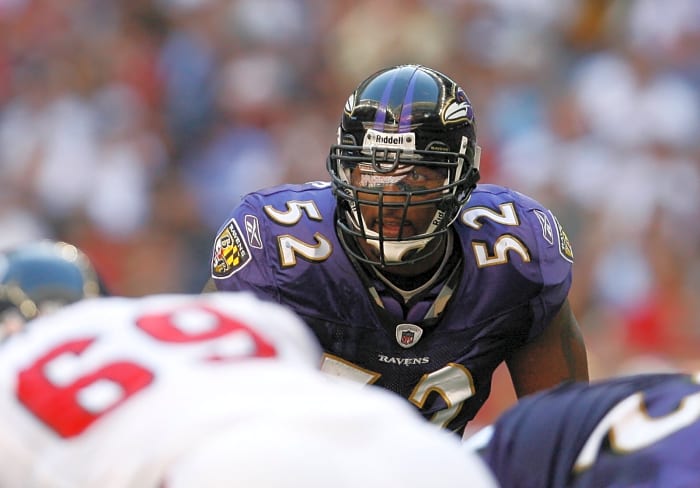
Butkus may have been the most feared off-ball linebacker in NFL history; Lewis sustained excellence for much longer. The 1996 first-round pick played 17 seasons, earning 10 All-Pro accolades (seven as a first-teamer). A 4-3 middle 'backer converted into a 3-4 inside presence, Lewis dominated for most of his career. He earned Defensive Player of the Year honors in 2000 and 2003. The initial honor came as the Miami alum anchored one of the greatest defenses in NFL history, and he punctuated the slate with a Super Bowl XXXV MVP honor. After a first-team All-Pro honor at 35, Lewis hung around until 37, when he joined Ed Reed in helping the Ravens make a goal-line stand to vanquish the 49ers in Super Bowl XLVII.
Bernstein Associates/Getty Images
The Bills ended up with the long-term prize of the 1987 Eric Dickerson three-team trade , which gave the Colts Dickerson and the Rams picks. Bennett, a Colts draftee who had not yet signed his rookie contract, went to Buffalo and played nine seasons. While he did display pass-rushing chops, the longtime Bruce Smith wingman was still a true linebacker more often than not. The outside 'backer reached five Pro Bowls and landed on the 1988 All-Pro first team. Bennett registered 52.5 sacks as a Bill and started 17 playoff games with the franchise, teaming with Smith and Darryl Talley as front-seven mainstays under Marv Levy.
Rich Graessle/Icon Sportswire
Checking all the boxes as an off-ball linebacker, Kuechly is the most accomplished player in Panthers history. He needed only eight years to achieve such status, and the 2012 first-round pick ended up a Hall of Famer on the second ballot. Breaking up a J.J. Watt string of Defensive Player of the Year honors by winning the award in 2013, Kuechly was at the center of a Carolina resurgence. The Panthers defense teamed with Cam Newton to produce four playoff berths from 2013-17, and Kuechly powered that unit to Super Bowl 50. Kuechly went 7-for-8 in All-Pro accolades (five first-team honors) but retired at 28 due to concussion concerns.
Denver Post/Getty Images
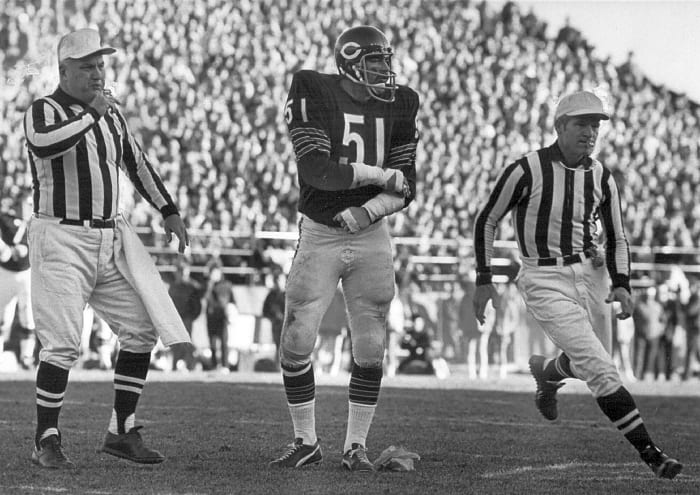
For inside linebacker peaks, this is the highest. Butkus played only nine NFL seasons (and no playoff games), yet he was named to two All-Decade teams. Terrorizing ballcarriers during his pre-injury period in the 1960s, Butkus remains one of the NFL's most legendary defenders. Chicago's spot here was the toughest race to win, as three other Bears LBs -- Bill George, Mike Singletary, Brian Urlacher -- are enshrined in Canton. Butkus was more than just a feared tackler, however. He displayed range, intercepting 22 passes, and was quite good at forcing fumbles as well. The other three Bears LBs played longer, but did not leave the legacies Butkus did.
George Gojkovich/Getty Images
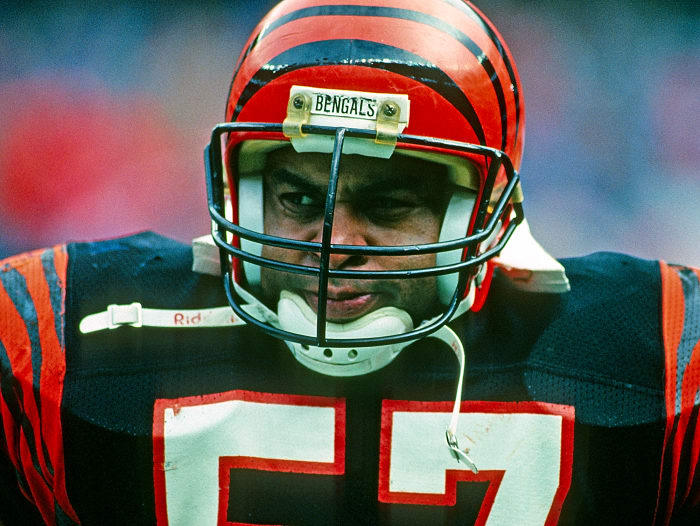
Williams represented connective tissue from the Bengals' Super Bowl XVI and XXII teams, playing 14 seasons -- all in Cincinnati. Excelling as a pass rusher from his outside linebacker position (63.5 sacks), Williams also recovered 23 fumbles -- including four during a nine-game 1982 season shortened by a players' strike -- and forced at least 17. The Bengals placed Williams as both an outside 'backer in 4-3 and 3-4 schemes. His 1988 was quite eventful, being elected a city councilman before registering a sack in each of the Bengals' three playoff games that season -- at age 34.
George Gojkovich/Getty Images
The Matthews brothers sure brought durability to the equation. Both Clay and Bruce played 19 NFL seasons . Clay, who entered the league five years before his Hall of Fame brother, played 16 of those years in Cleveland. Clay's 278 career games (during a career spent with the Browns and Falcons) are the most by any linebacker. He earned four Pro Bowls and was named to the 1984 All-Pro team. Playing outside linebacker in 4-3 and 3-4 schemes, Matthews is retroactively credited with 75 sacks as a Brown. Only Myles Garrett has more. The Cleveland mainstay also intercepted 15 passes with the Browns, including a game-sealing pick to stave off the Bills in the 1989 divisional round.
Ron Kuntz Collection/Getty Images
The Super Bowl V MVP in a losing effort -- the only such MVP in the game's 60-year history -- Howley was a Bears draftee who came out of an early retirement caused by a knee injury. After Howley missed the 1960 season, the Bears traded him to the Cowboys for second- and ninth-round picks. Howley played 13 seasons with the Cowboys; that stretch included a string of five straight first-team All-Pro seasons. That streak ended with Howley's MVP honor, but he helped Dallas to its first Super Bowl win a year later. A strong coverage LB, Howley worked as an outside 'backer in Tom Landry's 4-3 defense. He finished his career with 25 interceptions (six in 1968 and five in 1971).
Denver Post via Getty Images
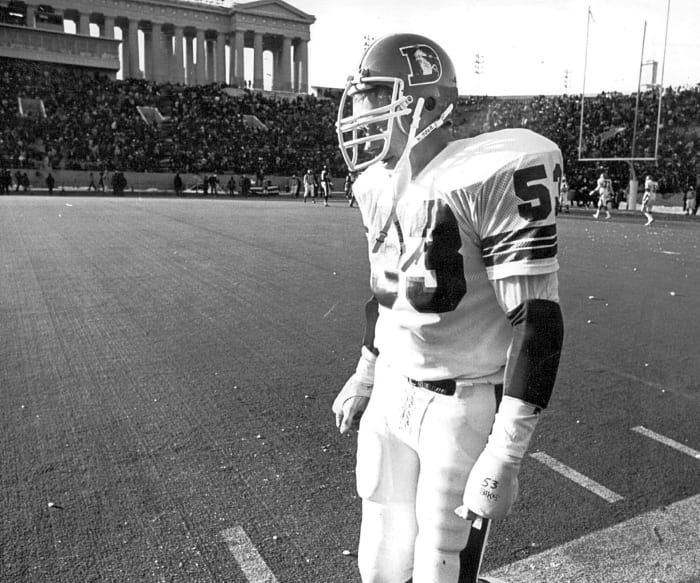
Von Miller is a pass rusher; Gradishar is Denver's best pure linebacker. Stationed in the middle of the Broncos' Orange Crush defense, Gradishar shone as one of the best inside linebackers in history. The 1974 first-round pick earned five All-Pro honors and claimed Defensive Player of the Year in 1978, the year the Steelers dynasty peaked. A tremendous coverage 'backer, Gradishar helped the Orange Crush topple the Steelers and Raiders in the 1977 playoffs to produce the Broncos' first Super Bowl berth. Among the most prolific tacklers in league annals, Gradishar also finished his career with 20 interceptions.
Bettmann/Getty Images
The Lions replaced the Rams as the Browns' top rival for NFL supremacy by 1952, and they won three championships in a six-season span. A 1953 seventh-round pick was a central figure in Detroit's surge, one that hinged on a host of future Hall of Famers. Schmidt became one of the middle linebacker position's forefathers, preceding the likes of Dick Butkus and Ray Nitschke as a Midwestern MLB mainstay. Schmidt soared to nine straight All-Pro accolades (eight first-team honors), intercepting 24 passes and finishing the 1955 season with a then-record eight fumble recoveries -- still the second-most ever by a defender. Of the midcentury Lion greats, Schmidt achieved the most.
Focus On Sport/Getty Images
Schmidt gobbled up first-team All-Pro honors at middle linebacker through Nitschke's fifth season, and Dick Butkus entered the league three years later. Nitschke finished as a first-team All-Pro just twice (three second-team selections) and made just one Pro Bowl. But he thrived in the middle of Phil Bengston's storied Packer defenses. The 1958 third-round pick -- one of many future icons Vince Lombardi inherited and molded upon arrival in 1959 -- did not become a full-time starter until 1962, but once in the lineup, the middle 'backer dominated. Nitschke finished his career with 24 INTs as part of five championship teams, hanging around 15 seasons.
Aaron M. Sprecher/Icon Sportswire
Ryans will probably be better remembered for his Houston coaching stay by his tenure's end, but he did stand out for a stretch as a Texans middle linebacker. Earning Defensive Rookie of the Year honors in 2006, Ryans quickly became one of the young franchise's top players. The Alabama alum became a second-team All-Pro in Year 2 and finished his six-year Houston stay (as a player) with two Pro Bowl invites. Ryans posted at least 13 tackles for loss in two seasons and returned from a season-ending injury in 2010 to start 16 games in 2011 -- the Texans' first playoff season. Houston traded him to Philadelphia in 2012.
Focus on Sport/Getty Images
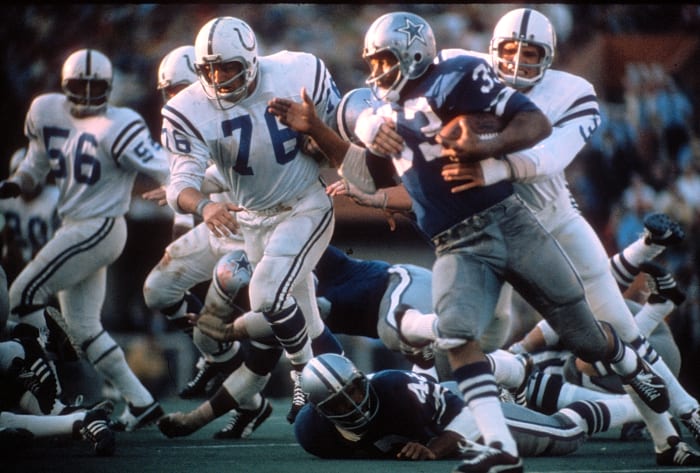
Had Ted Hendricks played his full career with the Colts, Curtis' Baltimore legacy would probably be different. But the future Hall of Famer parted ways with the then-AFC East team after his fourth season. Curtis, a converted fullback drafted in the 1965 first round, is the pick following an 11-year Colts career. The four-time Pro Bowler intercepted 25 career passes (21 as a Colt) and was one of the anchors for a dominant 1968 Baltimore defense that steamrolled its way to Super Bowl III. That team, of course, is better known for a loss than what it accomplished prior to that Miami day. Curtis went on to help the Colts to their first Super Bowl win two years later.
Chris Keane/Icon Sportswire
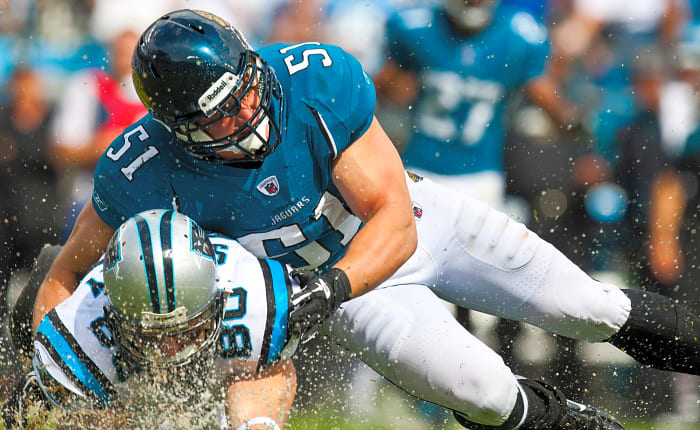
Toiling for a host of bad Jaguars teams, Posluszny finished his career on the 2017 "Sacksonville" squad that nearly booked a Super Bowl LII berth. The Jags signed the former Bills second-round pick to a six-year, $45 million deal in 2011. The Penn State product started seven seasons with the Jags, earning Pro Bowl acclaim in 2013 and tallying four 130-plus-tackle seasons. Posluszny intercepted 11 passes (most by a linebacker in team history) and registered 13 sacks as a Jaguar, finishing with 13 tackles for loss in 2015. A stalwart during a mostly down Jags era, Posluszny was a consistently productive player at both middle linebacker and outside LB.
Focus on Sport/Getty Images
Derrick Thomas was a pass rusher, but Bell would have been the pick regardless. An all-time athletic specimen, Bell thrived for a decorated Chiefs defense and was the first Chief enshrined in Canton. Kansas City could have used Bell as a terrorizing pass rusher, but instead, he dominated as an ahead-of-his-time playmaker at the OLB spot. Bell played 14 Chiefs seasons and managed a staggering nine touchdowns -- eight on defense, one via an onside-kick return. Not drafted until the 1963 seventh round, the Minnesota alum's highlights are highly recommended. Bell (26 INTs, 40 sacks) jumps off the screen even on a 1969 defense that produced six Hall of Famers.
17 of 32
Las Vegas/Oakland/Los Angeles Raiders: Ted Hendricks
Focus on Sport/Getty Images
It took Hendricks until his seventh season to make the move to Oakland, shining with the Colts before a one-year stop with the Packers in 1974. The historically disruptive player cost the Raiders two first-round picks under the free-agent system at the time, but Hendricks fit right in. The football savant was a three-time All-Pro as a Raider, playing nine seasons with the Silver and Black. Used as an outside linebacker in multiple schemes, Hendricks tallied 42 sacks and represented the only defensive connective tissue between the team's three Super Bowl wins (1976, 1980, 1983). The 6-foot-7 "Mad Stork" was also on Calais Campbell's level as a kick blocker.
Matt A. Brown/Icon Sportswire
A San Diego native, Seau was omnipresent for the Chargers throughout the 1990s. The 1992 Bolts are the only team to go from 0-4 to the playoffs, snapping a nine-year drought. San Diego then motored to its only Super Bowl two years later. Seau was the best player (by far) on both teams. Working primarily as an outside linebacker, Seau soared to nine All-Pro teams in 13 seasons as a Charger. He posted three seasons of at least 125 tackles and five sacks, finishing with 47 sacks with the Bolts. Certainly one of the greatest players of the 1990s, the front-seven force is on the short list for the greatest all-time Charger.
Nate Fine/Getty Images
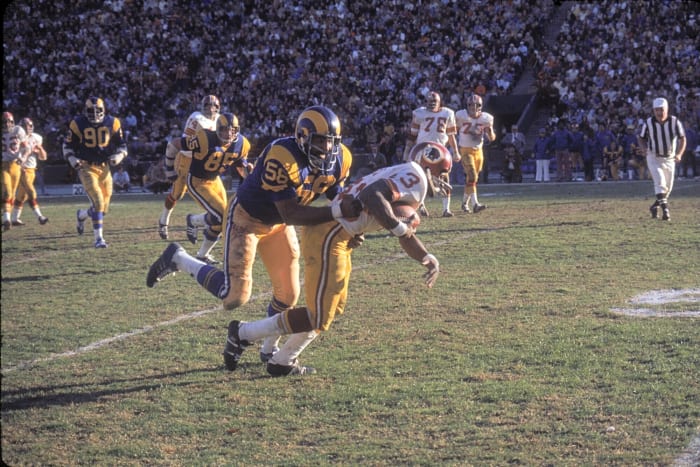
Breaking in with the Rams when their Fearsome Foursome defensive line was still in place, Robertson transitioned to working with the likes of Jack Youngblood and Fred Dryer. Robertson brought high-level athleticism and coverage chops to his OLB position. The 1971 Defensive Rookie of the Year made five straight All-Pro teams, helping Rams squads win five consecutive NFC West titles during a span marked by regular QB turnover. Intercepting 19 passes and returning four for TDs in eight Rams seasons, "Butch" is best known for a cross-field pick-six that buried Washington in the 1974 divisional round. The Rams traded Robertson to the Bills in 1979, reuniting him with Chuck Knox.
Kevin Reece/Icon Sportswire
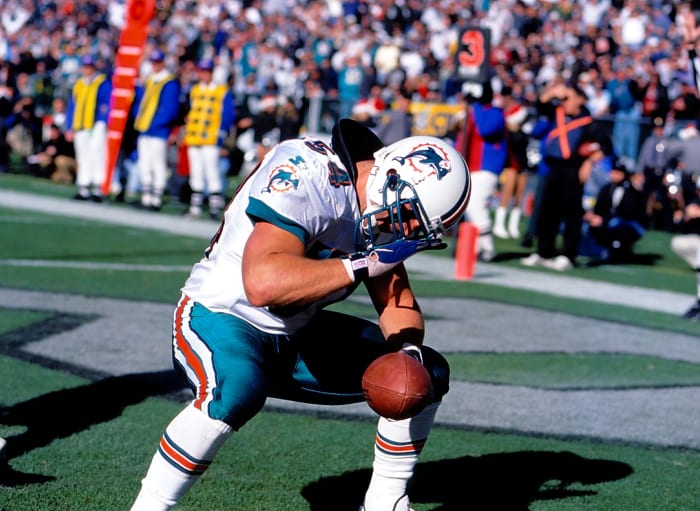
Only 5-foot-11, Thomas played much bigger and was a long-running Jason Taylor teammate for Dolphins teams that were playoff regulars late in Dan Marino's career and in the immediate aftermath of the all-time great's retirement. In the mold of an old-school middle linebacker, Thomas totaled six 150-tackle seasons and journeyed to seven All-Pro teams during a 12-year career in Miami. Playing his prime under Jimmy Johnson and Dave Wannstedt, Thomas started on five playoff teams. Since Thomas' rookie season, only three players (Ray Lewis, London Fletcher, Bobby Wagner) have more tackles than the Hall of Fame Dolphin's 1,734.
George Gojkovich/Getty Images
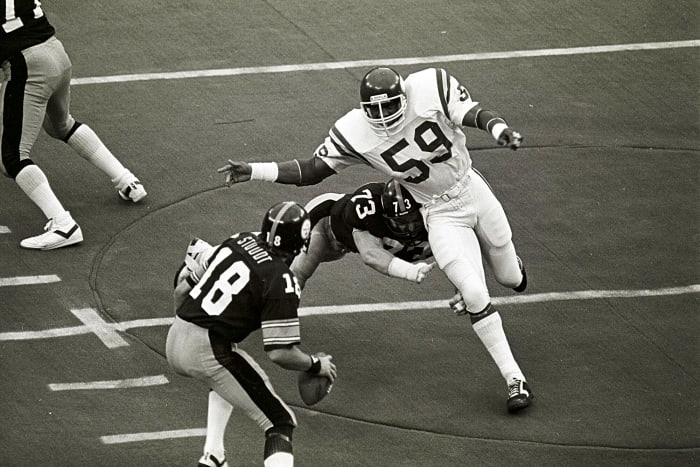
Blair caught the last years of the Purple People Eaters' defensive line and bridged the gap to the 1980s, anchoring some less-heralded Viking teams during Bud Grant's final seasons. Blair stood out as an outside linebacker, playing his entire 12-year career in Minnesota. The 1974 second-round pick earned six Pro Bowl invites (1977-82). Blair did start for the Super Bowl XI-bound 1976 Vikings, but did his best work over the ensuing several years. He retired with 16 INTs, 23 sacks, and 20 fumble recoveries. While forced-fumble data does not cover Blair's entire career, the 6-foot-5 defender is credited with 15 over his final eight seasons.
Focus on Sport/Getty Images
All due respect to Bill Belichick pieces Tedy Bruschi, Mike Vrabel and Dont'a Hightower, Buoniconti is in the Hall of Fame after doing his best work as a Patriot. Perhaps better remembered for his stay on Don Shula's legendary Dolphins teams and for his "Inside the NFL" contributions, Buoniconti started his career with the Patriots and earned four of his five first-team All-Pro honors with the franchise. Known then as the Boston Patriots, the AFL club received superb Buoniconti work; 24 of his 32 career INTs came as a Patriot. The middle 'backer is also retroactively credited with 18 sacks with the franchise. The Pats traded him to the Dolphins in 1969.
Stephen Dunn/Getty Images
Demario Davis' ageless run in New Orleans made this a debate; he simply never came off the field when the Saints were on defense. But Mills remains a towering presence in New Orleans, rising above a 5-foot-9 frame to be a leader on the best defenses in franchise history. The nerve center for the Saints' Dome Patrol linebacking corps that thrived in the late 1980s and early '90s, Mills was a key part of the franchise's Jim Mora-era uprising. The USFL refugee-turned-Hall of Famer started for four Saints playoff teams from 1987-92, earning All-Pro recognition in 1991 and '92. Mills forced 18 fumbles and recovered 17 as a Saint, remaining one of the most important players in franchise history.
Focus on Sport/Getty Images
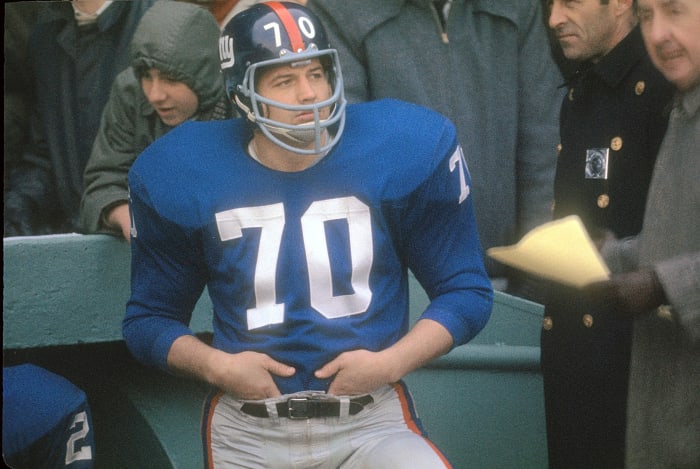
We will cover Lawrence Taylor when our series reaches the pass rushers, but Taylor was a linebacker in name only. He transcended the position; decades before LT modernized the rush linebacker role, Huff was a prototype middle linebacker. Originally a Tom Landry charge in an innovative 4-3 scheme, Huff was part of the storied Giants defenses that popularized presences on that side of the ball. The physical LB was also solid in coverage -- albeit in a run-oriented era -- and his arrival in the 1956 third round helped key a Giants turnaround that brought an NFL title and five more championship game appearances. New York's defensive downturn began with Huff's 1964 trade to Washington.
Frank Jansky/Icon Sportswire
A chunk of Grantham's prime came before the Jets existed, as he was an original New York Titan to start the AFL's 10-year run. Grantham lasted until 1972 with the Jets, playing only in New York during a career that included eight All-AFL honors. The last of those came in 1968, when the Jets reached their only Super Bowl (they made it count). Grantham intercepted 24 passes and is retroactively credited with 38.5 sacks, including 8.5 in a 1964 first-team All-AFL campaign. Much of Grantham's career was spent with unremarkable Jets teams, but he helped Joe Namath reach the sport's pinnacle during a brief Jets apex in the late 1960s.
Herb Scharfman/Sports Imagery/Getty Images
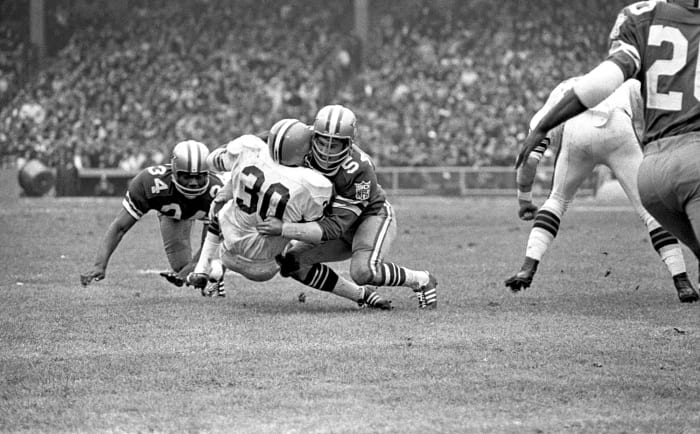
While it was best to avoid looking at Bednarik's broken finger during his interviews, "Concrete Charlie" is a celebrated NFL figure as the league's last true iron man. Although he was a center on offense, Bednarik is better known for his time as a linebacker with the Eagles. Playing each LB spot in Philly, Bednarik played all 14 seasons of his career with the team. He earned nine All-Pro honors (six first-team placements). Known more for ferocious tackling (as Frank Gifford could attest), Bednarik intercepted 20 passes as well. He also made a championship-clinching stop on Jim Taylor that sealed the Eagles' 1960 NFL title win over the Packers -- Vince Lombardi's only playoff loss as a head coach.
Focus on Sport/Getty Images
In this list's toughest call, Ham edges Jack Lambert. Lining up as an outside linebacker in Pittsburgh's 4-3 scheme, Ham became one of the greatest coverage LBs in NFL history. Playing behind the Steelers' Steel Curtain D-line certainly helped matters, but that front four aided Lambert considerably as well. Ham intercepted 32 passes during his 12-year career spent entirely in Pittsburgh and is retroactively credited with 25.5 sacks. Ham added five more INTs in the playoffs, including two against Ken Stabler in the 1974 AFC championship game. As a Hall of Famer on a team with several legends, the sound performer is among the more underrated greats in NFL history.
28 of 32
San Francisco 49ers: Patrick Willis
Tony Medina/Icon Sportswire
Perhaps no one on this list was as great as fast as Willis, who rocketed to the first-team All-Pro level as a rookie. Willis earned All-Pro acclaim, including five first-team selections, in each of his first six seasons. Playing only eight years, Willis still made the Hall of Fame. Although Willis' career was relatively short, the Ole Miss alum was the best player on each Jim Harbaugh-era 49ers team that reached the NFC championship round in the early 2010s. Reaching 20.5 sacks and 60 tackles for loss, Willis did just about everything well and gave the 49ers an instant defensive centerpiece. That mattered more when Harbaugh and Vic Fangio came to town in 2011.
Joe Nicholson-Imagn Images
Contemporaries Willis and Luke Kuechly may have been better, but Wagner has both beaten for enduring dominance. The longest-running member of Seattle's tone-setting unit that powered the team to back-to-back Super Bowls, Wagner reached an astonishing 11 straight All-Pro teams during his career. Two of those came away from Seattle, but the 2012 second-round pick was an 11-year Seahawk who ended up being the face of the Pete Carroll defense. Though the Legion of Boom received more credit, Wagner outlasted all of them by many years. The middle 'backer has eight 130-tackle seasons, including a career-best 183 at age 33, as a Seahawk. He is the best defender in franchise history.
Chris Livingston/Icon Sportswire
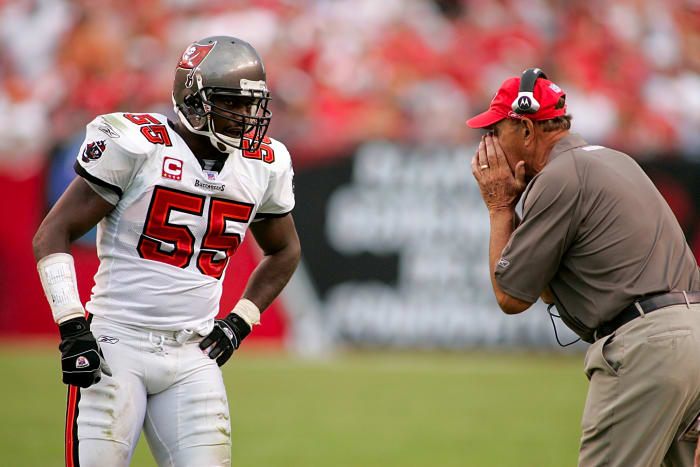
Lavonte David was a 14-year Buccaneers linebacker and one of his era's best; also a 14-year Buc, Brooks is one of the best linebackers in NFL history, and this space's greatest player in franchise annals . Brought in alongside fellow ACCer Warren Sapp in the 1995 first round, Brooks teamed with the gregarious D-tackle to forge a turnaround. The perennially lousy team rallied around Brooks to form a historically great defense. The nine-time All-Pro scored eight defensive TDs, including four in his Defensive Player of the Year 2002 season (which ended with a Brooks Super Bowl XXXVII pick-six). The OLB (27 career INTs) was the linchpin of Monte Kiffin's Tampa-2 defense.
Focus On Sport/Getty Images
Brazile made a steady impact during an Oilers reload in the 1970s. Working with fellow Hall of Fame defenders Elvin Bethea and Curley Culp on Earl Campbell-powered teams, the outside 'backer fared well as a rusher and in coverage for Houston squads that surfaced as a threat to the Steelers dynasty by the late 1970s. "Dr. Doom" made six straight All-Pro teams from 1976-81. Never missing a game, Brazile totaled 11 forced fumbles between the non-strike seasons of 1980, '81 and '83. Illustrating his all-around game, Brazile earned first-team All-Pro nods in 1978 and '79 -- the "Luv Ya Blue" Oilers two AFC title game years -- despite only tallying 10 sacks total in that span.
Nate Fine/Getty Images
It took a while for Darrell Green to surpass Hanburger as the best defender in Washington history. Chosen in the 1965 18th round, Hanburger played all 14 of his NFL seasons with Washington. He served as the team's defensive leader, and his peak years came as George Allen completed a turnaround built on savvy veterans. A holdover the aggressive trader did not tamper with, Hanburger was a six-time All-Pro who was among his era's most reliable players. The outside linebacker was a quality blitzer (46.5 sacks), and he intercepted 20 passes -- four coming as Washington reached its first Super Bowl in 1972.





 On Facebook
 On Flipboard





















 +
+






