
-

-


Follow Us
-

 On Facebook
 On Flipboard


The Montreal Canadiens have not had a goaltending situation this good in a long time. Think about what came after Patrick Roy left in December 1995. Jocelyn Thibault stepped into an impossible situation as Roy’s successor and never really had a chance. His time in Montreal was largely unremarkable. Jeff Hackett was solid but uninspiring. José Theodore had one transcendent season in 2001-02, winning both the Vezina and Hart Trophies, then mostly returned to the ordinary and was traded.
Carey Price was generational but spent much of a decade carrying mediocre rosters on his own, with a succession of forgettable backups behind him. In 30 years of post-Roy hockey, the Canadiens never had what they have now: two young, legitimate NHL goaltenders who complement each other at the top of a system quietly loaded with serious depth behind them.
That future is not just deep. It is one of the most intriguing goaltending prospect pools in the NHL, built around a rare combination of volume and a top-tier talent in Jacob Fowler, who remains in the early stage of his NHL career and still fits within the broader prospect conversation.
The Prospect Pool Nobody Saw Coming
Since 2022, the Canadiens have drafted a goaltender in every single NHL Draft — Emmett Croteau (6th round, 162nd overall, 2022); Jacob Fowler, Quentin Miller, and Yevgeni Volokhin (69th, 128th, and 144th overall in 2023); Mikus Vecvanags (5th round, 134th overall, 2024); and Arseni Radkov and Alexis Cournoyer (3rd and 5th round, 82nd and 145th overall, 2025).
Seven goaltenders across four consecutive drafts tell part of the story, but the mix is what stands out. Montreal has selected goalies from different age curves, leagues, and development paths rather than leaning on a single profile. Across those drafts, the repeated focus on goaltending raised a clear question: why keep adding at this position when other needs remained?
That question really came into focus at last year’s draft when the Canadiens used two more picks on goaltenders. Then this season, the picture began to change. Fowler reached the NHL, while Croteau, Miller, and Volokhin each had standout seasons. What once looked excessive now seems intentional.
Why the Timing Matters
With Dobes and Fowler established at the NHL level, the organization now has what goaltending development demands most: stability. No emergency call-up looming. No starter controversy forcing a premature decision. The six prospects beneath them can develop at their own pace.

That is where most organizations get it wrong. Goaltending timelines are nonlinear, and teams that harm prospects most accelerate decisions because the calendar demands it. Montreal is not immune to that risk. Fowler was among the youngest goaltenders in the NHL this season to take on meaningful minutes. What set him apart was not only his age, but the workload. The other goalies in that range barely played by comparison. It reflects a different timeline, one that does exist at this position, but far less frequently and with far less margin for error.

The other side of this is just as important: salary cap management. Dobes and Fowler are young and affordable now. Four or five years from now, if both become genuine NHL starters, the Canadiens could face a difficult decision. Two high-end goaltenders on market-value contracts would take a significant share of the cap, which must also support elite forwards and defencemen.
Having six legitimate prospects in the pipeline gives the organization flexibility. If one young NHL goaltender prices himself out, a credible in-house answer is already developing. That approach is almost never seen in the NHL, where most teams react rather than plan this far ahead.
Montembeault Is Done
There is little ambiguity left. Montembeault’s 2024-25 season was a collapse in the truest sense — not a rough patch or injury-hampered stretch, but a sustained performance decline that made the decision for the organization.
He provided stability during the rebuild’s most uncertain years, and that deserves acknowledgment. But the Canadiens are moving on this offseason, and it now reads more like a formality than a choice. They are not searching for answers. The pipeline is stocked, the NHL crease is covered, and the next phase runs through Laval rather than via an emergency free-agent signing.
Ranking the Prospects
Let’s take a closer look at Montreal’s goaltending prospect pool and why it stands out across the league.
Croteau (6-foot-4) has the strongest recent case. After a disastrous 2023-24 season at Clarkson, where he posted a 3.53 goals-against average (GAA) and an .835 save percentage (SV%) in six games, he reset at Dartmouth and delivered one of college hockey’s most impressive turnarounds this season. He led the ECAC with a .922 SV% and a 1.93 GAA, carried Dartmouth to its first conference title, and earned a Mike Richter Award nomination. For a sixth-round pick, his trajectory has shifted dramatically.
Miller (6-foot-3) has already taken a significant step in his development. The Montreal native moved from the Quebec Maritimes Junior Hockey League (QMJHL) to the University of Denver and adjusted quickly in a demanding environment. Before an injury ended his season in January, he had earned NCHC Goaltender of the Month honours in both November and December. The sample is incomplete, but the early return points to a prospect worth watching, especially given where he’s from.
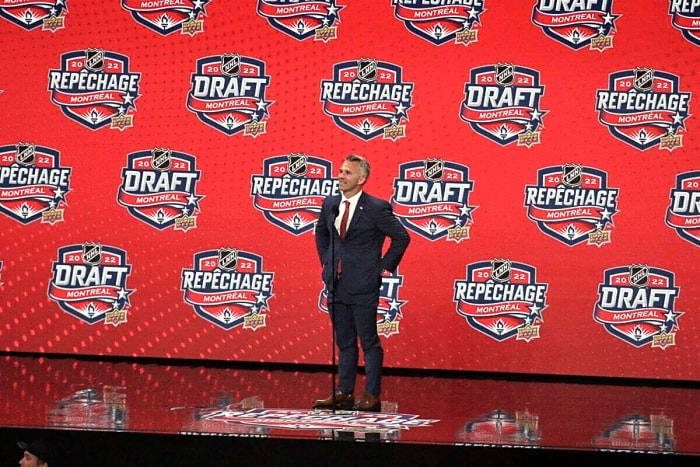
Volokhin (6-foot-3) is one of the more intriguing names in this group. He played just four games with Spartak Moscow before being sent down to the VHL, where he posted a .945 SV% and a 1.58 GAA over 35 games, including nine shutouts. The level of competition requires context, but that kind of statistical dominance at age 20 in a professional league stands out. He remains under contract with Spartak Moscow through the 2027–28 season, which pushes his timeline out and leaves his long-term projection open.
Radkov (6-foot-4) is still in the early stages of his development. A third-round pick with size, he saw significant minutes across two QMJHL teams this season, but the results were uneven. The next phase comes at UMass, where a more structured environment should provide a clearer assessment of his progress.
Cournoyer (6-foot-4) continues to build momentum. Undrafted in his first year of eligibility, he forced his way into the conversation with a dominant second half in the QMJHL before being selected in 2025. Now at Cornell, he has stepped into a meaningful role as a freshman, appearing in 28 games and posting a 2.05 GAA and a .915 SV% with an 18–10–0 record. The next stage of his evaluation will come from how that game continues to translate at the NCAA level.
Vecvanags (6-foot-3) is the least defined of the group. His path through multiple leagues this season reflects his current development. The physical profile is there, and there are flashes against strong competition, but the overall body of work remains limited. He is a longer-term projection.
The Draft Dividend
Because of this, Montreal enters the next draft cycle without any obligation to the position. That is a genuine competitive advantage. Goaltending is unpredictable enough that forcing picks is almost always a mistake. The Canadiens can take the best available skater and trust their pipeline will take care of itself.
For a position where teams so often overreact, overthink, and overcorrect, that kind of calm is difficult to manufacture. Not long ago, drafting another goaltender felt like a quirk. Draft after draft, the picks kept coming, and the questions kept mounting. Now that those questions have been answered, for at least the next several years, the Canadiens will not need to think about the position. For a franchise that has gotten so much right during this rebuild, the goaltending pipeline might be the quietest masterpiece of all.
More must-reads:
- Unhappy Connor Hellebuyck rips 'unacceptable' Jets to add to Winnipeg's problems
- Brady Tkachuk sent the wrong message to open playoffs for Senators
- The 'Stanley Cup Playoff hat-tricks' quiz
Breaking News
Trending News





Customize Your Newsletter
 +
+




Get the latest news and rumors, customized to your favorite sports and teams. Emailed daily. Always free!
PRIVACY POLICY COOKIE POLICY CONTACT US
ABOUT YARDBARKER TERMS OF SERVICE


By using this site, you agree to our Terms of Service and Privacy Policy.
This site is for entertainment purposes only.
There is no gambling offered on this site.
Gambling Problem? Call 1-800-Gambler.
