
-

-


Follow Us
-

 On Facebook
 On Flipboard


The Ottawa Senators will have some extra hardware around the rink this week after Brady Tkachuk and Jake Sanderson return from Milan. The two were instrumental in Team USA’s gold medal win at the 2026 Olympic hockey tournament, with Tkachuk putting up three goals and five points in his first Olympic games and Sanderson locking down the blueline in his second go-around. A big win can lead to a huge confidence boost, and it wouldn’t be surprising to see those two hit the ground running when they trade their red, white, and blue threads for red, black, and gold.
But the biggest takeaway from the Olympic tournament was how great the hockey was with the NHL’s participation. It was reminiscent of some of the greatest tournaments of yesteryear, ones that live on in a nation’s collective memory for decades. I’d imagine most Canadians who were watching the game can still remember where they were when Sidney Crosby scored the Golden Goal in 2010.
So, with the NHL set to resume this week, let’s remember some of the greatest performances from Senators players at the Olympics. The only caveat is that the player had to have been with the Senators when they left for the tournament; former players with impressive performances won’t qualify for this list. With that, let’s see the five greatest Olympic performances from Senators.
5. Tim Stutzle, Germany – 2026
Tim Stutzle did not disappoint in his first Olympic appearance in Milan. In five games, he led the Germans with four goals, doubling Leon Draisaitl’s total, and finished second in scoring with six points. With him in the proverbial driver’s seat, Germany finished in sixth place, their best finish ever with NHL players competing. Although they couldn’t quite get by Slovakia in the quarterfinals, it was exactly what the Senators were hoping to see from their young superstar: speed, skill, and dominance.
Stutzle’s best game was also his first. Against Denmark, he scored twice in the second period, first on a big one-timer and then off a deflection on the power play, giving the Germans a 3-1 win. He also scored against the Latvians and Americans, although both ended in tough losses. Still, Germany had a favourable matchup against France in the play-in round, and after adding two more assists, Germany was off to face the Slovaks. Unfortunately, that’s where Stutzle and the German team’s tournament ended, as they fell to Slovakia 6-2.
4. Alexei Yashin, Russia – 1998
Alexei Yashin has a complicated history in Ottawa. He was an incredible player when he was on the ice, but his struggles with management resulted in his tense departure in 2001. Thankfully, that trade brought in future stars Jason Spezza and Zdeno Chara, who ushered in a new era of Senators hockey. But there’s no denying that Yashin was the Senators’ first franchise player, and in the late 1990s, there were few better than him.
For proof, look at Yashin’s performance at the 1998 Nagano Olympics. In six games, his six points tied for second on the team with Sergei Fedorov, and his three goals were the third-most behind Pavel Bure and Andrei Kovalenko. He was also just one of three Russians to score multiple goals in a single game. Although Russia couldn’t get by Dominik Hasek and the Czechs in the gold medal game, the 1998 Olympics confirmed Yashin’s place among some of the best Russia had to offer, and he was inducted into the International Ice Hockey Federation (IIHF) Hall of Fame in 2020.
3. Marian Hossa, Slovakia – 2002
The 1998 and 2002 Olympic hockey tournaments were set up quite differently from how they are now. The tournament began with a pre-tournament of sorts, with the bottom eight teams competing in a qualification tournament before the preliminary round. The two pool winners were then entered into the main tournament as the seventh and eighth seeds. That created some issues, especially for NHL players competing for those lower-ranked teams, as the NHL break didn’t start until Feb. 13, four days after the main tournament kicked off.
Since the tournament was in Salt Lake City, Utah, some NHL players snuck in a few games before officially going on break, but the Senators’ schedule prevented Marian Hossa from joining Slovakia. The one game he could make was against Latvia, in which he scored a goal and added an assist in a 6-6 tie. The other two games ended in losses, pushing Slovakia into the consolation round before the Senators went on break.
There might have been a little frustration when Hossa joined Slovakia on Feb. 14 against France. Without a win in the pre-tournament, they were now competing for 13th place. It was also the first game that Slovakia had its full roster on the bench, and they did not hold back, shelling the French goalie with 49 shots and scoring seven goals, three of which came from Hossa. With one more assist, Hossa finished his first Olympic Games with four goals and six points in two games.
2. Erik Karlsson, Sweden – 2014
Erik Karlsson nearly did it all at the 2014 Olympics in Sochi. He led Sweden with four goals and eight points, and tied with the USA’s Phil Kessel for the tournament scoring lead, making him an easy choice for the tournament’s top defenceman and the Olympic All-Star Team. The only thing he missed out on was a gold medal, losing 3-0 to Canada in the final game and ending up with a silver.
In many Olympic tournaments, top scorers pad their stats when they face the weaker teams of their pools. However, Karlsson proved that he could score against everyone but the Canadians. He opened Sweden’s first game with a goal against Czechia, then helped get the Swedes back on track with a game-tying goal against Latvia, propelling Sweden to a 5-3 victory. Finally, in the semi-final against Finland, he scored the game-winning goal, sending Sweden into the gold medal match. No other player was more impactful to his team at the 2014 Olympic tournament, other than Canada’s Carey Price.
1. Daniel Alfredsson, Sweden – 2006
There aren’t many players more internationally decorated than Daniel Alfredsson. Over his 18-year career, he appeared in the third-most Olympic games of any Swede and sits second in all-time points. He won a silver medal in 2014 at 41 years old and was inducted into the IIHF Hall of Fame in 2018. But he was at his best at the 2006 Olympics in Turin, Italy. With a Hall-of-Fame roster featuring Mats Sundin, Henrik Zetterberg, Peter Forsberg, Nicklas Lidstrom, and Daniel and Henrik Sedin, Alfredsson led Sweden with five goals and 10 points in eight games, helping Sweden win their second gold medal in Olympic history.
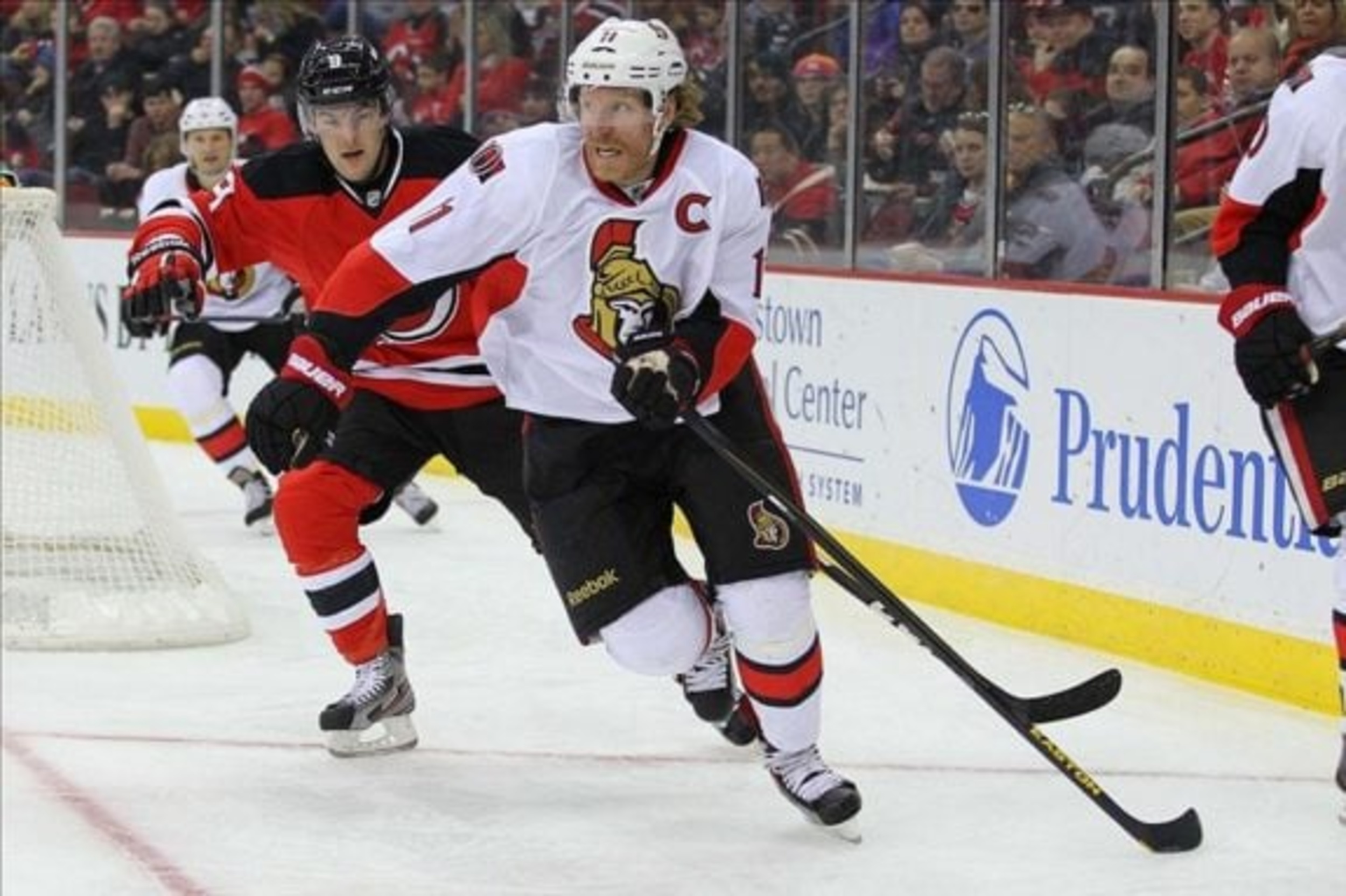
Alfredsson’s most important game was arguably against the United States in the preliminary round, where he scored the opening goal seven minutes into the game to get Sweden on the board. Mike Modano scored the equalizer 10 minutes later, locking the two powerhouses into a tense struggle for the next 30 minutes. But, with Sweden on a power play partway through the second period, Alfredsson sent the puck to Mikael Samuelsson, who scored the eventual game-winner. That win put them ahead of the Americans in the standings and gave them a much easier runway to the gold medal game, where they defeated Finland 3-2.
There will be many more opportunities for local players to become national heroes now that the NHL is back at the Olympics. Who will be the next Senator to thrive on the international stage? We’ll have to wait until 2030 to find out.
More must-reads:
- Lightning's Jon Cooper finally named Coach of the Year, but it doesn't feel right
- Rams' Les Snead gives huge Aaron Donald update
- The '20-point Stanley Cup Playoffs' quiz
Breaking News
Trending News





Customize Your Newsletter
 +
+




Get the latest news and rumors, customized to your favorite sports and teams. Emailed daily. Always free!
PRIVACY POLICY COOKIE POLICY CONTACT US
ABOUT YARDBARKER TERMS OF SERVICE


By using this site, you agree to our Terms of Service and Privacy Policy.
This site is for entertainment purposes only.
There is no gambling offered on this site.
Gambling Problem? Call 1-800-Gambler.
