
-

-


Follow Us
-

 On Facebook
 On Flipboard

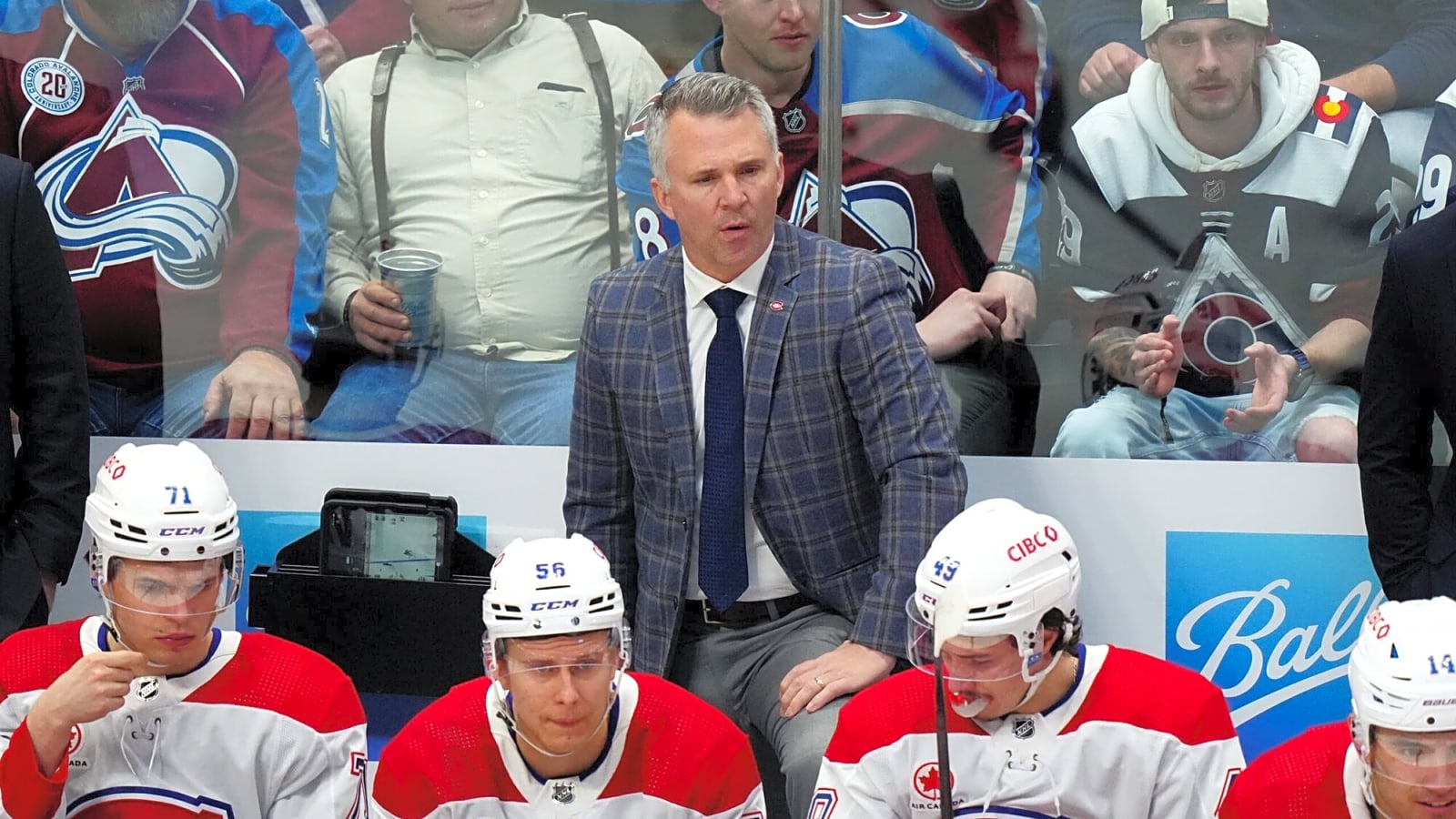
When Martin St. Louis was named an interim NHL head coach in February 2022, eyebrows were raised.
St. Louis, a highly respected Hall of Fame player, had a coaching résumé that included youth hockey in Connecticut… and nothing else. He was tasked with the most prestigious and scrutinized coaching assignment in hockey — leader of the Montreal Canadiens. A job that chewed up and spit out a long line of experienced coaches and franchise icons.
While the Habs’ rebuild remains a work in progress, St. Louis has survived. Fellow Hall of Famer Patrick Roy has the New York Islanders off to a competitive start. Rod Brind’Amour has been a staple in Carolina for eight seasons. All told, there are 21 former NHL players in NHL head coaching roles today.
But we can’t forget Wayne Gretzky’s four seasons of frustration in Phoenix. Or Adam Oates’ unceremonious stint in Washington. It triggers the question: Do great players make great coaches? Are lesser NHL players better fits? How about coaches without flashy playing careers? Today, we’re finding out which type of former player has the most success behind NHL benches.
NHL Coaching Tiers
So, how will we sort our modern NHL coaches?
To keep it simple, I’ve created four tiers based exclusively on NHL playing experience. First, you’ve got your high-end NHL players (the ‘Stars‘) — anyone who played 1,000 career games. This is the tier of elite players turned coaches that launched today’s burning question. Hall of Famers Bill Barber and Jacques Lemaire were added to the tier with fewer than 1,000 games given their exclusive status.
Next are your NHL staples (the ‘Veterans‘) — more than 400 but fewer than 1,000 games. The third tier comprises the guys that never quite stuck in the big leagues (the ‘Journeymen‘) — at least one NHL appearance but less than 400 caps. Last, but not least, is everyone else — a tier of coaches that never reached the NHL as players (the ‘Career Coaches‘).
| Tier | Name | # of Coaches | NHL Games as Player |
| A | Stars | 31 | 1,000 or more |
| B | Veterans | 30 | 400 to 999 |
| C | Journeymen | 42 | 1 to 399 |
| D | Career Coaches | 50 | 0 |
We’ve only included coaches that have: (i) been behind an NHL bench in the 21st century; and (ii) debuted in 1984 or later. This intentionally excludes the likes of Scotty Bowman (Tier D, if curious), Glen Sather and Pat Quinn, famous bench bosses of a different era of total organizational control. There’s also a 30-game cutoff to weed out current rookie coaches and past interim or emergency coaches. That’s a total of 153 modern coaches tiered in today’s exercise.
Here are the 32 current NHL head coaches under these criteria based on playing careers:
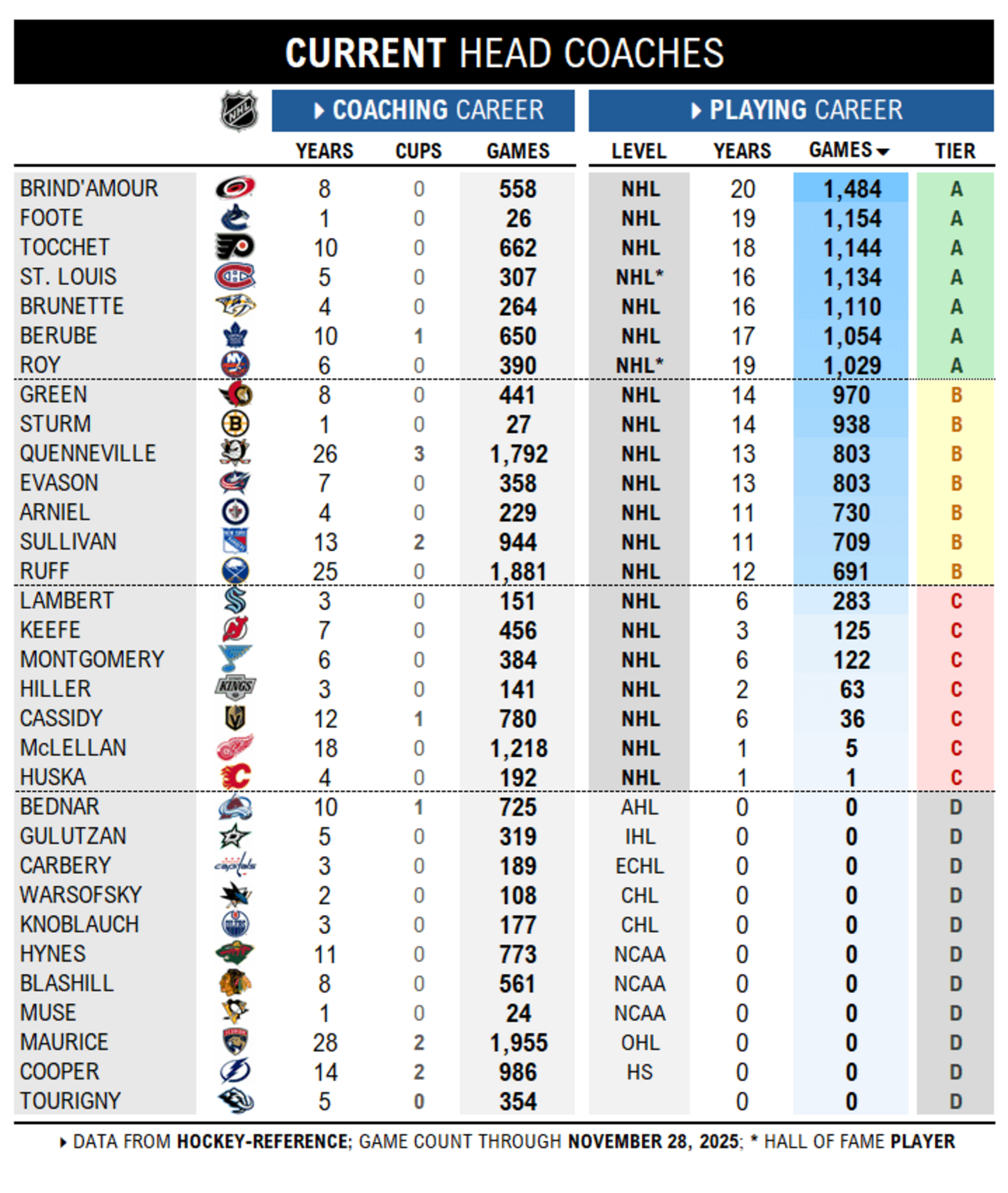
With the goal posts set, who are you betting on as the most successful coaching tier?
Tier A: Stars ⭐
Average NHL Playing Career: 17.6 seasons
Average NHL Coaching Career: 4.7 seasons
How They Got Here: To play 1,000 NHL games, you’ve had a long career and made some serious money. Thirteen of the 31 coaches in this tier are Hall of Fame players. These guys didn’t need to coach. But each wanted a post-playing career and strong organizational ties presented opportunities. Many players in this tier thoroughly apprentice first (Randy Carlyle, Kirk Muller) but some cut the line on name recognition (Gretzky, Kevin Lowe).
Current Coaches in Tier (7): Berube; Brind’Amour; Brunette; Roy; St. Louis; Tocchet; Rookie: Foote
What does this tier do well?: Quit coaching. No, seriously. Twenty of 31 star coaches spent four seasons or fewer as NHL bench bosses. It’s often been a short stint with a single team (Denis Savard, Eddie Olczyk, Phil Housley, Bryan Trottier, etc.), then quickly moving on to another accessible role in hockey given their status. Former stars enjoyed long, successful playing careers and typically don’t want the stress if head coaching isn’t an immediate fit.
Shortest Average Coaching Career, by Tier
| Tier |
Average NHL Seasons Played |
Average NHL Seasons Coached |
| Stars | 17.6 | 4.7 |
| Journeymen | 4.4 | 6.8 |
| Veterans | 11.7 | 7.2 |
| Career Coaches | None | 7.7 |
| Average | 7.1 | 6.8 |
What does this tier do poorly? Communicate. Now, there are excellent communicators among the group — Tocchet famously connects well with players. But the undoing of many former greats is communication style. That’s a logical result given talented players often needed less direction in their own careers, a well-cited excuse for Gretzky’s dismal run in the desert. But the gap is often amplified from getting head coach gigs without enough past experience. It’s frequently assumed great players will just ‘figure it out’ since they know locker rooms. But like Coach Bombay learned, it’s not that simple…

Best of the tier: Jacques Lemaire — the longest-tenured in the tier — coached 17 seasons and won the 1995 Stanley Cup in New Jersey. His former teammate, Larry Robinson, is the last Hall of Fame player to coach a Cup winner. That was 25 years ago. Carlyle (Anaheim ’07) and Craig Berube (St. Louis ’19) are the only other 1,000-game players to win a ring head coaching since 2000.
Tier B: Veterans ✈️
Average NHL Playing Career: 11.7 seasons
Average NHL Coaching Career: 7.2 seasons
How They Got Here: These types of players (400 to 999 career NHL games) were fixtures in the league. Fixtures, but not superstars up for awards or cashing big in free agency. They spent a lot of time at the highest level but never got too cozy. Most were done playing in their late-20s or early-30s, so there was a lot of life ahead of them without assured post-playing careers or generational wealth like Tier A guys.
Current Coaches in Tier (7): Arniel; Evason; Green; Quenneville; Ruff; Sullivan: Rookie: Sturm
What does this tier do well?: Win Cups. Pound for pound, the veteran player tier of coaches has had the best Cup frequency. Maybe it’s the deep NHL playing experience — without the star treatment — that has helped this player type be relatable and close the deal on postseason opportunities.
Best Stanley Cup Title Efficiency, by Tier
| Tier | NHL Seasons Coached | Stanley Cups | Seasons per Cup |
| Veterans | 216 | 8 | 27 |
| Career Coaches | 384 | 12 | 32 |
| Stars | 147 | 4 | 37 |
| Journeymen | 287 | 4 | 72 |
| Total | 1,034 | 28 | 37 |
What does this tier do poorly? Stay in one place. Unlike many one-and-done star coaches, these stubborn veteran players solider on. They earned a lot of respect in their careers, often have ties to multiple franchises, and aren’t packing it in after one head coaching gig. One-third of this tier has coached for at least three teams already, led by Quenneville (five), Gerard Gallant (four), and Brian and Darryl Sutter (four each).
Best of the tier: Only five head coaches have won multiple Cups this millennium and three are in this tier: Quenneville (three in Chicago); Sullivan (two in Pittsburgh); Darryl Sutter (two in Los Angeles). Dan Bylsma (Pittsburgh ’09) is the other Cup-winning coach in the tier. It also features hockey lifer Lindy Ruff (37 seasons as an NHL head coach or player).
Tier C: Journeymen
Average NHL Playing Career: 4.4 seasons
Average NHL Coaching Career: 6.8 seasons
How They Got Here: This player tier got a taste of the NHL, ranging from cups of coffee (Ryan Huska) to frequent call-ups (Dallas Eakins) to short bursts of regular work (Brad Shaw). On-ice careers didn’t deliver financial security to this tier. So, you have two kinds of coaches: ones that pivoted to coaching young like Keefe and those that played in the minors forever like Lambert.
Current Coaches in Tier (7): Cassidy; Hiller; Huska; Keefe; Lambert; McLellan; Montgomery
What does this tier do well?: Survive. Much like the journeymen identities built in their playing careers, this coach archetype grinds their way to relevance. Whether long stints in the minors honing their coaching crafts or hard-earned reputations as long-time assistants worthy of a shot, these coaches typically don’t have the pedigree as players to be unprepared or make mistakes.
What does this tier do poorly? Playoffs. No tier has a bigger drop in performance from regular season to postseason. Now, every coach’s points percentage drops in the playoffs as there are no three-point games. That’s a given. But the extent of the gap is revealing. Notable examples include Bruce Boudreau, Keefe, McLellan, Montgomery, Alain Vigneault, and Ron Wilson. Each led high-performing groups to recurring postseason disappointment. A lack of big-game NHL experience revealing itself or bad luck with underachieving cores?
Biggest Decrease in Points Percentage in Playoffs, by Tier
| Tier |
Regular Season Points % |
Playoff Winning % |
Decrease |
| Journeymen | .553 | .482 | .071 |
| Stars | .537 | .492 | .045 |
| Veterans | .539 | .498 | .041 |
| Career Coaches | .548 | .513 | .035 |
| Average | .546 | .500 | .046 |
Best of the tier: In 287 seasons, this tier has won just four Cups: Cassidy (Vegas ’23); Claude Julien (Boston ’11); Peter Laviolette (Carolina ’06); and Marc Crawford (Colorado ’96). But there is no shortage of solid, successful coaches already named in this section. Add Terry Murray and Rick Bowness to the list.
Tier D: Career Coaches
Average NHL Playing Career: Zero NHL games
Average NHL Coaching Career: 7.7 seasons
How They Got Here: Coaches in this tier were not all ‘bad’ hockey players or athletes. Far from it. Nearly all played junior, college, or in pro leagues. Many had other professions before coaching — Pat Burns (policeman) and Jon Cooper (lawyer), for example — that offers unique perspectives. The majority started at low levels given few connections and without the blind trust afforded to elite players. These are dedicated students of the game, uber-motivated to stick in the big leagues.
Current Coaches in Tier (11): Bednar; Blashill; Carbery; Cooper; Gulutzan; Hynes; Knoblauch; Maurice; Tourigny; Warsofsky; Rookie: Muse
What does this tier do well?: Long careers and postseason success. This tier honed their craft young, not tied down by playing careers. 30% of them last at least 10 NHL seasons, highest of any tier. The ones that break through are exceptional, having needed to win early and often to build careers from scratch. The career coaches have the top playoff winning percentage (.512) and most Cups (12) — a testament to experience and a lifetime of pouncing on opportunities.
Percentage of Coaches With 10+ Seasons, by Tier
| Tier | 20+ Season Career | 10+ Season Career |
| Career Coaches | 10% | 30% |
| Journeymen | 2% | 24% |
| Veterans | 10% | 23% |
| Stars | 0% | 13% |
| Total | 6% | 24% |
What does this tier do poorly? Show weakness. When you haven’t played in the NHL, you don’t get there through self-doubt. Confidence is a prerequisite to rise through the ranks and earn respect in the hockey cult, heavy on alphas. Among the longest-tenured in the tier, we find serious swagger that is some combination of effective, endearing and infuriating: Maurice (28 NHL seasons); John Tortorella (23); Barry Trotz (23); Ken Hitchcock (22); Mike Keenan (20); Jacques Martin (18); Pete DeBoer (17); Mike Babcock (17); Pat Burns (14); Cooper (14); Bob Hartley (13); and Michel Therrien (12).
Best of the tier: The hockey lifers with a dozen-plus seasons above delivered 11 of the tier’s 12 Cups — a who’s who of 21st-century coaches. Bednar (Colorado ’22) is the other non-NHL player with a title in the modern era. Career coaches are hot these days, having won six of the last eight Cups.
Answering the Question
Every coach and their individual background and skill set is different. We’re grouping them together to try to find objective answers today. But each coach deserves the opportunity to create their own narrative. That said, here are my takeaways from the analysis on which player type I’m hiring (or passing on):
- Not Worth the Risk: The Stars arrive late to coaching, rarely get the requisite experience, aren’t typically in it for the long haul, and lean more miss than hit, featuring a handful of strong coaches and many quick flameouts. Few have thrived in the salary cap era. Great players rarely make great coaches. I’m passing.
- Move your Franchise Forward: The Journeymen provide big boosts to organizations as hungry, hardworking coaches that help teams level up. Perhaps it’s the grinder’s approach or challenges adapting under the bright lights, but journeymen coaches have rarely gotten teams over the top.
- Low Risk, High Reward: The Veterans often draw well on NHL familiarity without all-world skills or paychecks. These hires are sellable to fans and locker rooms as credible, known commodities. The group is top heavy when it comes to success as veteran NHLers presided over all three multiple Cup-winning franchises of the 2010s. It’s an archetype worth betting on.
-
Some Risk, Biggest Reward: The Career Coaches are committed and relentless. The odd one just won’t translate to the NHL, but that’s true of any rookie coach. I’m taking a promising career coach above all other options to deliver a Cup. History says you’re most likely to get a sharp hockey mind that thrives in the playoffs. An NHL playing career? It’s not needed. Just ask Scotty Bowman.
POST
Data from Hockey-Reference
More must-reads:
- The top 10 players in 2026 Stanley Cup Final: Golden Knights have the star power
- Does the NHL have a playoff format problem?
- The 'Men's French Open champions' quiz
Breaking News
Trending News






Customize Your Newsletter
 +
+




Get the latest news and rumors, customized to your favorite sports and teams. Emailed daily. Always free!
PRIVACY POLICY COOKIE POLICY CONTACT US
ABOUT YARDBARKER TERMS OF SERVICE


By using this site, you agree to our Terms of Service and Privacy Policy.
This site is for entertainment purposes only.
There is no gambling offered on this site.
Gambling Problem? Call 1-800-Gambler.
