
-

-


Follow Us
-

 On Facebook
 On Flipboard
It should come as no surprise that I love junior hockey. Although the NHL puts on a fantastic show and features the best players on the planet, all the games I’ve been to feel the same. But every Western Hockey League (WHL) game has been unique: finding the perfect seats in Medicine Hat, noticing that I couldn’t see the other end of the arena in Moose Jaw, sitting ice-level and hearing the glass rattle in Red Deer and feeling the roar of the crowd in Lethbridge while I skated in a game during the intermission. It was those memories that made me want to see every team in the league play in their hometown arena.
There’s something naturally small-town about junior hockey. Even in a larger city like Lethbridge or Saskatoon, the game has that same level of intimacy. It’s more relaxed, more welcoming, more intentional. It caught my in-laws off guard when I took them to their first WHL game last year; after only viewing Calgary Flames games, they expected a bare-bones production. Instead, they got an NHL-level show at a fraction of the cost.
However, two WHL teams don’t quite fit in with the rest. The first is the Calgary Hitmen, which I saw play in March 2024. Although they began as an independent club, they were purchased by the Flames in 1997, which switched their home to the Scotiabank Saddledome and kicked off a decade as one of the top teams in the league. Watching them play in an NHL arena wasn’t like anything that I’d seen before. The small-town vibe was replaced by the extravagance of the NHL, like a peek at a Flames game from the club seats.
The other is the Edmonton Oil Kings, which I planned to see for my 10th stop in November 2025. They began life in the WHL as an extension of the Edmonton Oilers and quickly took over as the top team from the Hitmen, not long after their inaugural season. I’d heard great things about the venue, but knew little about the team other than where they sat in the standings. It was almost like they didn’t have an identity beyond the Oilers.
To better understand the city and the team, I asked fellow Hockey Writers Jesse Courville-Lynch about his experiences covering the Oil Kings for a year and a half. I was also joined at the game by my sister, who had accompanied us to the Hitmen game nearly two years ago, and my aunt and uncle, who had hosted my wife and me at the Red Deer Rebels game and were more than willing to see another WHL game with us. After all, this stop crosses off my second province, so it was worth making into a special occasion.
Oil Kings History
Bill Hunter is arguably one of the most important men in the history of junior hockey. As owner of the Oil Kings, he was a founding member of the WHL, and despite pushback from the Canadian Amateur Hockey Association (CAHA), he never gave up the fight for better competition for western clubs. It was his unwavering support of the sport that led him to help set up the World Hockey Association (WHA) in 1971, as well as the team that would become the NHL’s Oilers.
Happy birthday to the late GM/Head Coach William "Wild Bill" Hunter who was born ON THIS DAY in hockey history (May 5, 1920):#VintageHockey #WHA @EdmontonOilers pic.twitter.com/9ATC0cUzAL
— Vintage Hockey Showcase (@hockey_vintage) May 5, 2025
However, Hunter didn’t create the Oil Kings. Edmonton had a long tradition with junior hockey; 1940 Stanley Cup Champions Neil and Mac Colville got their start with one of the many clubs in the city, as did a young Johnny Bucyk. But more competitive leagues were the future of the game, so the city league was shut down in 1950, and an all-star squad was created from the ashes. Dubbed the Oil Kings as a nod to the city’s connection to the oil and gas industry, they joined the Western Canada Junior Hockey League (WCJHL) in 1951-52.
Founded in 1948, the WCJHL aimed to create better competition and organization in junior hockey in Western Canada, but in practice, it was a mess. By the time Edmonton joined, the Regina Pats had already won two of the three titles, and over the next five seasons, they went on to win three more. By 1956, the league was dead, and the Pats and Oil Kings went on to find better competition elsewhere.
Hunter also wasn’t responsible for the Oil Kings’ rise to Western dominance. After leaving the WCJHL, the Oil Kings joined the senior-level Central Alberta Hockey League (CAHL), as no other top-tier junior leagues existed in Alberta then. Playing against men gave the junior Oil Kings a significant advantage when facing their peers, and Edmonton represented the West at the Memorial Cup for six straight years from 1960-65. However, they only managed one Cup win in that stretch of dominance, showing just how much better the East still was than the West.
But that was about to change, and Hunter had everything to do with it. In 1965, he bought the Oil Kings and began concocting plans to create a better junior hockey landscape. Edmonton remained strong and returned to the 1966 Memorial Cup, and although they went on to beat the Oshawa Generals five games to two, the biggest news story came from the Memorial Cup dinner on May 13, 1966, where Hunter surprised those gathered with an impassioned speech.
“I can see in the immediate future teams from Halifax and Vancouver competing in a Canadian junior league. Every area in Canada has a right to try and win the Memorial Cup, not just a few.”
Bill Hunter (from “Sees All-Canada League,” Winnipeg Free Press, p. 65 – 14/05/1966)
Although few took him seriously then, it took Hunter and a group of like-minded owners in Alberta and Saskatchewan just five months to create the Canadian Major Junior Hockey League, which would later become the WHL. Over the next five seasons, both of Hunter’s dreams were realized: he had a competitive junior league in the West, and after 1970, everyone was able to compete for the Memorial Cup.
Maybe it was the realization of his plan that shifted Hunter’s focus to a new opportunity – professional hockey. The WHA mirrored the WHL in many ways, especially in its outlaw status, but Hunter took what he learned in the 1960s and used it to build the Oilers into a dominant franchise. But the new professional league became the demise of the Oil Kings. Immediately after the Oilers were created, the Oil Kings began losing money. Hunter sold the team to a former Oil Kings and Oilers coach, Brian Shaw, in 1974, and without the influx of pro cash, he had no choice but to move the team.
“This past year (1975-76) was the worst,” said Shaw. “We were playing in an antiquated building (Edmonton Gardens), and there was the Taj Mahal (Edmonton Coliseum, home of the Oilers) right across the street. The people wouldn’t go into one and look across the street at what we could have been playing in…I honestly felt we could have kept the club in Edmonton, but I’ll tell you…I didn’t notice the phone ringing off the hook in Edmonton asking for season tickets.” (from ‘Shift in franchise has owner Brian Shaw confident of the future,’ Brandon Sun, pg. 8 – 15/06/1976)
The Oil Kings packed up and moved to Portland, who were hungry for top-level hockey, and the team was welcomed with open arms. But Hunter didn’t take the loss lying down. The Bombers, once a WHL powerhouse, had fallen on hard times, and although they planned to move to Winnipeg, Hunter swooped in to purchase the team and turn them into the second Oil Kings.
But fans did not come crawling back. The new Oil Kings only lasted a few seasons before relocating to Montana in 1979-80 and Spokane in 1980-81, where they finally folded. Former league president Ed Chynoweth also tried to bring junior hockey back to the Alberta capital, founding the Edmonton Ice in 1996, but that team also struggled with keeping fans, and they moved to Cranbrook, B.C., after two seasons.
Yet it was the NHL that eventually saved the Oil Kings. In 1997, the Calgary Flames purchased the ailing Calgary Hitmen, offering to share ice time with them at the Saddledome, and over the next two decades, the Hitmen led the WHL in attendance and won two league titles. The Oilers wanted to do the same, but no WHL franchise was selling, and there were no plans for expansion. So, the Oilers instead relocated their farm team to Edmonton in 2003-04 with plans to eventually trade it for the Saskatoon Blades, but an agreement couldn’t be reached, and the franchise suspended operations in 2005.
The Oilers tried one more time to buy a team, targeting the struggling Tri-City Americans, but the league blocked the move to keep the team in Washington. However, an olive branch was extended to Edmonton after the Chilliwack Bruins joined the WHL in 2006-07. Not wanting the league to be uneven, Edmonton was offered an expansion team for the 2007-08 season. A fan vote was held as to what the team should be called, but it was never really a contest. The WHL just isn’t complete without the Oil Kings.
Franchise Leaders:
- Most Points (Total): Michael St. Croix (2008-13) – 320
- Most Points (Season): Michael St. Croix (2011-12) – 105
- Most Goals (Season): Dylan Guenther (2021-22) – 45
- Most Games Played: T.J. Foster (2008-13) – 338
- Most Wins (Total): Tristan Jarry (2011-15) – 93
- Most Wins (Season): Tristan Jarry (2013-14) – 44
- Honoured Numbers: None
- Highest Drafted Players: Griffin Reinhart, 4th (NY Islanders, 2012); Dylan Guenther, 9th (Arizona, 2021); Sebastian Cossa, 15th (Detroit, 2021)
Rogers Place
The Oil Kings initially played in the Edmonton Gardens, an Edmonton staple since it was opened on Christmas Day in 1913, becoming the city’s first indoor rink. It was originally intended for livestock shows, which gave rise to the nickname, ‘The Cow Barn,’ but hockey worked just as well. However, by the 1960s, that was no longer the case. Not only were there many obstructed sight lines and girders that dripped onto the ice, but, as the Edmonton Journal put it, the arena was “a disaster waiting to happen…The old house with its obsolete lighting fixtures, oily wooden floors and sordid washrooms is an eyesore to hockey fans and others to crowd into it.”
Finally, the city’s fire chief condemned the building as a fire hazard, forcing it to undergo $670,000 in renovations to make it ready for the upcoming hockey season. With a new 5200 seating capacity, it was a much better experience and became the first home of the WHA’s Oilers, but as popularity for the new pro team erupted, the Gardens was soon outgrown. It would be fine for the Oil Kings, but the Oilers needed something better. In 1974, they moved to the brand-new, 16,000-seat, state-of-the-art Coliseum, and while it was great for the Oilers, the Oil Kings struggled in the building’s shadow, resulting in their move in 1976.
The Gardens was demolished in 1982, and two years later, it was replaced with the Northlands AgriCom, which became the home of the Edmonton Ice out of necessity in 1996. It was advertised as a cheaper alternative to NHL hockey, but the parking costs were nearly as high as the tickets, making it the most expensive team to see in the league. Combined with a subpar 3500-seat arena, the Ice failed to attract nearly enough new fans, ultimately leading to the team’s relocation two years later.
When the Oil Kings rejoined the WHL in 2007 with the Oilers’ backing, they joined them in Rexall Place, then moved to Rogers Place in 2016, where they remain. With 18,347 seats, it’s the second-largest arena in the WHL behind Calgary, although, like the Calgary Flames, they don’t open up the whole building for most WHL games. That still allows Edmonton to pack in around 10,000 fans on an average night, the most of any WHL team in the league today.
Rogers Place is located right in the middle of downtown Edmonton, making it very easy to get to by either car or on foot. My wife and I decided to take advantage of the milder weather and walk to the arena, and although we were slightly confused by which entrance to use, it was remarkably easy to navigate for a first-time visitor. We then entered Ford Hall, a huge, arching foyer with plenty of natural light and smooth, flowing lines, setting the tone of Rogers Place as a professional venue. There, we met up with my sister, aunt, and uncle, and with about 30 minutes to puck drop, we entered the arena.
Food and Extras
Summary
- Tickets – $28 (Ticketmaster)
- Hat – $35-45
- Jersey – $190
- Puck – $13-20
Rogers Place is a gorgeous venue. It’s easy to navigate, especially for a WHL game with 8,056 fans, and the views are fantastic. Tickets are fairly reasonable, too, starting at about $25 for behind the net, but I opted for one tier above, selecting the $28 seats across from the opposing goalie. They can get expensive, with the seats behind players’ benches at over $40, but that felt about right for the venue.
Once at our seats, the Oil Kings put on a great show. The intro video was one of the best I’ve seen, with Avenged Sevenfold’s ‘Hail to the King’ playing over the Oil Kings’ players sitting regally in a throne between game highlights. I also really enjoyed the announcer’s hometown bias; when Edmonton scored, he was high energy and always concluded the call by asking the crowd, “Can I get a ‘Woah Yeah’?” When Saskatoon scored, I could barely hear the names.

The food and souvenir offerings weren’t as exciting, though. Any specialty food stall was closed, and the main booths offered little more than KFC, Pizza 73, or arena staples. The souvenir stand was plopped in the middle of the concourse and was still half populated by Oilers merchandise, which meant there were hardly any unique Oil Kings’ items. Additionally, the prices were quite high; my basic poutine was over $20, and my souvenir haul of a puck, keychain, Christmas ornament and a reusable bag totalled over $40. That’s almost double the cost of the same souvenirs in Saskatoon.
Nov. 30, 2025 – Edmonton Oil Kings vs. Saskatoon Blades
With our food purchased, we made our way down to the seats: eight rows up and right across from the opposing goal line. I had been impressed with the Saddledome’s views, but sitting here in Rogers Place left me speechless. They were right – this has to be one of the prettiest venues in hockey. Even though I was several rows above the ice, it felt like I was right up against the glass. No wonder people pay hundreds of dollars to sit here for an Oilers game.
It was non-stop action after the puck dropped. Rowan Calvert and Hayden Harsanyi put the Blades up 2-0 less than four minutes into the game, both of which came on the power play. The Oil Kings answered back three minutes later, though, with Max Curran also scoring on the power play and Adam Jecho tying the game at 2-2 before the halfway mark of the first period. But the Blades weren’t done, and with just over two minutes remaining in the first, Oilers’ prospect David Lewandowski got Saskatoon back in the lead.
The second period was all Edmonton, with Andrew O’Neill and Ethan MacKenzie giving the Oil Kings their first lead early in the period, and although those were the only two goals scored, there were plenty of chances on both sides. The scoring opened back up with 11 minutes left in the game, kicked off by Oil Kings’ newcomer Poul Anderson, but the Blades’ captain, Tyler Parr, answered right back to keep it a one-goal game. Miroslav Holinka answered back for the Oil Kings, and Calvert returned the favour, but with 30 seconds left on the clock, it wasn’t enough to defeat the Oil Kings at home.
After the game, I learned that there was going to be an autograph line featuring several players. I love getting an autograph as a souvenir; it’s always fun to meet the players and get a one-of-a-kind souvenir from the game. So, after checking with the people I came with if they’d be OK to wait for a bit, I took my spot at the back of the line and began to take in the sights of Rogers Place as it began to shut down for the night.
The Oilers were prominently featured everywhere I looked. Banners featuring all the current players lined the rafters, advertisements for the team’s rewards programs were displayed prominently around the concourse, and blue and orange filled the spaces in between. As for the Oil Kings, there wasn’t anything implying they’d even been here outside of the line I was standing in. It was almost like I was in the wrong place, like I wasn’t supposed to be here.
That feeling had been present at the Hitmen game I saw, but to a far lesser extent. Here, with the lights shutting off and fans not in line (including the people who came with me) ushered out of the concourse and back into Ford Hall, it felt like our time was up. They had to get ready for the Oilers, because that was the only tenant that really mattered.
Jesse admitted that the Oil Kings often struggled to separate themselves from the Oilers. “When they’re struggling, it’s empty,” he said. “However,” he added, “I think the city does a really, really good job promoting the Oil Kings when they’re doing well to get fans to games, which exposes their own identity. Prime example will be the teddy bear toss game, which I expect to be sold out.”
Jesse has been following the Oil Kings since the 2013-14 season during their dominant playoff run en route to their third title. “My first memory in terms of being a fan would’ve been watching their Memorial Cup series against the Portland Winterhawks in Edmonton and seeing just how diehard a hockey fanbase the city is, even for a WHL team. That was when Nic Petan & Matt Dumba were on the Winterhawks, and the Oil Kings had a super team, unreal times.”
That Oil Kings’ team, led by Henrik Samuelsson and Curtis Lazar, along with future NHLers Tristan Jarry, Dysin Mayo, and Griffin Reinhart, lost just two games before meeting the Winterhawks in the Final. The two powerhouses were closely matched, with the home team winning in the first four games, but the Oil Kings took the fifth and seventh games on the road, becoming the first team in WHL history to accomplish the feat in a championship series.
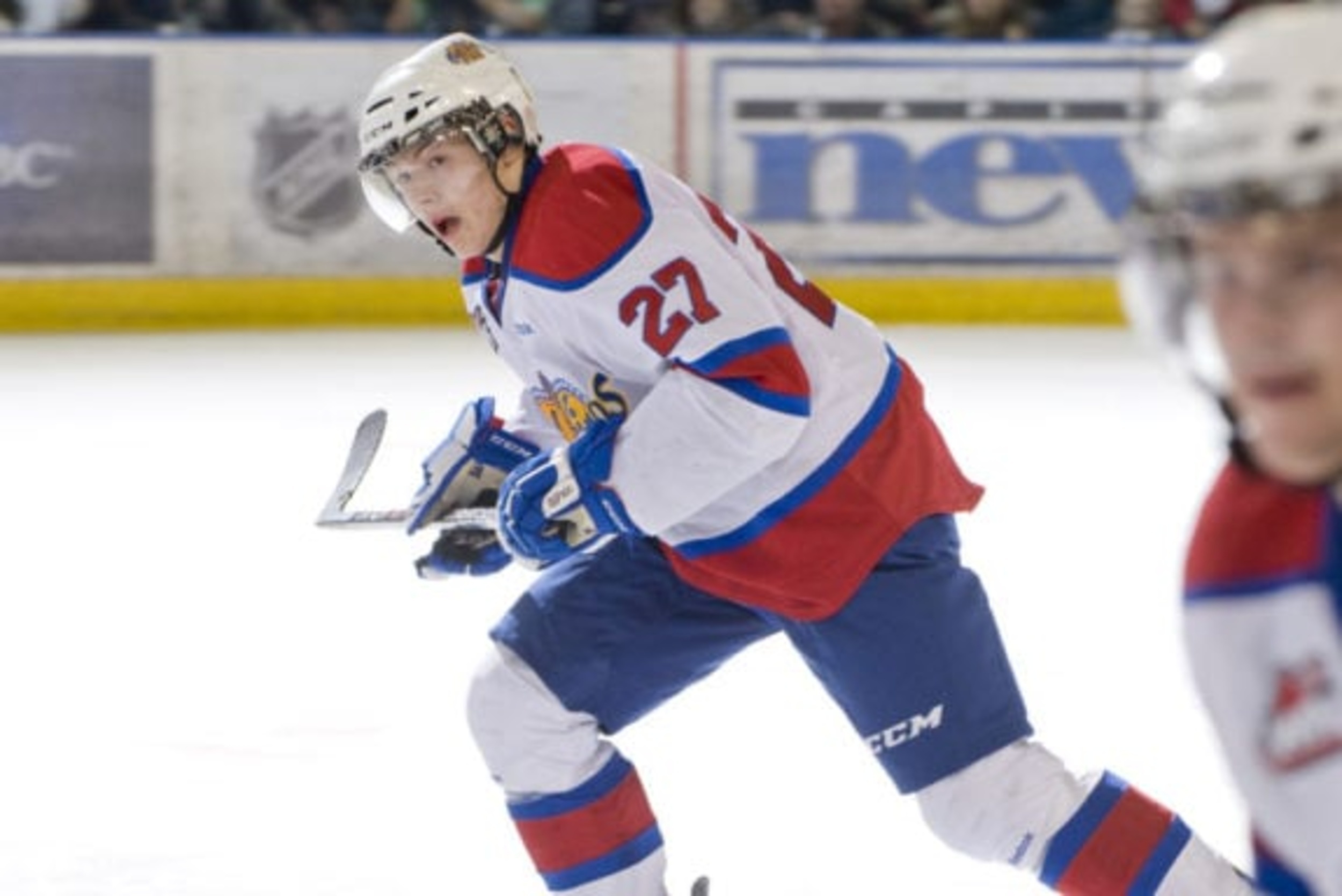
Those early experiences led Jesse to pursue a credentialed spot with the Oil Kings after joining The Hockey Writers. “The draw was how they promoted the games and their in-arena handling of how they treated fans, ran the games, and just the overall competitiveness of the team,” he said. “I enjoyed following/covering the Oil Kings because of those same diehard fans who interacted and wanted to know more about the team, which made it worthwhile. They wanted to know things, I had some connections to let them know, it was fun.”
When fans want to know about their NHL teams, they can look up one of several credible insiders like Elliott Friedman, Chris Johnston, or Pierre LeBrun. Those sources don’t exist for WHL teams, but they also aren’t as important; in a lot of smaller centres, you can just ask your neighbour for the inside scoop, and there’s a good chance that they’ve heard something. It’s the benefit of playing in a small town – the fans are passionate and well-informed, creating a tightly-knit community around the team. Somehow, the Oil Kings have captured that within the big city, which I didn’t expect.
To me, that’s the Oil Kings’ identity. They haven’t gone down the same path as Calgary, giving fans a sample of what it’s like to watch an NHL game with a smaller crowd. That game was full of glitz and glamour, making the Hitmen experience truly unique among the small-town teams in the WHL.
Edmonton instead embraced those small-town traditions. It just so happens to be in a nearly 20,000-seat arena, which creates a little cognitive dissonance to the uninitiated. The announcer antagonizes the opposition, local talent is featured during the intermission, and the section behind the Blades’ net was filled with people banging noise sticks, which didn’t stop for most of the game. If you’re looking for an NHL show, you’ll be underwhelmed, but those fans who love the Oil Kings have continued to show up for the team, embracing the strange junior team hidden in the shadow of the Oilers.
By the way, the Teddy Bear Toss, which took place a week after my trip, wasn’t quite a sell-out, but it was close, bringing in 16,887 fans to Rogers Place and setting a record for the most bears thrown at an Oil Kings’ game with 16,303. Jesse was right – people show up for this team. You just need to know where to look.
More must-reads:
- Winners, losers from Sunday's Stanley Cup playoffs: Vegas stuns Avalanche for 3-0 series lead
- Winners, losers from Saturday's NHL playoffs: Hurricanes get even with OT win
- The 'NASCAR Coca-Cola 600 winners' quiz
Breaking News
Trending News




Customize Your Newsletter
 +
+




Get the latest news and rumors, customized to your favorite sports and teams. Emailed daily. Always free!
PRIVACY POLICY COOKIE POLICY CONTACT US
ABOUT YARDBARKER TERMS OF SERVICE


By using this site, you agree to our Terms of Service and Privacy Policy.
This site is for entertainment purposes only.
There is no gambling offered on this site.
Gambling Problem? Call 1-800-Gambler.
