
-

-


Follow Us
-

 On Facebook
 On Flipboard


The art of shaping a surfboard has dramatically evolved over dozens, maybe hundreds of years of surfing. From early pioneers who would fell trees and hack and carve them into a 15-to-20 feet long wooden board – to the modern principles of today, where computers are used to keep up with shaping demand, the way boards are released into the wild is on a continual learning-path, becoming more efficient over every generation.
Up until the late 1950s, balsa wood and redwood were the main materials used for shaping a surfboard, balsa offering a more lightweight version that redwood. Then, shapers would combine the two – balsa became the center of the board, with redwood making up the rails. Bill Stewart, of Stewart Surfboards, based out of San Clemente (no relation to legendary boog hound Mike Stewart) has shaped boards this way in the past, including creating a 21 stringer shape.

Bill learned this balsa and redwood combination under the guidance of Terry Martin (from Hobie Surfboards), Phil Edwards (credited as the first surfer at Pipeline) and Mickey Munoz (experimental SoCal surfer riding 6'8” boards in the 50s and one of the OG Waimea crew). These boards were then coated with fiberglass and polyester resin, which was the industry standard back then. These days, Stewart Surfboards can whip up any shape you'd like.
Balsa and redwood surfboards are now incredibly rare in the line-up due to the rise of polyurethane (PU) foam, which was introduced into the surfing world in the late 50s. Hobie Alter was handed some PU foam by a resin salesman in 1957 – and he quickly realised the material offered many advantages over balsa wood boards; it was much easier to mold into shape, lighter and had more flex and buoyancy.
By the late 90s, shapers began experimenting with epoxy resin on PU blanks, because epoxy resin was lighter then polyester resin. These are called PE boards. Epoxy resin was also able to be used with Expanded Polystyrene (EPS), which blew open ideas around surfboard construction – even if early EPS-foam boards felt a bit off in the early days.
These days, PU and EPS are the main two board types you will have to choose between – unless you go to a specialist and create a custom wooden board, or any other alternative type. The language around foam cores has become a bit muddied too. You will often hear the phrase, 'PU or Epoxy?' Which technically isn't true. Epoxy is only the resin that laminates an EPS foam blank. Here's the run down of what this all means and what you can expect from each one as a general rule of thumb.
Polyurethane – Peformance Feel
PU surfboards are made from a polyurethane foam core, aka, the blank. To make a PU blank is an extremely complex process but the crux of it is: polyol and isocyanate are mixed together and poured into a mould, this then expands and transforms into PU foam. This is then heated up to cure, cut in half and a stringer is inserted by gluing it to the center. Most shapers do not create their own blanks, but rather order them in specifically. There are even more planet-friendly versions of foam blanks now, such as what Popyola are doing by creating their blanks out of recycled materials. You may recall a recent video with Portuguese slab chaser, Miguel Blanco, charging one of these boards at some of the heaviest waves in the world.
PU boards are preferred by shapers due to them being easy to shape. A planer can mow PU foam like a knife through butter and it allows for a level of intricate hand-shaped refinement that the world's best shapers meticulously carry out. In fact, you can use any tools to work PU foam, sandpaper, hand-planers, custom kit to get really into the finer side of things. An incredibly versatile core of your surfboard. Once the PU board is shaped, it's usually glassed with polyester resin.
For surfers, you might not even know the construction of your board – but as soon as you move away from PU, you'll probably figure out something feels very different. PU boards tend to give a more traditional feel to surfing – maybe that's traditional because it's been the industry standard for so long. PU foam boards will sit you lower in the water too, in comparison to other alternatives. When you're up and riding, these boards offer a deeper level of sensitivity and form the core of high-performance surfing. They're heavier than epoxy boards but are also less durable, meaning you're going to pick up a few dings and heel-dents along the way.
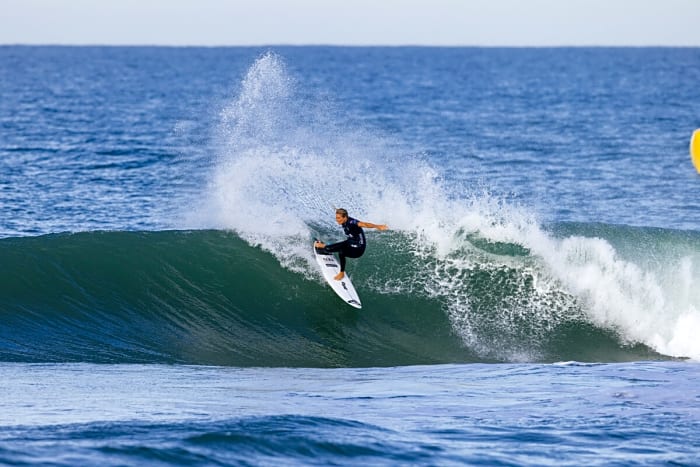
EPS/Epoxy – Lighter, Stiffer, More Buoyancy
EPS boards are made from an EPS blank, which sounds obvious. This is different to its PU counter-part in many ways. EPS is created by steaming polystyrene beads, causing them to expand. These are then dried, placed into a mold and smashed together to form the shape of a surfboard blank. Once in the mold, they're given another steam bath to keep them stuck together in one block of foam, which is then cut to shape and voila, you have an EPS blank.
EPS foam is more lightweight than PU and can sit you on top of the water more -- mostly because there's a lot of air trapped within a water repellent, closed-cell structure. While the list of benefits seem attractive, EPS is also stiffer than PU and can feel more skatey when surfing. EPS also requires specific tools to shape it, to avoid ripping the foam beads. You'll need sanding mesh, as opposed to normal sandpaper, to help make an EPS blank take shape. And there's the added factor that EPS is generally more expensive than PU.
Now, when coating the board, there are a few options shapers can use. The most popular options are either polyester resin, or epoxy resin. Most of the time, when an EPS blank is used, it is finished with an epoxy resin, to help toughen the board up. Hence where the phrase PU vs epoxy comes from. This makes the board stiffer to surf but the trade off is, it's lighter, tougher and will last you longer. For example, you can have a 10 foot longboard with an EPS core and epoxy finish, and it may feel up to half the weight of a PU board.

Which One Wins?
As with most things in surfing, it's not as clean cut as that. PU and EPS both have their places in the surfing world. If you want a more durable board that sits you on top of the water more, check out EPS foam shapes. If you want a more performance-orientated board, then PU may be the way to go.
Your best bet is to try both, and figure out which one really works for you in a whole range of conditions. Better yet, contact your local shaper and have them walk through your surfing, ability and where you want to be and take it from there. And yes, you can also have a PU board with an epoxy resin. The core of the surfboard is just one of the decisions to make when choosing a fresh whip, so having someone to talk over the many nuances of board design could be a huge help. Just don't go in with volume as your top parameter for choosing a board. Volume is an important metric but it shouldn't be your only defining factor.
More must-reads:
- Yankees players make feelings on Aaron Boone clear after getting swept by Rays in ALDS
- Update emerges on if Chargers could make stunning Jim Harbaugh move
- The 'Last 2-rushing-TD duos by team' quiz
Breaking News
Trending News







Customize Your Newsletter
 +
+




Get the latest news and rumors, customized to your favorite sports and teams. Emailed daily. Always free!
PRIVACY POLICY COOKIE POLICY CONTACT US
ABOUT YARDBARKER TERMS OF SERVICE


By using this site, you agree to our Terms of Service and Privacy Policy.
This site is for entertainment purposes only.
There is no gambling offered on this site.
Gambling Problem? Call 1-800-Gambler.
