
-

-


Follow Us
-

 On Facebook
 On Flipboard


When the Athletics entered their most recent rebuild, a number of core players were moved for younger prospects. A tradition that A’s fans have become more than familiar with. Matt Olson and Matt Chapman were the biggest names shipped out of Oakland, with less-than-ideal returns, but Chriss Bassitt was also traded.
Bassitt went to the Mets with pitchers Adam Oller and J.T. Ginn coming back in the deal. While Oller never carved out much of a role, Ginn is finally starting to shine four long years later.
After dealing with injury after injury, Ginn was given a bigger role in 2025 pitching to a 5.08 ERA across 90.1 innings. Those are fine numbers, but hardly what the A’s were hoping for.
However, the pitcher we are seeing in 2026 looks much closer to the one who landed on top prospect lists as he was climbing the Mets’ system. While not on an ace trajectory, Ginn has found ways to use his pitch mix to avoid barrels, making a strong case for him to be a rotation fixture moving forward.
Stats were taken prior to play on June 4.
What’s Led To Ginn’s Success?
Everyone loves the 100-mph fastball and strikeout artist. It’s what makes the highlights, catches the attention of fans, and opens the checkbooks of owners. But, it is not the only way to get a batter out, and we are seeing more of that this season.
The way Gin attacks hitters is not overpowering. His four-seam fastball sits 94 mph and has a below-average movement profile, which is why he’s leaned into his cutter and sinker. Three different fastballs all asked to do something different.
Ginn leads with a sinker that he uses against both righties and lefties. The 27 inches of vertical movement is well-above average and causes the pitch to drop as it approaches the plate, often leading to a ground ball and soft contact.
He pairs his sinker with a slider that also has well-above-average vertical movement but more horizontal movement, causing batters to confuse the two pitches out of his hand. That’s led to a 29% whiff rate on the pitch.
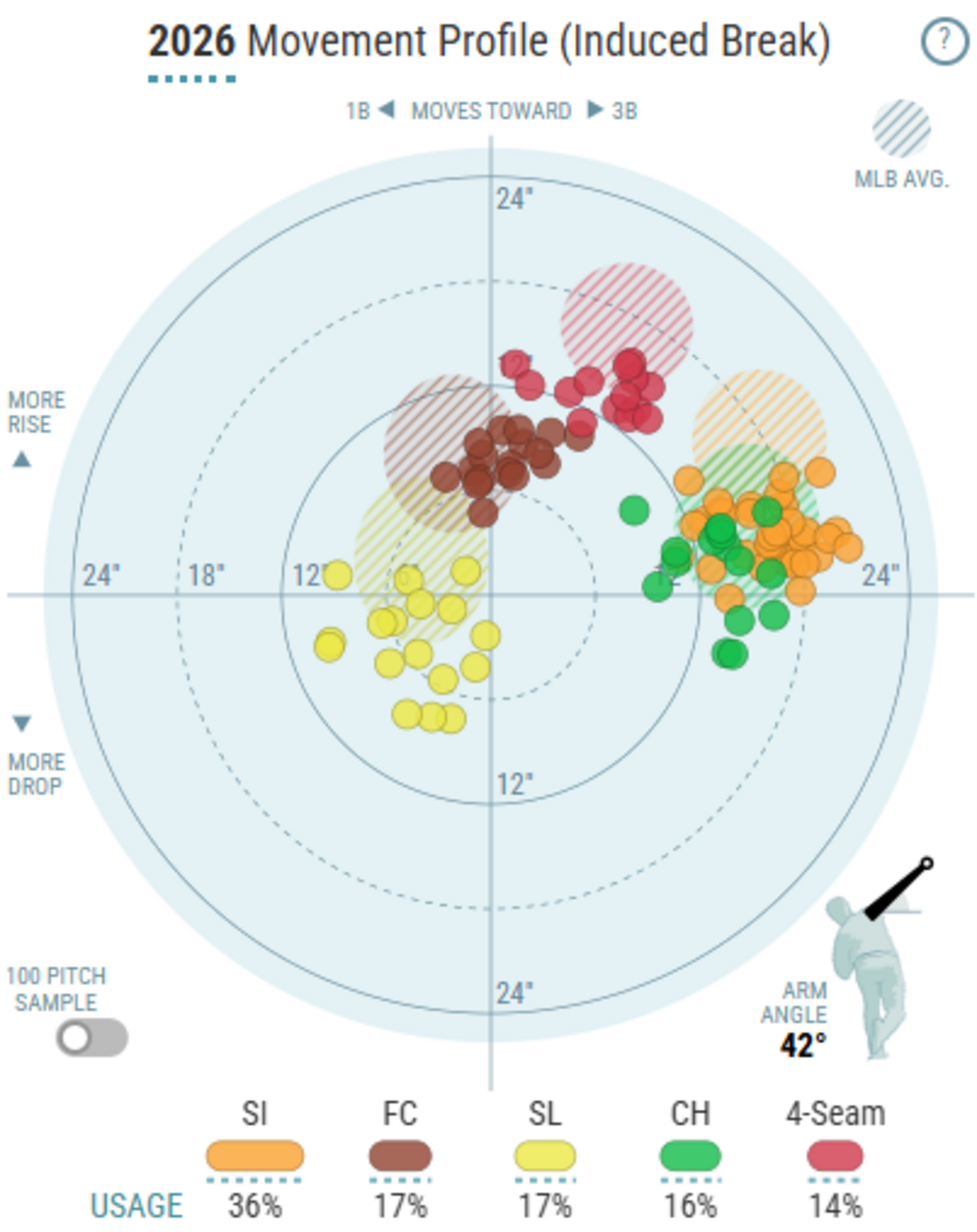
Via Baseball Savant
The picture above shows Ginn’s movement profile. The faded circles represent league average for each pitch, and you can see just how much more drop Ginn gets compared to most pitchers.
Once you mix in a cutter, the occasional four-seamer, and a changeup to lefties, you have a guessing game at the plate. Pair elite vertical movement on multiple pitches with a repertoire that is difficult to predict, and it creates a large challenge for opposing hitters.
What’s the plan of attack against Ginn? With some pitchers, you make them locate their slider and hunt fastballs. Or you know the changeup is lethal so you lay off low pitches, hoping to earn a fastball in zone. For Ginn, he’s not so predictable.
Ginn uses his sinker 36% of the time, but batters are only hitting .224 off the pitch. The other four pitches all fall between 13-17% usage.
What’s more, pitchers usually have a go-to two-strike pitch in order to put batters away. For Ginn, he goes to the sinker 28% of the time, the slider 14% of the time, the changeup 19% of the time, the four-seamer 15% of the time, and cutter 14% of the time.
Like I said, it’s a guessing game that makes up for what he might lack in pure velocity or frisbee-esque breaking balls.
If you watch a Ginn start, you will see batters being fooled. Late swing decisions or failing to get off their “A swing” has resulted in a 48% ground-ball rate and 87 mph average exit velocity. This has led to a 2.87 ERA, 4.10 FIP, and 3.87 xERA across 59.2 innings.
While Ginn’s start has been promising and a major lift for an Athletics rotation that had plenty of questions, there’s still room for improvement.
Next Steps for Ginn
In my opinion, the next step that Ginn has to take is consistency — a broad term that I’m using to cover more than one area of his game. He does not need to excel in every aspect of his game, but if he can improve even slightly across a few aspects, he will become a more complete pitcher.
Let’s start with pitch-to-pitch consistency. Ginn’s 11% walk rate is well-below league average, but I do not think it is because he has awful command. At times, Ginn can spot his fastballs right on the black and get ahead of counts.
The next pitch, or inning, that command can falter, leading to him fall behind and eventually issue ball four. If he can find a way to replicate those well-located pitches more often, it will unlock his secondaries and lead to better results.
The best example of this was his start in San Diego, where he only lasted 2.1 innings due to allowing six walks, but no hits. In that game, Ginn could not get any feel for his pitches. His sinkers were missing low in the zone, and none of his secondaries were able to be set up. That caused a poor outing just one start after pitching eight no-hit innings.
Ginn followed up his San Diego start with six innings of four-hit, one-run baseball but did allow three walks. That was the fourth game he has allowed three or more walks with his other nine appearances, albeit some much shorter, allowing one or no walks.
Locating pitches with as much vertical movement as Ginn’s can be difficult. I do not think he will eventually develop into the type of arm that rarely issues walks, and that’s okay. Being a ground-ball pitcher should help eliminate some baserunners and limit damage done in the air.
Sinker-heavy pitchers can have a tendency to have slightly lower strikeout numbers due to the amount of balls that get put into play via the ground ball. I don’t think Ginn needs to chase strikeouts or work to improve in that regard too much. He can be successful with his current plan of attack, and if he finds more consistency the A’s have a very useful pitcher on their hands.
Final Thoughts
Coming into the season the A’s rotation was an obvious weak spot. Not only did they lack high-end talent, but also depth. The emergence of J.T. Ginn has been a pleasant surprise that gives them an option now and into the future.
Sure, the A’s have three lefties that have higher ceilings coming up — in Gage Jump’s case, already here — but they need a righty to balance them out.
I’m not sure if the improvements Ginn has made both in movement and velocity are a product of the A’s development or more simply him being fully healthy. Regardless of the reason, the A’s needed someone to step up this season to help give them a chance at a postseason berth, and Ginn has filled that need nicely.
More must-reads:
- Twins' Royce Lewis has been on fire since his reset
- Cristopher Sanchez's scoreless streak ends as fifth-longest ever
- The 'Foreign-born 250-HR club' quiz
Breaking News
Trending News




Customize Your Newsletter
 +
+




Get the latest news and rumors, customized to your favorite sports and teams. Emailed daily. Always free!
PRIVACY POLICY COOKIE POLICY CONTACT US
ABOUT YARDBARKER TERMS OF SERVICE


By using this site, you agree to our Terms of Service and Privacy Policy.
This site is for entertainment purposes only.
There is no gambling offered on this site.
Gambling Problem? Call 1-800-Gambler.
