
-

-


Follow Us
-

 On Facebook
 On Flipboard
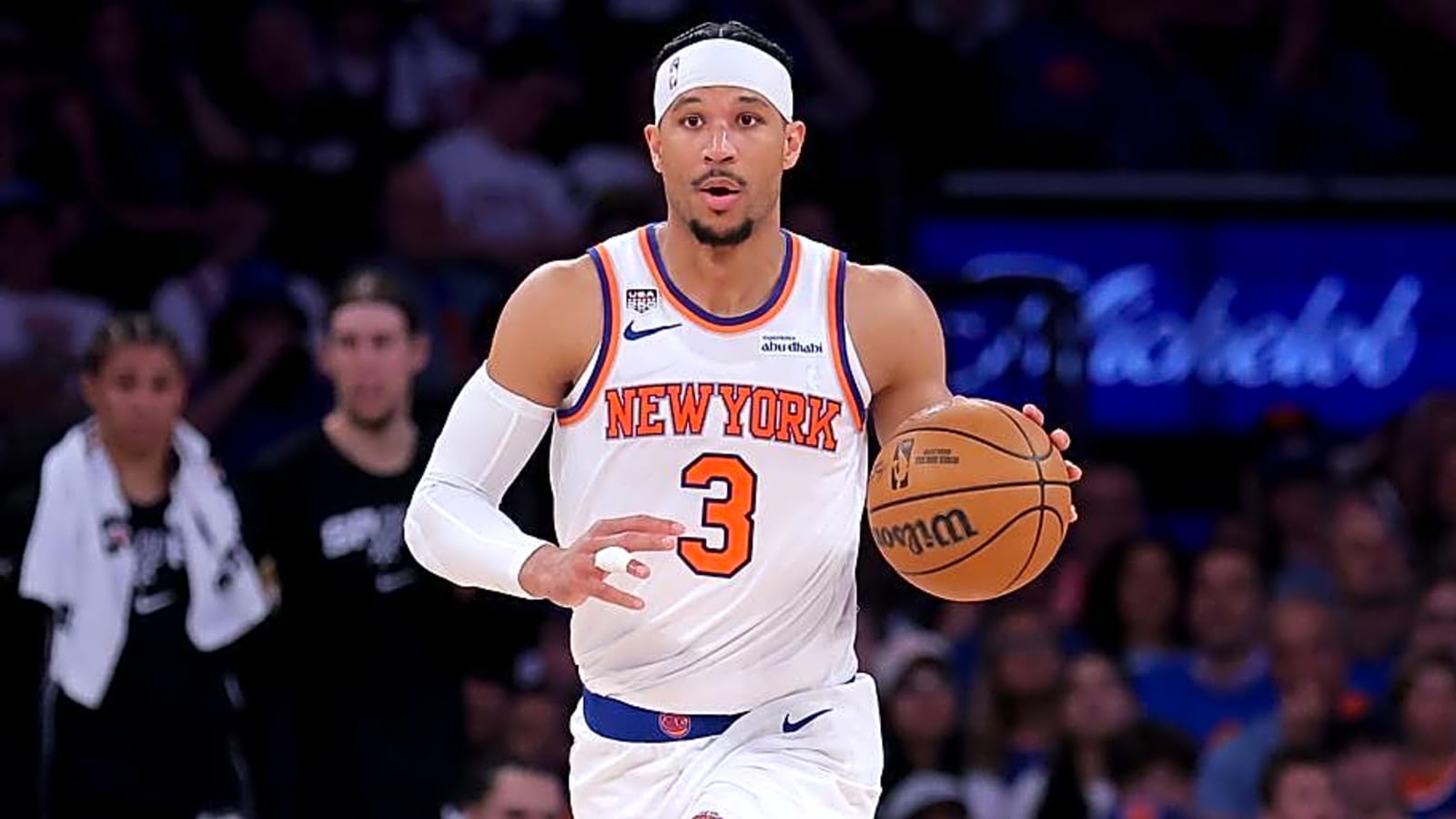
Josh Hart is coming off a strong 2025-26 campaign that saw him average 12 PPG, 7.4 RPG, and 4.8 APG on 50.8/41.3/72.0 shooting splits. He started all 19 of the Knicks’ playoff games en route to the team’s first title in 53 years.
Obviously, it’s known that Hart is one of the NBA’s best rebounders in terms of inch-for-inch skill. Also, Hart’s impact isn’t just limited to the counting stats; he’s the definition of someone you want if you’re building a champion.
But Hart is also someone who is propped up when the Knicks are winning, and receives some of the most flak, outside of the obvious targets in Karl-Anthony Towns and Mikal Bridges, when the Knicks flounder.
All of this creates a complex situation in terms of how to best use him.
Knicks sometimes had more success without Hart
The talk of the town for most of the season was inserting either Landry Shamet or Deuce McBride into the team’s starting lineup. There was some credence to that, since basically, for starters, any lineup McBride was inserted to flourished—that’s how it’s been since he’s become a regular rotation with the Knicks.
Throughout the season, I tracked all types of lineup data, thanks to PivotFade (which will sadly be shutting down on Sept. 1).
The Knicks’ starting lineup had a 118.5 offensive rating, 114.8 defensive rating, and +3.7 net rating during the 2025-26 season—including the NBA Cup Final and the postseason. However, all other lineups for the Knicks in 2025-26 had a 121.1 ORTG, 111.8 DRTG, and +9.3 NETRTG. Those numbers really make you think.
Why might the Knicks decide to go with a shooter over Hart in their starting lineup? During the 2025-26 season, the Knicks were exponentially better when they put four “shooters” on the floor alongside Karl-Anthony Towns.
| ORTG | DRTG | NETRTG | |
|---|---|---|---|
| 5-Out w/ KAT | 126.0 | 111.8 | +14.2 |
| All Other Lineups | 119.5 | 112.4 | +7.1 |
For context: The “shooters” in this exercise would be any combination of Jose Alvarado, OG Anunoby, Mikal Bridges, Jalen Brunson, Jordan Clarkson, Mohamed Diawara, Tyler Kolek, Deuce McBride, Landry Shamet, and Guerschon Yabusele.
The idea is that if you surround KAT with four other "shooters," you'll create the best possible spacing for him. The lineup data backs that up.
In the playoffs, when the Knicks used five-out with KAT, they produced a 135.3 ORTG, 101.9 DRTG, and +33.4 NETRTG in the playoffs. All other lineups in the postseason had a 120.0 ORTG, 106.3 DRTG, and +13.7 NETRTG. Obviously, the latter are still amazing numbers, but they're a step down from a group of certain lineups without Hart that demolish teams.
Josh Hart has limitations, but he makes up for them in other ways
Shax on Twitter hand-tracked every single halfcourt offense. More specifically, he tracked when the opposing team’s big—their “five”—guarded Josh Hart when the five-man starting lineup was on the floor. In these scenarios, the opposing team would basically be throwing "ghost coverage" at Hart, meaning their center is guarding him when he's sitting beyond the three-point arc but from the paint.
That defensive coverage restricts the Knicks' capability to operate and usually hampers the offense, at least that's what happened during most of the 2025-26 season.
Using my own tracking data, in the games with “heavy” five-on-Hart usage (opposing team uses it for 10+ halfcourt offensive possessions vs. the starting lineup), the Knicks struggled to a 105.2 ORTG, 115 DRTG, and -9.8 NETRTG in those games. In all other lineups in those selected games, the Knicks excelled.
| Knicks in Games w/ Heavy 5-On-Hart Usage, 2025-26 Season | ORTG | DRTG | NETRTG |
|---|---|---|---|
| Starting Lineup | 105.2 | 115.0 | -9.8 |
| All Other Lineups | 124.1 | 107.0 | +17.1 |
There were two games in the Finals vs. the Spurs (Game 1 & Game 3) where 5-on-Hart defense was used against the starting lineup. The starting lineup offense (123.2 ORTG) was much better than all other lineups (112.2 ORTG) in those two games.
To that point, something that the data simply doesn't quantify is the type of synergetic player that Hart is. He's one of the truly elite connectors on both sides of the floor who doesn't ever require to be the focal point.
The thing to remember when talking about Hart’s inclusion or exclusion from the starting lineup is his fit alongside Knicks’ star Jalen Brunson.
According to DataBallr, among the three options with at least one of them or both of them on the floor, the Knicks’ highest ORTG (122.5) and NETRTG (+9.4) came from when Brunson AND Hart were on the floor, and that includes in the playoffs.
| ORTG | DRTG | NETRTG | |
|---|---|---|---|
| Brunson & Hart ON | 122.5 | 113.1 | +9.4 |
| Brunson ON & Hart OFF | 121.2 | 115.1 | +6.2 |
| Hart ON & Brunson OFF | 113.7 | 111.3 | +2.4 |
Hart's role in Knicks' championship can't be overlooked
Knicks fans saw in the Finals just how crucial Hart was, even when he wasn’t scoring.
He almost averaged 10 rebounds per game. He had 15 rebounds and six assists in the Game 1 victory. Then he put together a 13-point, 11-rebound performance in the NBA Finals-clinching Game 5 win. The Knicks’ were plus-38 in Hart’s 152 minutes played in the Finals and minus-26 in the 88 minutes that he sat in the series.
The data into the series is even cleaner, per PivotFade. The Knicks had a 114.4 ORTG with Hart on the floor, which isn’t great, but that number was accompanied by a 100 DRTG, and +14.4 NETRTG. Without him on the floor vs. the Spurs? The Knicks had a 109.1 ORTG, 125.6 DRTG, and -16.5 NETRTG. That’s a 30.9 points per 100 possession swing!
Hart rewarded Mike Brown and Leon Rose for sticking with him by helping deliver a championship to MSG. Rewind back to March following a frustrating win against a skeleton squad Warriors team and Brown, angered by the performance, looked like he was on the brink of making a lineup change.
While for much of the season, the question seemed to be should the Knicks swap Hart out for either Deuce/Shamet, it ended up being Bridges who needed to take a seat in the first round. But then the Knicks became a historic team and the questions seemed to disappear, as they do when teams don't lose.
Staying with the status quo works, for now
One of the biggest things to take from all of this is that there are a lot of factors that come into play with Brown's lineup decisions. He’s afforded even more wiggle room now that he’s brought the Knicks’ franchise back to perfection with their championship title.
With the Knicks, we saw how Tom Thibodeau’s coaching style ended up leading to his demise. With Brown, he’s much better at handling the different personalities in the locker room with the Knicks. When things weren't clicking on the floor, it seemed like Brown always found the right recipe for success. In the end, though, he still realized that his starting five sticking together was their best bet at winning.
A thing that came apparent with how Brown handled the whole ordeal (whether to keep starting Hart or make a change) was that he perfectly understood the dynamics of the team. Despite being one of the further down the line options in terms of “stars” on the Knicks’ roster, Hart is one of the leaders in the locker room.
Outside of Jalen Brunson—who is the team’s captain—Hart is probably the “next man up” in terms of leaders. KAT isn’t the type of guy to step on toes. Mikal Bridges is everyone’s best friend. OG Anunoby is, well, a quiet force. Hart is like that perfect puzzle piece to what already looks to be a complete puzzle. Just that glue guy that makes everything click.
New York is going to enter the 2026-27 season with the same starting five we've seen for most of the previous two seasons. That should be the case because the Knicks just won a championship.
The question becomes, will there be a Hart-related change to explore more deeply if the same success doesn’t come for this group? There's at least some evidence that lends itself to it that idea, but also on- and off-court reasons to keep Hart as a starting lineup focal point.
Get Knicks On SI straight to your inbox: sign up for our free newsletter here.
More must-reads:
- Five most important potential trade chips in 2026-27 NBA season
- Angels have clear first order of business under new ownership
- The 'Season sack leaders by team' quiz
Breaking News
Trending News




Customize Your Newsletter
 +
+




Get the latest news and rumors, customized to your favorite sports and teams. Emailed daily. Always free!
PRIVACY POLICY COOKIE POLICY CONTACT US
ABOUT YARDBARKER TERMS OF SERVICE


By using this site, you agree to our Terms of Service and Privacy Policy.
This site is for entertainment purposes only.
There is no gambling offered on this site.
Gambling Problem? Call 1-800-Gambler.
