When it comes to legends of the college basketball game, the Atlantic Coast Conference has produced some of the greatest. Here's our list of the 25 best, listed in chronological order.
1 of 25
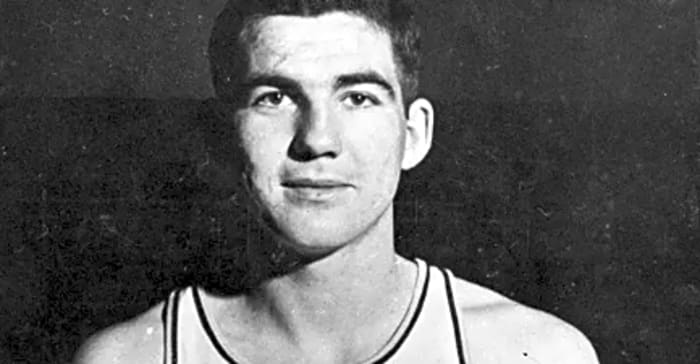
Dickie Hemric, Forward, Wake Forest (1952-'55)
Wake Forest University
Hemric was the first star of the Atlantic Coast Conference. After playing his first two seasons of college ball when Wake Forest resided in the Southern Conference, the Demon Deacons moved to the ACC. He went on to win ACC Player of the Year in 1954 and '55, and the league's male athlete of the year in his final campaign. Hemric remains the school's all-time leading scorer with 2,587 points and 1,820 rebounds. The All-American's No. 24 was retired by Wake Forest.
2 of 25
Lennie Rosenbluth, Forward, North Carolina (1955-'57)
Bettmann/Contributor/Getty Images
Rosenbluth was a significant reason for North Carolina winning its first national title in 1957. The national player of the year that season, Rosenbluth averaged 28.0 points (totaling a school single-season record 897 points) and 8.8 rebounds for coach Frank McGuire's 32-0 Tar Heels. During his three seasons at North Carolina, Rosenbluth averaged a school-record 26.9 points, and his 2,047 total points rank sixth in school history while earning All-ACC first-team honors three times and the league's player of the year in 1957. His 10.4 career rebounding average currently ranks among the top 10 in school history.
3 of 25
Len Chappell, Forward-Center, Wake Forest (1960-'62)
Wake Forest University
Wake Forest had another ACC star in Chappell, who was a three-time, first-team all-conference selection and the league's player of the year in 1961 and '62. During his final campaign, Chappell averaged 30.1 points on 54.8 percent shooting and 15.2 rebounds, when he was named ACC Athlete of the Year. Third in Wake Forest history with 2,165 points, Chappell held the title of career ACC scoring leader until the mid-2000s. Chappell's No. 50 is also retired by the Demon Deacons.
4 of 25
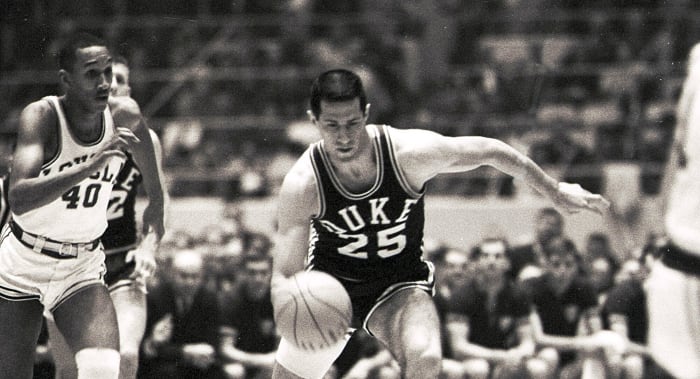
Art Heyman, Guard-Forward, Duke (1961-'63)
Rich Clarkson/NCAA Photos via Getty Images
One of three players to be unanimously named a first-team All-ACC selection. Heyman ranks among Duke's and the conference's all-time leaders, averaging 25.1 points -- spanning three seasons. His 10.9 career rebounding average also ranks among the best in school history. The most notable of Heyman's three seasons came in 1962-63, when he averaged 24.9 points and 10.8 rebounds to lead the Blue Devils to their first Final Four appearance and earn ACC Player of the Year and National Player of the Year honors from The Associated Press.
5 of 25
Billy Cunningham, Forward, North Carolina (1962-'65)
Bettmann/Contributor/
Before Cunningham found success in the NBA as both a player and coach, he put together one of the greatest careers in North Carolina and ACC history. While his 24.8 scoring average is among the best in school history, Cunningham is Carolina's all-time leader in rebounds per game with 15.4. His 1,062 career rebounds rank fifth in school history, and he recorded 60 double-double games for points and rebounds. Cunningham's 48-point effort versus Tulane on Dec. 10, 1964, is the second-highest scoring game among all Tar Heels. The All-American and 1965 ACC Player of the Year is was a three-time, first-team all-conference pick.
6 of 25
Charlie Scott, Guard, North Carolina (1968-'70)
University of North Carolina
During his four seasons as a Tar Heel, Scott was a three-time, first-team All-ACC selection who ranks among the top 10 in school history with a 22.1 scoring average and total points (2,007). His 43 against Wake Forest during the 1969-70 season is tied for eighth in school history. Scott also ranks in North Carolina's top 10 in made field goals (805).
7 of 25
Tommy Burleson, Center, North Carolina State (1972-'74)
North Carolina Sports Hall of Fame
The first of two members from N.C. State's 1974 national championship squad -- which took down mighty UCLA, in the process. One of the great defensive post players of all time, the 7-foot-2 Burleson was a two-time All-ACC first-team pick (1972, '73) and an All-American. He ranks second in school history with 1,066 rebounds and is 10th with 1,598 points for the Wolfpack.
8 of 25
David Thompson, Forward, North Carolina State (1973-'75)
Rich Clarkson/NCAA Photos via Getty Images
One of the greats to ever take a college court, Thompson was a three-time ACC Player of the Year, two-time national player of the year, and twice selected the conference's Male Athlete of the Year. He's still considered one of the most exciting players in the history of college basketball. The high-flying Thompson averaged 26.8 points and led the Wolfpack to the 1974 National Championship, when he was named Final Four Most Outstanding Player. He’s the only N.C. State player to have his number (44) retired by the school, where he ranks second in career points (2,309).
9 of 25
John Lucas, Guard, Maryland (1973-'76)
University of Maryland
Three times, Lucas was named a first-team All-Big Ten performer for the Terrapins. In his four seasons at Maryland, the two-time All-American averaged 18.3 points and shot 52.5 percent. A wizard with the basketball, Lucas also dished out nearly five assists per game and averaged 3.4 rebounds. In 1976, Lucas was named ACC Athlete of the Year.
10 of 25
Phil Ford, Guard, North Carolina (1975-'78)
Rich Clarkson/NCAA Photos via Getty Images
As is the case with many on this list, Ford was not just among the best in the history of UNC basketball but in the college game overall. He ranks fourth among all Tar Heels with 2,290 career points. His 865 made field goals and 753 assists are also among the most in school history. Ford averaged 18.6 points and shot 52.7 percent while dishing out 6.1 assists per game. In 1977-78, the two-time All-American was the ACC Player of the Year and honored with the Wooden Award. In addition, Ford was twice named ACC Athlete of the Year (1977, '78) and a three-time, first-team all-conference selection.
UPI/Bettmann Archive/Getty Images
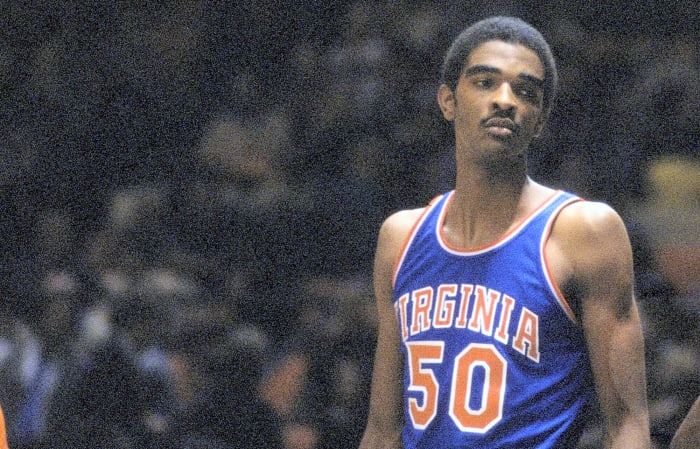
The 7-foot-4 Sampson is one of two players to win the Naismith Player of the Year award three times. In four seasons at Virginia, Sampson averaged 16.9 points, 11.4 rebounds and 3.5 blocks. However, he never won a National Championship. The three-time national player of the year and ACC Player of the Year, Sampson, whose No. 50 was retired by the program, is the school's all-time leader in rebounds (1,511), made field goals (899), and blocks (462). He was inducted into the College Basketball Hall of Fame in 2011.
Wally McNamee/CORBIS/Getty Images
Worthy averaged a team-leading 15.6 points during the 1981-82 season, which the Tar Heels concluded with the school's second national title. An All-American that season, Worthy was named NCAA Tournament Most Outstanding Player in 1982, the same campaign we has named ACC Player of the Year. Overcoming an injury that cut short his freshman season, Worthy totaled 1,219 points (14.5 average), 620 rebounds (7.4), 208 assists (2.5), 117 steals (1.4), and 94 blocks (1.1) for his collegiate career.
13 of 25
Michael Jordan, Guard, North Carolina (1982-'84)
Bettmann Archive/Getty Images
Jordan is arguably the greatest basketball player of all time, more so for what he did in the NBA. But the signs of his true greatness were obvious at North Carolina. He was the ACC Rookie of the Year in 1982 — the same season when his late jumper helped deliver a National Title for the Tar Heels. Jordan averaged 19.8 points and showed some defensive dominance in his last two seasons while earning All-American honors in both. During his three collegiate seasons, Jordan averaged 17.7 points, shot 54.0 percent, and pulled down 5.0 rebounds per game.
14 of 25
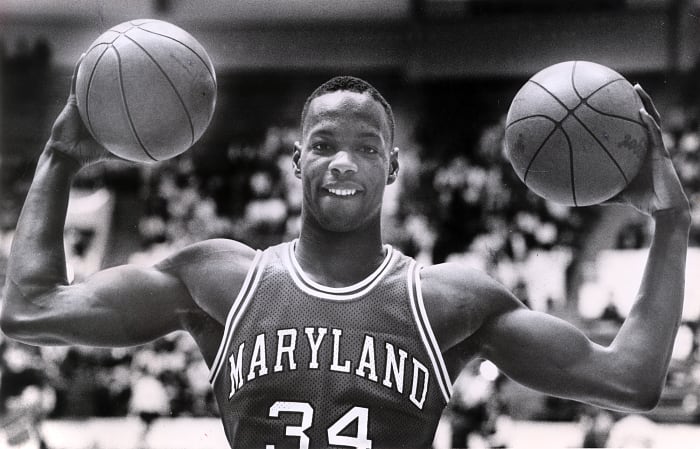
Len Bias, Forward, Maryland (1983-'86)
Joel Richardson/The Washington Post via Getty Images)
The tragic tale of Bias's life is well documented. Notably, because Bias appeared headed for NBA stardom following a highly successful college career, which began with some raw, unpolished talent. The All-American forward was twice named ACC Player of the Year (1985, '86). As a senior in 1985-86, Bias averaged 23.2 points and 7.0 rebounds -- both career highs. He shot 53.6 percent for his career and even showed off some impressive ball-handling skills during his time at Maryland.
15 of 25
Johnny Dawkins, Guard, Duke (1983-'86)
NCAA Photos/Contributor/Getty Images
Dawkins never earned ACC Player of the Year honors while at Duke. However, he was a two-time first-team All-American (1985, '86) and the Naismith Player of the Year as a senior in 1985-86, when he averaged 20.2 points and shot 54.9 percent for the national runner-up Blue Devils. He ranks second in school history with 2,556 career points. Dawkins' No. 24 was retired by the school, and he was part of the ACC's 50th Anniversary men's basketball team.
Focus on Sport/Contributor/Getty Images
The pride of prep powerhouse DeMatha Catholic, Ferry was a two-time ACC Player of the Year (1988, '89), and the first player in conference history to record at least 2,000 points, 1,000 rebounds, and 500 assists. His college career culminated with a senior season in which he averaged 22.6 points on 52.2 percent shooting and 7.4 rebounds, winning the Naismith and UPI Player of the Year Awards. Ferry ranks among the top 10 in school history for points (2,155), rebounds (1,003), and assists (506), and helped lead Duke to three Final Four appearances.
17 of 25
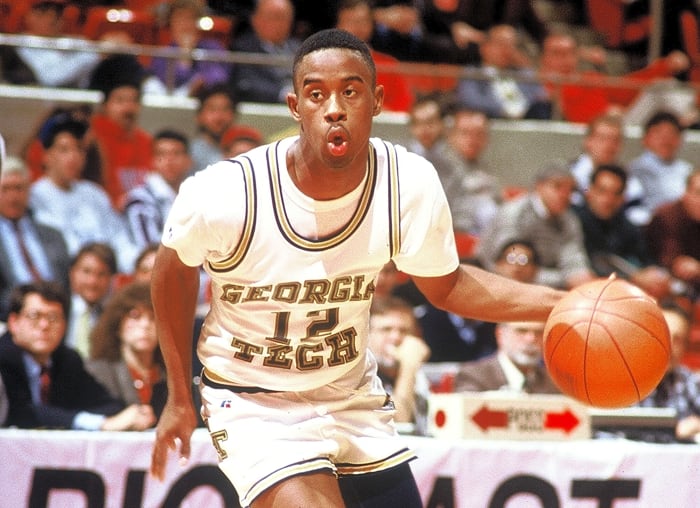
Kenny Anderson, Guard, Georgia Tech (1990-'91)
Bob Stowell/Getty Images
Anderson spent just two seasons at Georgia Tech but earned All-American honors in both. He was named ACC Rookie of the Year for 1989-90, when he helped lead his team to the Final Four. During that stellar freshman campaign, Anderson averaged 20.6 points on 51.5 percent shooting and 8.1 assists. As a sophomore, the two-time All-ACC first-teamer averaged 25.9 points and a career-high 5.7 rebounds and 3.0 steals.
Phil Sears/Contributor/Getty Images
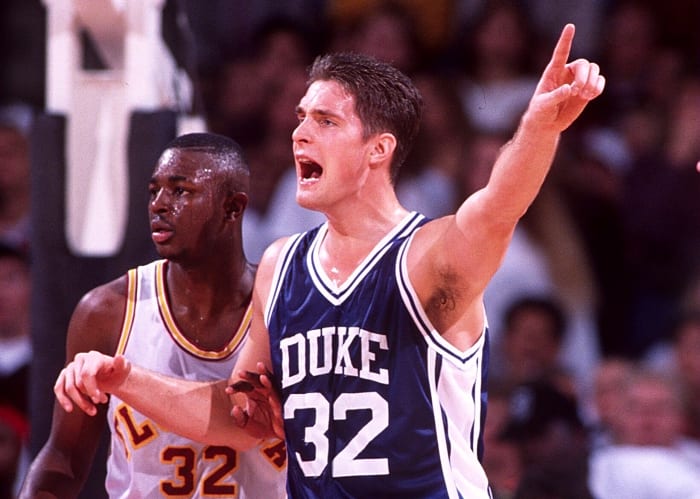
Loved by Dukies and hated by most other hoops fans, Laettner is one of the greats ever to play the college game. A career 57.4 percent shooter and the all-time leader with 407 NCAA Tournament points, Laettner was a two-time national champion, an All-American, and ACC Player of the Year. His game-winning shot against Kentucky in the 1992 regional final is simply legendary. Laettner ranks third all-time at Duke in points (2,460), first in 3-point field-goal percentage (48.5), third in rebounds (1,149), and fifth in steals (243). The two-time ACC Athlete of the Year is a member of the College Basketball Hall of Fame.
19 of 25
Bobby Hurley, Guard, Duke (1990-'93)
Rich Clarkson/NCAA Photos via Getty Images
Hurley could be an agitator at times, but he also helped the Blue Devils win back-to-back national championships and is the NCAA's all-time leader in assists with 1,076 (7.7 average). He averaged a career-high 13.2 points and 7.6 assists while earning Final Four Most Outstanding Player honors in 1991-92. A season later, Hurley was named a consensus first-team All-American. Hurley earned all-ACC honors three times, highlighted by a first-team nod in 1993.
20 of 25
Grant Hill, Forward, Duke (1991-'94)
Phil Sears/Allsport/Getty Images
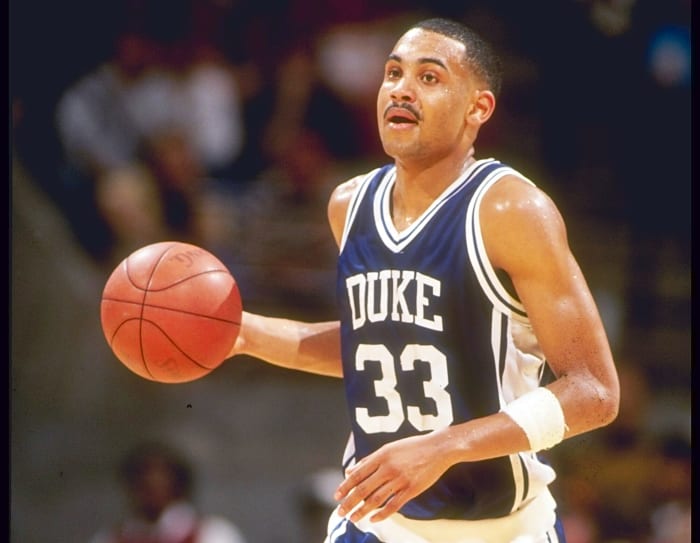
Hill joins Christian Laettner and Bobby Hurley on those back-to-back national title squads. He was the guy who threw the long inbounds pass to Christian Laettner for that unthinkable buzzer-beater against Kentucky in the 1992 NCAA Tournament. As a freshman on the Blue Devils' 1991 title team, Hill averaged 11.2 points and 5.1 rebounds. A consensus All-American and ACC Player of the Year in 1994, Hill is the first player in league history to record more than 1,900 points, 700 rebounds, 400 assists, 200 steals, and 100 blocks.
21 of 25
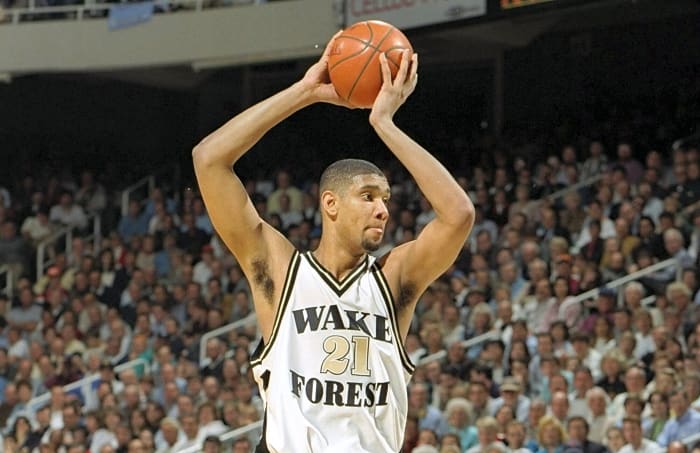
Tim Duncan, Forward, Wake Forest (1994-'97)
Doug Pensinger/Staff/Getty Images
Duncan got better each of the four years he played at Wake, where he was named All-ACC first team on three occasions and Player of the Year in 1996 and '97. The two-time All-American averaged a double-double from his sophomore year on, highlighted by 20.8 points and 14.7 rebounds while earning National Player of the Year honors in 1997. The 6-foot-10 Duncan will also go down as one of the best defenders (career 3.8 blocks per game) of all time, and was the ACC's career rebound leader with 1,570, until North Carolina's Armando Bacot surpassed him earlier this decade. For his college run, the Hall-of-Famer averaged 16.5 points, 12.3 rebounds, 3.8 blocks, and 2.3 assists.
22 of 25
Chris Paul, Guard, Wake Forest (2004-'05)
Sean Meyers/Icon Sportswire
The ageless wonder made a true name for himself at Wake Forest, where he played just two seasons, but made a major impact on the program. Paul was the ACC Rookie of the Year in 2003-04, when he averaged 14.8 points, 5.9 assists and 2.7 steals. The next season, Paul averaged 15.3 points, 6.6 assists and 4.5 rebounds. The All-American also shot 47 percent from 3-point range during his two seasons for the Demon Deacons.
23 of 25
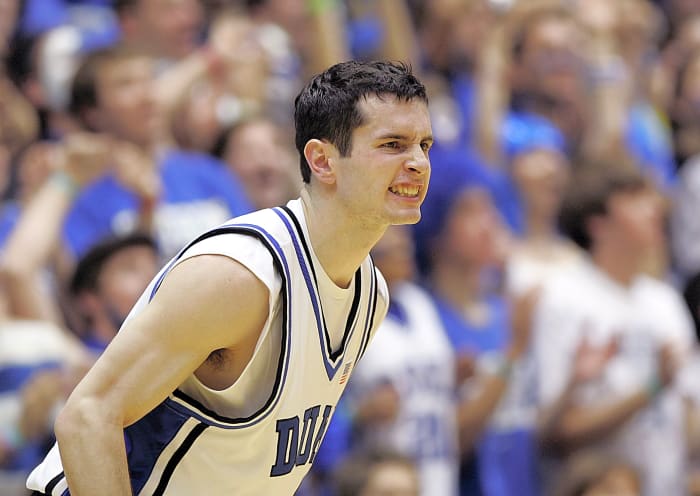
JJ Redick, Guard, Duke (2003-'06)
Kevin C. Cox/WireImage/Getty Images
The Blue Devils' all-time leader with 2,769 points, which is second-most in ACC history. The two-time national player of the year (2005, '06) is the ACC career leader with 457 made 3-pointers. The two-time conference player of the year and ACC tournament MVP also sits among the Duke leaders for free-throw percentage (.912), consecutive free throws made (54), 20-point games (70), and 30-point games (20). Redick, whose No. 4 hangs in Cameron Indoor Stadium, averaged 19.9 points and shot 40.6 percent from 3-point range for his career.
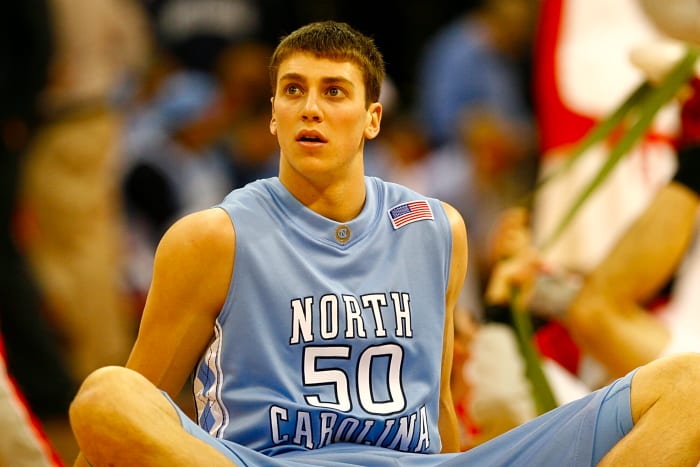
Andy Altenburger/Icon Sportswire
No player in North Carolina and ACC basketball history has scored more points than Hansbrough's 2,872. Meanwhile, he ranks eighth in league history for rebounds (1,219). Hansbrough is also among the school and conference leaders for double-figure scoring games (138), made field goals (939), and made free throws (982). Hansbrough, who averaged 20.2 points and 8.6 career rebounds, was the first ACC player to be named first-team all-conference four times, and he's also been honored as a three-time first-team All-American. He swept the national player of the year awards in 2007-08 and helped the Tar Heels win the 2009 national championship.
David Banks/Imagn Images
After a foot injury forced Brogdon to redshirt his 2012-13 sophomore season at Virginia, he returned determined to prove his worth. And he certainly did, starting all 108 games he played over the next three seasons for the Cavaliers. A first-team All-ACC performer in each of his final three collegiate seasons, Brogdon was twice honored as the league's defensive player of the year (2015 and '16). He was named ACC Player of the Year in 2015-16, when he averaged 18.2 points, shot 39.1 percent from 3-point range, and also set a career high with 3.1 assists per contest, while pulling down 4.1 rebounds a game. A two-time All-American (first and second teams), Brogdon is Virginia's all-time leader with an 87.6 free-throw percentage, and ranks among the school's career top 10 in points (1,809) and made 3-pointers (185).





 On Facebook
 On Flipboard












 +
+






