
-

-


Follow Us
-

 On Facebook
 On Flipboard

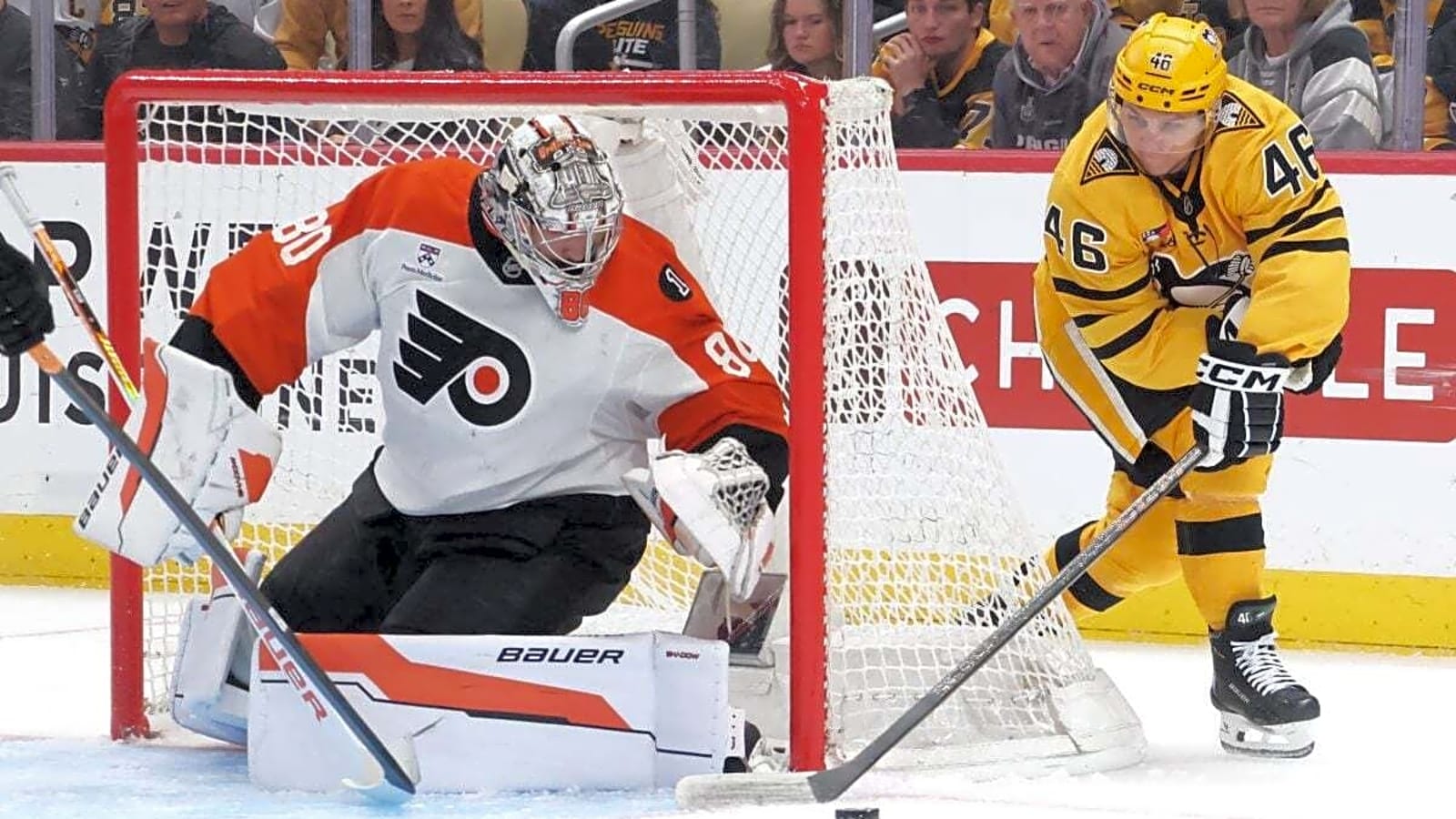
As rain fell outside Xfinity Mobile Arena on Saturday night, a giant cloud hung over the Pittsburgh Penguins’ dressing room. This may be an unexpected playoff run for the Penguins, but the consequences of it ending—especially so soon—are real. There are only so many chances left for Sidney Crosby and company, and a sweep to the hated Philadelphia Flyers would’ve been a demoralizing way to go out.
It would have felt sweet for the Flyers to finish the job on Saturday, in front of another sold-out crowd soaking in the first Stanley Cup Playoff games in Philadelphia since 2018. But just like in each of the first four Battle of Pennsylvania meetings in the Crosby era, the first chance to close out the series would not be the last. The Penguins extended the series with a 4-2 win, securing a return to the Steel City on Monday night.
Penguins Veterans Leading the Way
For all the talk of the young players powering the Penguins’ resurgence and the crafty moves general manager Kyle Dubas made since arriving in 2023 to get Pittsburgh back to the playoffs, this is still a veteran team. In fairness to the old guard, they held up their end of the bargain in the first three games, with Evgeni Malkin, Bryan Rust and Erik Karlsson scoring all four Penguins goals.
They amplified their impact with their backs against the wall on Saturday night. Crosby delivered (perhaps) one last blow in front of Flyers fans, one of the most mutually antagonizing relationships in the NHL. Just like Malkin in Game 3, Crosby buried a one-timer from the slot on the power play (PP), helping the Pittsburgh PP get back on track after a difficult start to the series.
Once again, Crosby was on the scene early in the third period, craftily using his skate to win a 4-on-4 board battle. Kris Letang has received a lot of criticism before and in this series, and for fair reasons. But he, too, offered a throwback moment, getting the puck in the middle and unloading a blast for his first goal and point of the series, punctuated by a big celebration as the Penguins restored their two-goal lead.
Couple that with a two-point game for Rickard Rakell and another assist for Karlsson, and Pittsburgh showed the poise expected of one of the league’s most battle-tested teams. It wasn’t just the offense; the Penguins delivered an excellent defensive effort down the stretch, giving the Flyers a taste of their own medicine in keeping them out of the high-danger areas after the lead was trimmed back to one.
Silovs Flips the Goaltending Script
Head coach Rick Tocchet has seen Arturs Silovs star after entering the middle of a playoff series before. Tocchet was essentially forced into using Silovs during the 2024 Western Conference Quarterfinals with the Vancouver Canucks after his top two goaltenders both went down with injuries. Silovs posted a .940 save percentage to win all three of his starts against the Nashville Predators, including a shutdown on the road in the series-clincher, despite not receiving any goal support until the final two minutes.
After Stuart Skinner struggled for the first time in the series in Game 3, Penguins head coach Dan Muse made a change in net and was rewarded. Silovs wasn’t tested at all in the first 10-plus minutes, so he worked with a lead almost the entire game. But that shouldn’t detract from his play, as he made numerous quality saves throughout the night.
In contrast, Dan Vladař was shaky in his first start after a collision with Bryan Rust brought his availability into question until Saturday morning. Vladař got a piece of Crosby’s one-timer in the first, but it bounced off the top of his glove and into the back of the net. But it was his mishandling of the puck early in the second period that really stung, as Rakell stripped him in the trapezoid and dove to slide the puck into the empty net.
Goaltending was regarded as arguably the Flyers’ biggest advantage entering the series, and that was certainly the case in the first three games. But Silovs’ heroics combined with Vladař’s vulnerability make that edge less clear than before.
Flyers Make a Change
So far, the only adjustment the Flyers have made since the series began is replacing an injured Emil Andrae with Noah Juulsen in Game 2. That’s life when you take a 3-0 series lead in the playoffs; if it ain’t broke, don’t fix it.
The Flyers probably won’t make major tweaks going forward, but they did show one adjustment as the game progressed. It showed on the Flyers’ first goal, when Trevor Zegras found Denver Barkey on the doorstep for the rookie’s first playoff tally. Barkey finished the game on the top line with Zegras and Owen Tippett, while Tyson Foerster joined the third line with fellow point-less winger Matvei Michkov between Noah Cates.
Barkey and Zegras had success earlier in the series when they both assisted on Jamie Drysdale’s series-opening goal. Despite standing at just 5-foot-9, Barkey hasn’t backed down around the boards or the net mouth in this series. The change also allows Foerster to return alongside Cates, with whom he’s played more than any current Flyer over the last few seasons.
What’s Next
Another game at PPG Paints Arena at 7 p.m. on Monday. The Penguins will look to successfully fend off elimination at home for the first time since their iconic 2017 Eastern Conference Quarterfinal Game 7 victory; they’re 0-2 in home elimination games since.
The Flyers have now played in six straight playoff series where a team has successfully staved off elimination. The good news for them is that the team that had the series lead wound up still winning each time. With the Carolina Hurricanes locked in as the series winner’s round two opponent, there should be urgency for the Flyers to finish the series on Monday to maximize rest—and more importantly, prevent the comeback seed from growing for their opposition.
More must-reads:
- Five surprising NHL stats that probably can't be replicated next season
- Chandler Smith not returning to Front Row Motorsports in 2027
- The 'Most passing-TD's by NFL team' quiz
Breaking News
Trending News


Customize Your Newsletter
 +
+




Get the latest news and rumors, customized to your favorite sports and teams. Emailed daily. Always free!
PRIVACY POLICY COOKIE POLICY CONTACT US
ABOUT YARDBARKER TERMS OF SERVICE


By using this site, you agree to our Terms of Service and Privacy Policy.
This site is for entertainment purposes only.
There is no gambling offered on this site.
Gambling Problem? Call 1-800-Gambler.
