
-

-


Follow Us
-

 On Facebook
 On Flipboard

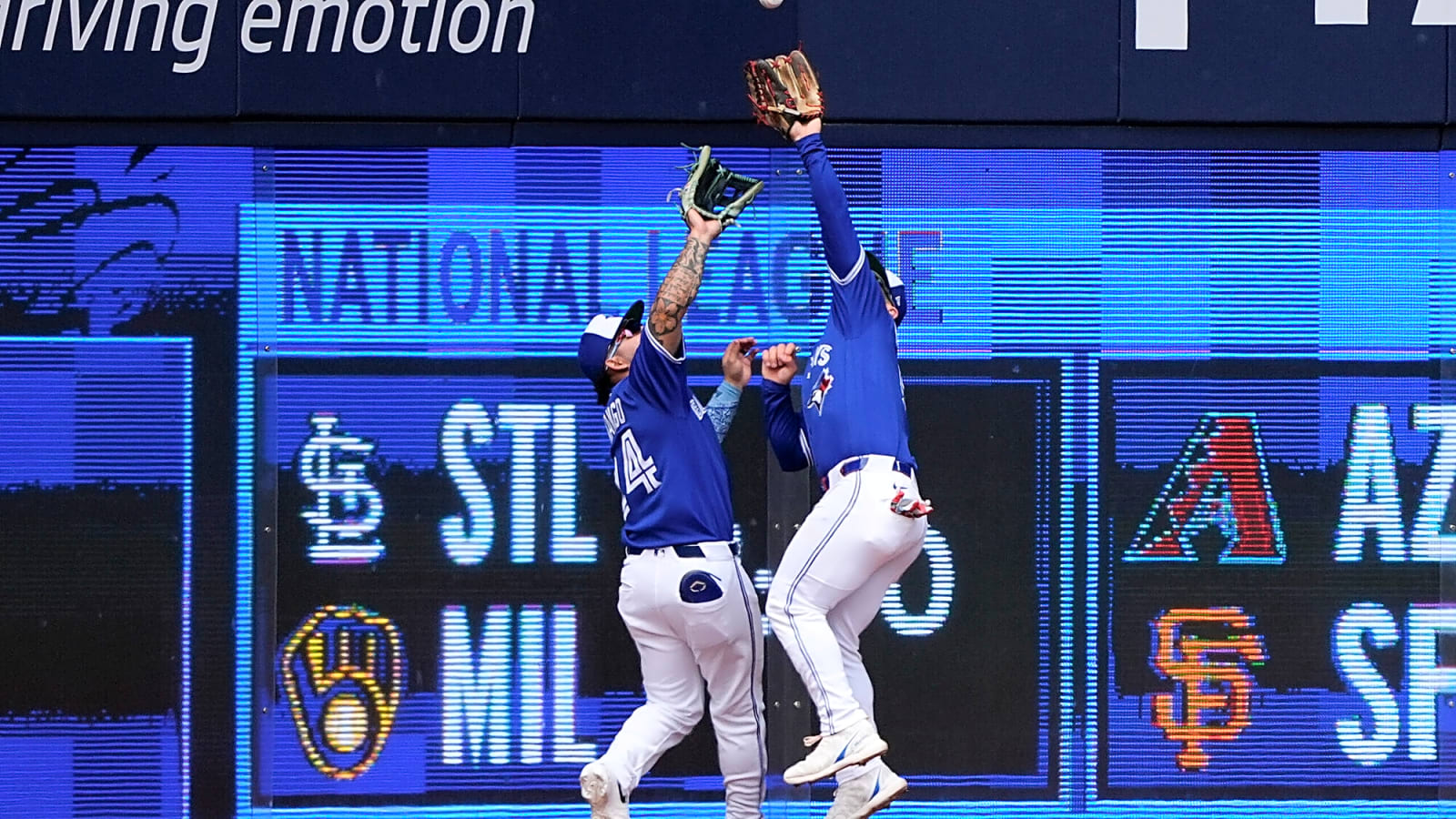
Many factors are to blame for the Toronto Blue Jays’ disappointing start to this season, namely these never-ending injury waves and an inconsistent offence. But you could argue that nothing has been more surprising than this team’s uncharacteristically poor defence thus far.
Delivering a fundamentally sound defensive product has been at the core of the Blue Jays’ team identity for the last few years. It’s one of the main philosophies that has separated them from offence-reliant clubs such as the New York Yankees, which also played a crucial role in their magical run to last fall’s World Series.
Across these first two months, however, we haven’t seen nearly enough of the defensively sound 2025 Jays.
Entering this season, Toronto’s defence was widely considered one of the premier units throughout Major League Baseball, after capturing consecutive American League team Gold Glove awards in 2023 and ’24 — almost winning a third straight in ’25 that ended up going to the Texas Rangers, whose defence led the majors in defensive runs saved (89), despite trailing Toronto’s in both fielding run value (44) and defensive WAR (38.8).
But there’s been a massive performance decline among several Blue Jays defenders to start the ’26 campaign, significantly diminishing the organization’s once top-of-the-heap run prevention.
| DRS (MLB rank) | OAA | FRV | |
| TOR’s defence from 2023-25 | 227 (1st) | 46 (T-6th) | 109 (2nd) |
| TOR’s defence this season | 0 (20th) | -2 (17th) | 11 (6th) |
We’ve witnessed an uptick in sloppiness and a failure to convert routine plays, causing Toronto’s defence to plummet from the sport’s top tier to hovering around the middle of the pack, results-wise. If not a bit lower than that in a few categories.
For an active group with four former Gold Glove winners (Vladimir Guerrero Jr., Daulton Varsho, Andrés Giménez, Myles Straw), five if you include Kazuma Okamoto’s NPB accolades, this isn’t anywhere close to the elite standard they’ve previously set.
What’s even more troubling is that, on paper, this was supposed to be an improved defensive personnel compared to a year ago. But instead, it’s been the complete opposite.
So, where have things gone wrong, and how did we arrive here so quickly? Let’s find out.
Core defender struggles
The Blue Jays need their best players to perform as their best players, as the saying goes. Much of the attention in that regard has been directed towards the offence, and understandably so. At the same time, it’s just as meaningful on defence, too, particularly when Varsho and Ernie Clement — two of this team’s top defenders — haven’t been at their best.
Varsho, who entered this season leading all major-league outfielders in DRS (85), OAA (50) and FRV (52) since 2022 and is considered by many — including manager John Schneider — as the premier defender at his position, has submitted a subpar first-half performance in ’26. In 464.2 innings as Toronto’s everyday centre-fielder, he’s accounted for just one DRS, OAA and FRV each thus far.
His range still sits in the 77th percentile of the majors, a ranking most outfielders would be pleased with. But considering he’s placed in the 95th percentile or higher each season since ’22, the 29-year-old’s expectations are higher than most.
It should be noted that Varsho’s average sprint speed has fallen to a career-low 27.2 (feet per second) this season. That certainly shouldn’t be overlooked, though his diminished outfield jumps are where his biggest concerns reside. He’s struggled with all three components in that department — reactions, bursts and routes, all of which have dropped considerably compared to his peak 2022-25 seasons.
That’s recently prompted a change to Varsho’s pre-pitch set-up in centre, during which he now angles both his feet outwards to put him in a more advantageous position for his initial read, as Sportsnet’s David Singh and Arden Zwelling outlined. And if it helps, that’s all that matters.
Daulton Varsho contributed a pair of strong catches during Friday's Blue Jays victory
Varsho, who’s been frustrated with his jumps this season, made an adjustment to his pre-pitch setup recently, angling his feet outwards in order to initiate backwards movement quicker pic.twitter.com/s4ZYSWLtuv
— Arden Zwelling (@ArdenZwelling) May 30, 2026
Clement’s defensive metrics have also been uncharacteristically poor this season, as evidenced by his minus-five DRS and OAA each and a minus-three FRV across nearly 400 innings at second base. He’s no longer a full-time utility player — whose infield defence earned a plus-15 OAA last season, placing in the 98th percentile — and has taken over the everyday role at second with Giménez moving over to shortstop.
That was supposed to improve Toronto’s middle-infield duo after Bo Bichette endured a miserable ’25 defensive performance, posting career-worsts in OAA (-13) and FRV (-13) at short. It was shaping up to become a pitcher’s dream tandem, and while there’s still time to evolve into that, they’re currently a long way off from reaching that scenario.
The most glaring issue that Clement must correct is his throwing decisions, the culprit behind three of his five errors on the campaign. This is where some of that earlier-mentioned sloppiness has reared its ugly head.
You may have also noticed that Clement’s arm strength has fallen significantly, averaging a career-low 76.6 m.p.h., down almost four ticks from last year. He hasn’t made any throws above 81 m.p.h. this season, either, also a career-low, though that’s likely a byproduct of being an everyday second baseman. He doesn’t need to let it loose as often anymore, like he used to at third or short.
In any case, the Blue Jays need Clement to play cleaner, and soon.
Key injuries
Alejandro Kirk, one of baseball’s best all-around catchers, has only played five games this season due to a fractured left thumb — and the Blue Jays haven’t been close to the same team without him, in the batter’s box or behind the plate.
Defensively, Kirk is as elite as they come for a catcher. Last year’s Gold Glove finalist, an award won by Detroit’s Dillon Dingler, entered this season trailing only Patrick Bailey for first in DRS and FRV with 48 and 60, respectively, since the start of ’22. There’s simply no replacing that production, despite the Blue Jays’ best efforts with Brandon Valenzuela and Tyler Heineman.
Those two aren’t Kirk, but they’ve done an exceptional job filling in for Toronto’s All-Star catcher on defence, combining for 10 DRS and 12 FRV over 485.1 total innings. That duo has held their own when blocking and framing pitches, and they’ve also been extremely efficient at throwing out baserunners — each ranking in the 86th percentile or higher in caught stealing above average.
There have been some learning curves, though, and those have been the moments when the Blue Jays miss Kirk the most. He brings a certain steadiness behind the plate that’s been absent from this team for nearly two months.
Enduring extended stretches without Nathan Lukes and Addison Barger, the club’s two most dependable corner outfielders, has also contributed to Toronto’s defensive decline from last season. Outside of Myles Straw, those two patrol the left and right corners better than any other players on this roster.
But because of a left hamstring strain and a bout with vertigo, Lukes — who accounted for 10 DRS, one OAA and a plus-five FRV in 909.1 innings split across all three outfield positions in ’25 — has logged fewer than 200 innings in the field this season. Likewise for Barger, who’s compiled just over 50 innings thus far and hasn’t been around to help minimize the running game against the Blue Jays’ outfielders.
When the former third baseman, turned right fielder, is playing, baserunners have to be on full alert, or else they’re liable to be gunned down. And that sense is rapidly growing around Lukes, too.
Corner outfield woes
Without the services of Barger and Lukes, their absences have magnified Jesús Sánchez and rookie Yohendrick Piñango’s performances, neither of whom has performed well in the corners.
Sánchez has played more right than left as a Blue Jay, struggling to minus-four DRS, OAA and FRV each through just over 250 innings. There’s been a noticeable decline in both his initial reactions and bursts, each falling to the worst of his career. And he’s also posted a career-low average arm strength of 86.7 m.p.h., down two ticks from a season ago.
Piñango’s defence has laboured in his brief time with the big-league club, mostly in left, where he’s registered minus-two DRS and minus-one OAA and FRV each over 155 innings. He doesn’t possess a strong arm or quick reactions within his first few steps, areas he’s attempting to make up for with his route efficiency — which also remains a work in progress.
The Blue Jays have needed to sacrifice a bit of outfield defence for offence in recent weeks, and that’s also meant playing Straw less than they’d probably prefer. However, the 31-year-old veteran’s results also haven’t been spectacular, albeit over a fairly limited sample size of 210.2 combined innings between all three outfield spots, as he sports minus-two DRS, one OAA and a zero FRV.
The trio of Sánchez, Piñango and Straw have to take a step forward. But they need more help, too, from those nearing returns from the injured list.
More must-reads:
- Will the Mets be sellers at the trade deadline?
- Will the Marlins trade Sandy Alcantara?
- The 'Foreign-born 250-HR club' quiz
Breaking News
Trending News




Customize Your Newsletter
 +
+




Get the latest news and rumors, customized to your favorite sports and teams. Emailed daily. Always free!
PRIVACY POLICY COOKIE POLICY CONTACT US
ABOUT YARDBARKER TERMS OF SERVICE


By using this site, you agree to our Terms of Service and Privacy Policy.
This site is for entertainment purposes only.
There is no gambling offered on this site.
Gambling Problem? Call 1-800-Gambler.
