
-

-


Follow Us
-

 On Facebook
 On Flipboard

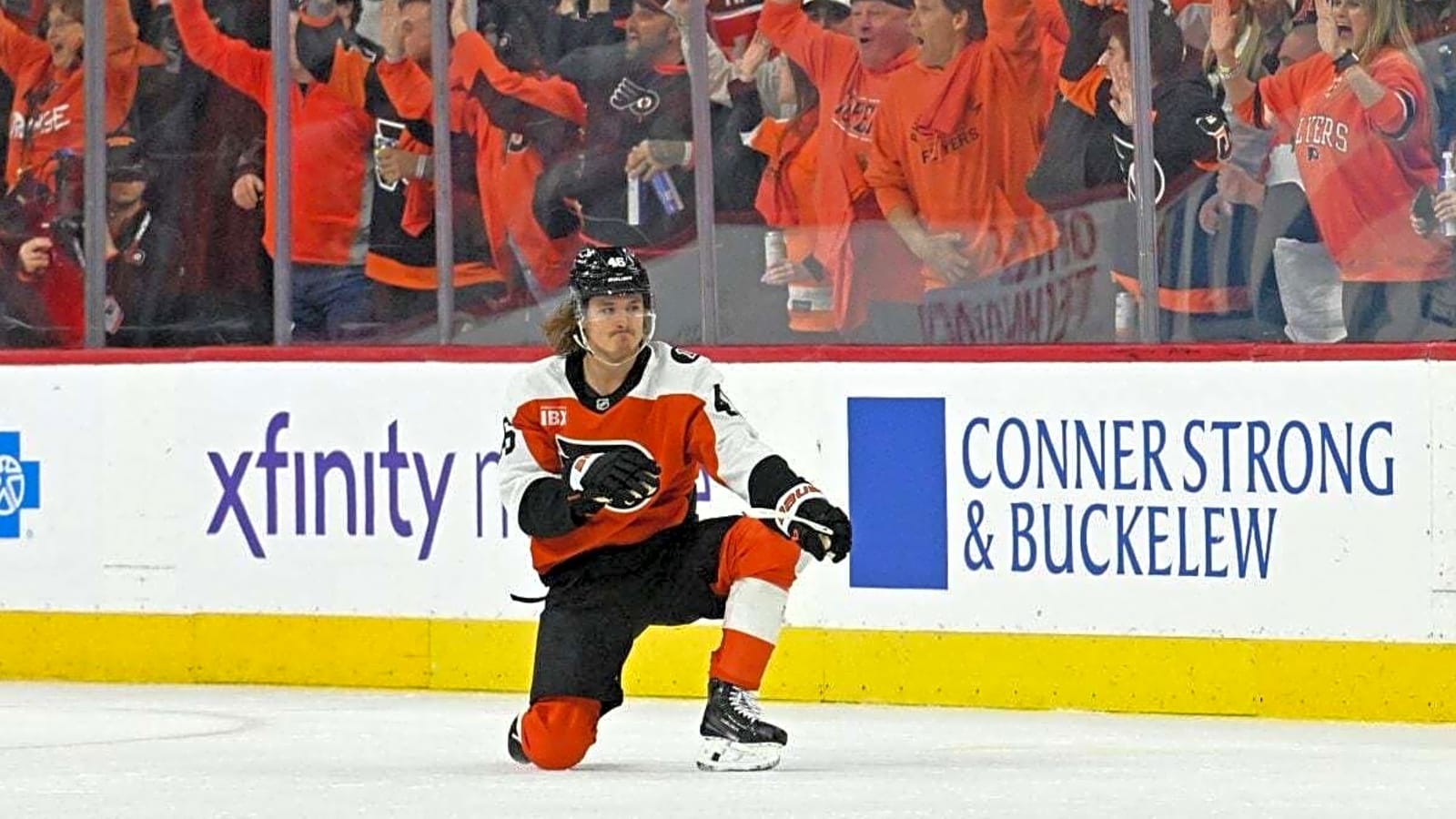
The 2025-26 season brought a lot of new things for the Philadelphia Flyers, including the marquee acquisition of Trevor Zegras, surprisingly-pleasant additions of Christian Dvorak and Dan Vladař, aand the NHL debuts of Porter Martone, Denver Barkey, and Alex Bump. Most importantly, playoff hockey returned to the City of Brotherly Love for the first time since 2018, stretching into the second round for the first time since 2012.
For the first time in a long time, maintaining the status quo wouldn’t be a bad place for the Flyers to stay. That could be enough for the franchise to make consecutive playoff appearances for the first time in more than a decade. But to become a true contender in the near future, the Flyers need growth from the 10 players 25 or younger, consistency from their veterans, and a smoother regular season to maintain confidence that they can take the next step sooner rather than later.
Projected Lineup
Scratched: Nikita Grebenkin, Carl Grundström
| Travis Sanheim | Rasmus Ristolainen |
| Cam York | Jamie Drysdale |
| Nick Seeler | David Jiříček |
Scratched: Simon Benoit
| Dan Vladař | Joseph Woll |
Up Front
The future will become the present in Philadelphia this season. Currently, Martone and Matvei Michkov are listed on the second and third lines, but they could easily both be on the top six by season’s end. Michkov’s combination of high-end puck skills and improved fitness and Martone’s promising first taste of the NHL are arguably the two biggest reasons for long-term optimism. The latter could experience some growing pains as he plays his first full NHL season, but still should make an impact.
The youth movement extends beyond them, too. Barkey was a surprising midseason call-up who forced his way into a regular role and proved his small size isn’t a deterrent, even in the playoffs. He’s listed as a winger for now, and that’s probably where he’s best off, but he could be the first fill-in if there’s a center injury in the top nine. Bump wasn’t quite as much of a lock last season, but still produced nicely. Both have the tenacity to play the bottom-six role the team’s winger logjam will require, at least at times.
Technically, Zegras started last season at center, too, but was quickly moved to wing and mostly played there until the spring. Zegras has proved he can handle the position’s defensive responsibilities, but his faceoff work still has a ton of room for growth. More importantly is whether he can take the next step, from just below point-per-game pace to at or above that threshold.
He and Owen Tippett had good chemistry at the end of 2025-26, which matters because Tippett is in a similar state. He looks like a 30-goal scorer but gets stuck in the high-20s. His consistency, always an issue, peaked at the end of the regular season before he played through injury (and was eventually sidelined) in the playoffs. At 27, it’s time to stop banking on meaningful growth, but he’s still a solid scoring winger with game-breaking speed.
Perhaps the biggest boost this unit will get is the full-time return of Tyson Foerster, who flirted with a 40-goal pace out of the gate until a Dec. 1 injury knocked him out of action for four months. He’s spent most of the last two seasons playing with Noah Cates, an underrated defensive stud who finished 11th in Selke Trophy voting and set career highs in goals and assists. Foerster has enough skill to play higher in the lineup, but their chemistry is always nice to fall back on.
While his playoff performance again underwhelmed, Travis Konecny is as reliable as they come in the regular season: 25-30 goals, 65-75 points in a top-six role. His play-driving numbers were disappointing last season, though a big 2026-27 from Martone could help if they stay together. Dvorak had a career season in his first campaign in Philadelphia, topping 50 points for the first time, although his defensive work wasn’t as strong as his reputation. He’s still a solid high-floor, low-ceiling middle-six center, though.
A sneaky underrated question is how the Flyers plan to use Sean Couturier. The captain started last season strong, couldn’t buy a goal for most of the winter, then looked close to pre-injury form once moving to the fourth line down the stretch. Spending $7.75 million on a fourth-line cenntere is hardly efficient roster construction, but it may be the best way for both sides to move forward.
If he stays down there, he’ll have a new linemate in Noel Acciari, a playoff foe in April. Luke Glendening surprisingly stabilized the fourth line at the end of last season after being claimed off waivers, and Acciari is a better version of his play style. Nikita Grebenkin should be in the mix as he’s healthy for the first time since March. His rookie season was intriguing enough to warrant another look, but he still has a lot to prove. Carl Grundström had one big heater last season but is otherwise just a respectable depth option.
On the Backend
Travis Sanheim is the Flyers’ best player and proved it without a doubt last season, playing more big-minute games, still postinng strong play-driving results, and recording a career-high 11 goals in the regular season, plus two more in the playoffs. Sanheim enters his 30s at the peak of his career. Usually, this is when the descent begins, though, and the Flyers need him to hold form for at least a couple of seasons.
A player is rarely viewed as important and expendable as Rasmus Ristolainen. Available at the 2026 Trade Deadline, the Flyers moved him to their top pair in February and stuck with it for their greatest stretch of the 2020s. Playoff Ristolainen largely didn’t disappoint, and yet Ristolainen likely would’ve been moved if John Carlson chose the Flyers in free agency or the Leo Carlsson offer sheet hit and cap space became a premium. He can’t maintain a power-play role, though; his 40-point Buffalo Sabres days aren’t returning.
The top two options to quarterback the power play are Jamie Drysdale and David Jiříček, two sixth-overall picks who stagnated before arriving in Philadelphia. Drysdale has already restored his previous shine, developing into a top-four option. Can he be more than that? The only way to know is if he stays healthy; after playing just 42 games in 2022-23 and 2023-24 combined, he’s missed 16 games over the last two seasons.

Improving shot velocity was a goal for Drysdale during the offseason, something Jiříček already has. But he lacks most of what Drysdale has gained over the last two seasons, namely the defensive reliability that coaches demand. He’s played one game as a Flyer, but there’s already much urgency to secure a spot, especially with 2023 first-rounder Oliver Bonk knocking on the NHL door.
Cam York could also get some minutes there, although he seems to have developed into a more defensive-minded option than expected when drafted. There’s more to give with the puck, though; York has eight total goals in the last two seasons following a 10-goal output in 2023-24, all at even strength. The Flyers need more offense in all situations, and improvement from players such York and Drysdale is one of the easiest ways to solve that.
Nick Seeler and Simon Benoit will not be part of that offensive jump. Both are similar players: defensive-minded left shots who block a ton of pucks and kill penalties. There’s one key difference, however. Seeler has filled his role very well, while Benoit has been an analytical nightmare with both the Anaheim Ducks and the Toronto Maple Leafs. He can fill in for Seeler for a potential short-term injury, but the Flyers are probably better off pulling from their prospect pool if one of their puckmovers suffers a major ailment.
In Net
The Flyers don’t have to live extended life without Vladař again, at least not now. His injury last January coincided with the team’s worst stretch by a mile, and his leaving Tuesday’s preseason game was a major scare. But head coach Rick Tocchet said that his injury is just day-to-day, leaving Vladař still entrenched as the team’s number one.
Vladař’s main skill last season was dependability. He only allowed three goals or more in consecutive starts three times, only one of which was longer than two games. His save percentage was within .002 of the NHL season average in every month except January, when he dealt with his aforementioned injuries. He was at his best when the games mattered most in the regular season and the playoffs.
One of the biggest reasons to believe Vladař can sustain his success is the improvement Joseph Woll offers behind him. Even in a down season, Woll’s save percentage was still 28 points better than Sam Ersson’s. His mark was even better than Vladař’s last season in the two prior campaigns and goals saved above expected backs up his talent.
Woll’s main concern is a fairly-extensive injury history. Aleksei Kolosov has yet to prove he can even be a capable third option at the NHL level, let alone anything more, although he’s just 24 years old. But that won’t matter if the Flyers get the best versions of their two main options, which would give them one of the NHL’s best tandems and give them a very high floor.
The Big Stories
Believe it or not, the Flyers did put up better numbers under the hood on the power play last season. According to Natural Stat Trick, they were 13th in shot attempts, seventh in expected goals (xG), and eighth in scoring chances (all per 60 minutes). Five of the top six teams by xG were in the league’s top half (the 19th-ranked Florida Panthers were the lone outlier). The Flyers somehow were dead last for the third time in four seasons. Reaching 19th this season would be cause for a parade.

The Flyers’ January struggles last season went well beyond Vladař’s injury. In that month, the Flyers played at a 60-point pace for an 82-game season, but in the rest of 2025-26, they were a 106-point team. Erasing a blip like that is easier said than done, though, especially with a young team. A lot of teams can claim to ignore that month in the big picture, but it still counts the same as any other.
Tocchet was barely mentioned above, but his influence obviously spreads across the entire roster. The Flyers enter his second season with a good defensive base to build on and his relationship with Michkov seems in a much better place. Like his team, last season gives reason to believe in Tocchet, but the lack of consistent success means there’s a lot to gain from establishing this Flyers group as a playoff regular.
More must-reads:
- Mark Messier torches Oilers for controversial Mike Babcock hiring
- Would Chargers trade QB Justin Herbert if season keeps going sideways?
- The '4K-yard, 30-TD NFL seasons' quiz
Breaking News
Trending News






Customize Your Newsletter
 +
+




Get the latest news and rumors, customized to your favorite sports and teams. Emailed daily. Always free!
PRIVACY POLICY COOKIE POLICY CONTACT US
ABOUT YARDBARKER TERMS OF SERVICE


By using this site, you agree to our Terms of Service and Privacy Policy.
This site is for entertainment purposes only.
There is no gambling offered on this site.
Gambling Problem? Call 1-800-Gambler.
